
Who is this for?
Local youth, farmers, women’s groups, PWD groups, schools, CBOs/NGOs, gov & private sector, and international learners. No prior experience required.
Accommodation & meals
Free/basic camping is typically available. Simple meal packages may be offered onsite. See the registration page for the current options per venue.
Payment methods
We support local MPESA & bank options for Kenya partners, and card/PayPal options for international participants via our sign-up flow.
Documentary & online access
Support the training film (pre-sales) to help cover tools, travel, and scholarships. Backers get viewing access when released.
Contact
Questions? Message us and we’ll help you choose modules, arrange group bookings, or discuss partnerships.
- Sign-up & logistics: /b4a-sign-up-form/
- Memberships / Sponsorship: /b4amemberships/
- Email: Bamboo4Africa@gmail.com
- WhatsApp (Kenya): +254 703 874 281
Lead trainer: Jaye Irving (Barefoot Design, AU) • Coordinated by Bamboo Creative Bali with Kenyan partners incl. Riziki Youth.
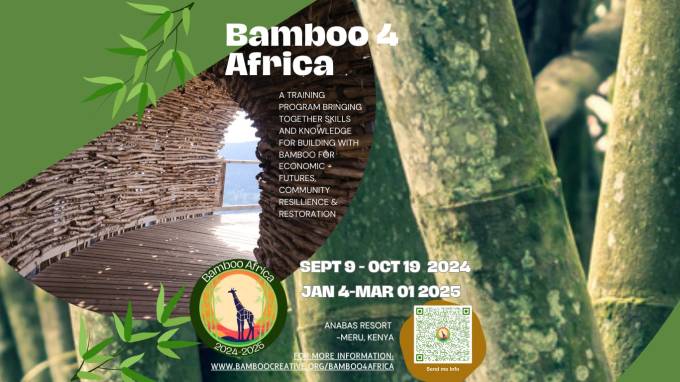
Bamboo 4 Africa Training Program is set to launch in Meru, Kenya, this January! This initiative is more than just a training—it’s part of a broader vision to create a sister-village network of regenerative communities across Africa and beyond.
Kenya is home to abundant bamboo resources, yet the lack of accessible technologies and skills has limited its potential. Through Bamboo 4 Africa, we aim to change that. Participants will learn sustainable bamboo management, innovative treatment techniques using the affordable hyperboloid tower + Vertical Soak Diffusion (VSD) method, and construction skills for small, scalable buildings. By enhancing local knowledge and integrating traditional craftsmanship with modern techniques, we empower communities to transform bamboo into a high-value resource.
Our goal extends beyond Kenya. By training “mini-experts” in bamboo clump management, biochar production, and sustainable building practices, we’re laying the groundwork for a pan-African network of climate-resilient, regenerative villages. These communities will serve as hubs of ecological innovation, cultural preservation, and economic empowerment, aligned with global Sustainable Development Goals.
How You Can Support:
💡 Pre-purchase our Training Documentary Film for US$50 and witness the impact firsthand.
🌿 Attend, Sponsor a local participant or contribute to program funding through our initiative.
Project Background:
A conversation began between Joel Odongo and myself during COVID, where we shared our visions for community development. Initially, he invited me to TANU (Transformation Advocacy Network Uganda) in Soroti to teach bamboo skills and construct a community center using bamboo and recycled plastic. Our discussions led to the topic of cooking fuel and naturally, to our respective various local dishes made from peanuts, eggplant, cassava, banana, and chili. I shared my observations from the Philippines, where charcoal is commonly used for firewood, often resulting in deforestation by charcoal sellers—a situation similar to that in Uganda. I provided some video resources, and Joel and the TANU women’s group experimented with making briquettes from organic waste using a small 25-liter drum (all they had available, though the standard is typically a 44-gallon drum). They used cassava flour (glue) to bind powdered charcoal into briquettes. Subsequently, we addressed the health issues of cooking indoors, and after sharing more resources the group went on to build a smokeless stove (https://bamboocreative.org/outreach/bamboo4africa/uganda/).
I then invited Jackson Buzingo, a syntropic agroforestry trainer from Tanzania, via LinkedIn to join our conversation about bringing bamboo and syntropic agriculture training to Joel’s community. Around that time, I also made contact with Bamboo Resource Centre Kenya, who were eager to learn syntropic agriculture training to help farmers in their area adapt to more frequent flooding and crop loss. In exchange, they would bring bamboo seedlings to plant at TANU. I started a crowdfunding page on my website near the end of COVID. Unfortunately, the COVID-19 pandemic and the associated travel restrictions and testing requirements posed significant challenges, and the crowdfunding campaign did not gain the traction we had hoped for. However, I remained committed to the vision and have since been working to develop a bamboo program with local Balinese builders, while continuing to explore ways to bring knowledge and skills training around cultivating and utilizing bamboo to those unlikely to be able to afford access to it.
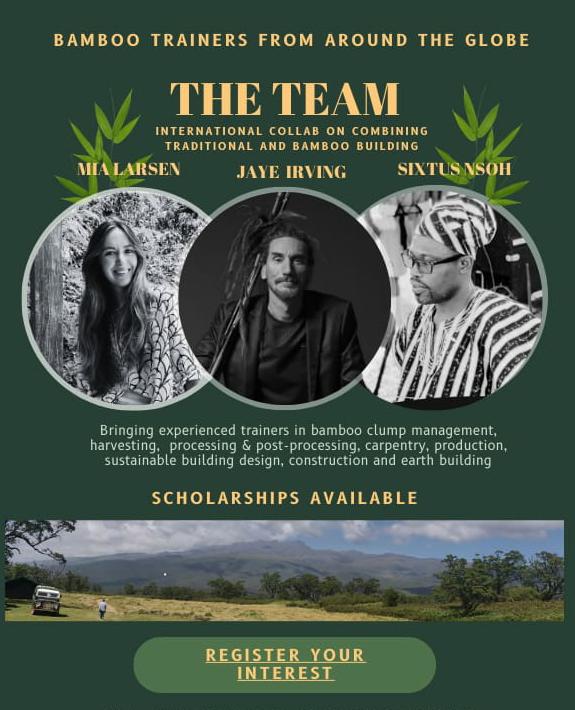
Our conversations continued on WhatsApp, with more people joining (now 40+ people), including Alemna in Ghana (One Burri), whom I found while researching traditional African housing using mud/clay; Tesfahun in Ethiopia, who was involved in a permaculture village project and syntropic farming training; and Mich (Mr. Micheni), who visited me in Bali last year during our May program. Also in May last year, one of our bamboo students expressed interest in bringing bamboo training to Egypt, which enabled me to consider actually being in Africa. I began planning to piggyback the Uganda/Kenya training onto that invite. The project quickly gained its own momentum. This was especially true with the involvement of Alex Traitler, another of our past bamboo students, and my first bamboo training teacher, Jaye Irving. His extensive knowledge and experience in bamboo cultivation and building is a veritable gold mine.
After four months of dedicated weekly online meetings, we are now ready to launch a comprehensive training program in Meru, Kenya at Anabas Resort that extends beyond the basic training offered by my company in Bali. We have called the training program “Bamboo 4 Africa” (www.Bamboo4Africa.org), and it will provide vital practical skills and knowledge on bamboo harvesting, management, treatment and carpentry, integrated with indigenous earth-building practices for constructing houses with bamboo. Our knowledge will be further developed during the training alongside One Buuri’s Sixtus Nsoh from Ghana and Sai Goutham from India. Our host’s daughter, Kagweni Channan, a journalist and documentary maker, will be our film-making collaborator alongside Alex Traitler, who will direct the skills-sharing side of the documentary-film and video training. The result will be an educative video series and a documentary of the training program, which will be completed and available for retail purchase next July 2025 after Phase 3 of the training is completed (March 2025).
As a Collective, our goal is to preserve the cultural skills and knowledge of bamboo inherent in ASEAN cultures and to dispel the stigma of bamboo being perceived solely as a “poor person’s building material—or just for the very rich.” By creating examples of attractive, affordable, and sustainable bamboo buildings, we emphasize innovation in bamboo treatment to enhance its longevity without the need for expensive industrial setups. With more than 70% of the world’s population living on less than USD$10 a day, finding low-cost building solutions that enable rural populations to maintain and uplift “village culture,” alleviate urban pressure, and conserve natural resources is crucial. This initiative aims to share the practical skills of bamboo building alongside affordable methods to enhance its utilization, as well as management and harvesting techniques to optimize bamboo resources, in a format that enables uptake by not only people in Africa but anywhere in the world. (The joys of digital downloading!) While also fostering a sister-village network and fair trade relations through connecting communities and sharing building practices, farming skills, and cultural and gastronomical celebrations.
Join us for a bamboo training program in Kenya in January 2025! 🌍🎋 by Natalie DavenportBamboo 4 Africa – has three parts.
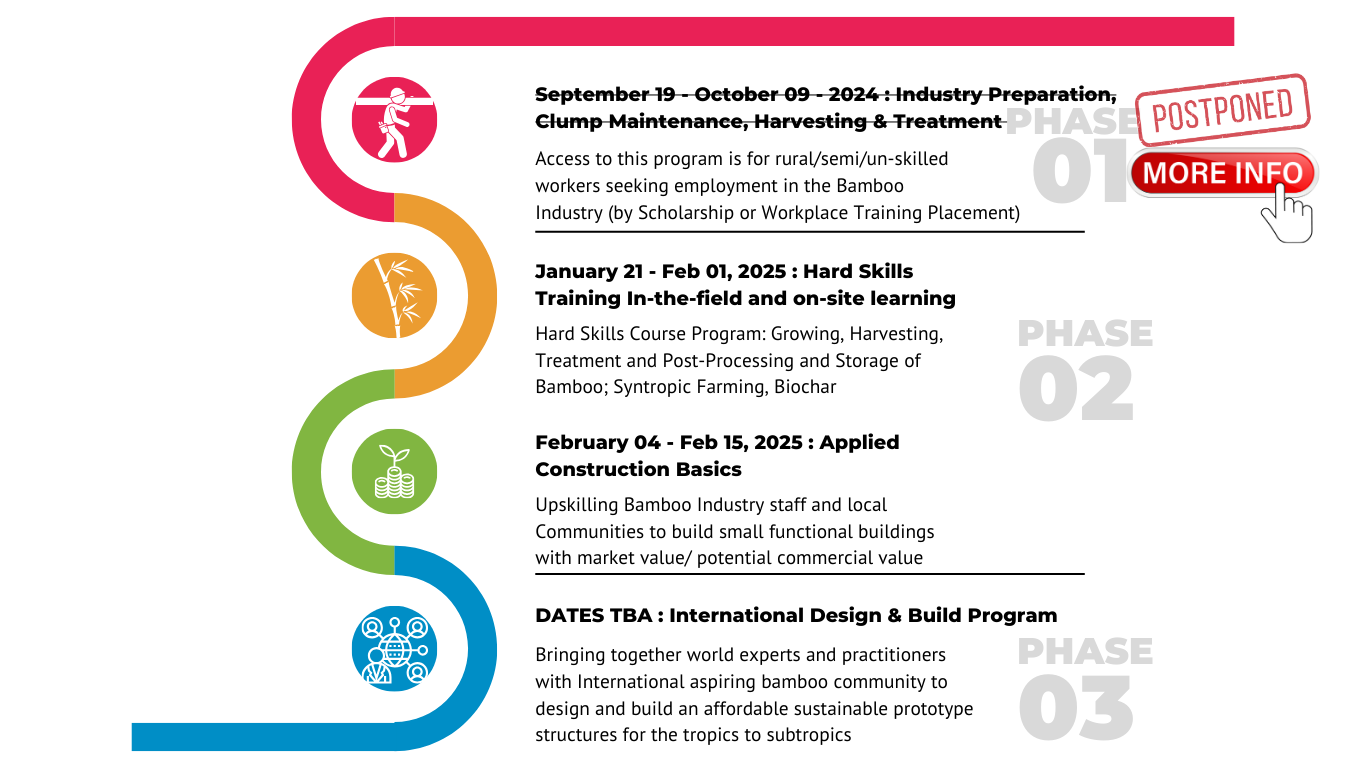
First is Phase 1: The Industrial Training; a full-scale harvest, clump management and Treatment & Processing program plus Biochar Production.
Phase 2 of the Bamboo 4 Africa Training Program focuses on Bamboo Carpentry and Construction Skills; developing building skills for small construction projects (Module 2) – with a condensed training on Management, Harvesting and Treatment of bamboo (Module 1).
See: https://bamboo4africa.org/#program
Phase 3 is a Bamboo Design Collaboration Bamboo and Bamboo & Mud Cottage Build slated for mid 2025. We are forming our team for working on this project so please get in touch if you would like to become involved.
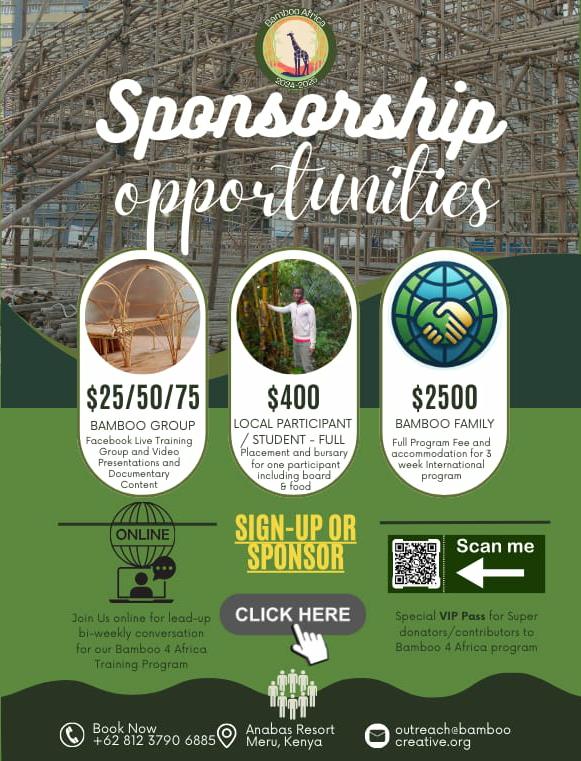
The Bamboo 4 Africa Documentary Film will be available during the Crowdfunding Stage at the special price of USD$50. As a bonus, supporters will have access to our Live Online Training Sessions via Facebook/Youtube. We hope to cover all the costs of the full training program and filming so others can access this knowledge. I have set the funding target at the bare minimum amount of funds needed. This amount is US$10,000/AU$15,000. It will get Jaye to Kenya and pay his flights, salary, insurance and tools. This will enable him to deliver 3 weeks training and harvest and treatment of the bamboo. We will use this bamboo for the Phase 2 & 3 of the training program. Kagweni, our media project partner on the ground in Kenya, can absorb the initial costs of filming. She is eager to learn the training herself. It was her father Mich who approached me in Bali. He wanted to build a small treatment facility in their hometown of Meru in Kenya. The treatment plant process, filmed through this documentary, will be located on his property. We have an agreement. Once our total funding goal is reached (US$125,000/AU$187,000), it will cover the budget outlined in our Project Funding Proposal. You can request access to the full proposal. Income from sales will be divided between the following groups. The Filming and Production Team headed by Kagz will receive 30%. Jaye and the Training Team will also receive 30%. The Future Workshops Fund is allocated 30%, and I will receive 10%.
I am offering additional add-on tiers to help reach the funding goal. The first add-on tier is a 2-3 hour private design/consult session with me. Disclaimer: I am NOT an architect. My expertise is experiential with 8 years hands-on. Another add-on tier will allow you to pre-purchase a 3 week in-person Bamboo Class. This training-only class will be with me and my team in Bali. I will use the funds at my discretion between the Bamboo 4 Africa training program costs. I will use them to maintain and develop my personal project goals. These are for Inclusive Regenerative Community Development Programs (See More). The third Add-On is a night or three’s stay in my or my daughter’s Bamboo Home in Bali. You can experience what it’s like living in a Bamboo House. Now that my daughter is living in Australia it’s free to have others come and stay. I plan to launch a second crowdfunding campaign in November to cover Phase 2 and the Training Documentary.
We are also partnering with the Bamboo Resource Centre Kenya to share the entire program’s knowledge. This knowledge will be integrated into their local institute’s comprehensive 200-hour training program. Our goal is to build momentum and develop a network of sister villages where future training sessions can be held. We aim to train trainers through an Eco-Cultural Leadership Program who can then train others and integrate the Bamboo 4 Africa Training Programs. This aligns with my company’s (Bamboo Creative Bali) and Bamboo Resource Centre Kenya’s Greater Vision. Aiming to establish Climate Adaptation Family Living Systems (CAFLS) Village Projects across Africa, there are already nine village hubs established in Kenya.
In Phase 3, we will work with Alemna and Sixtus from One Buuri in Ghana, Eduard, Jacklyne, and others in our Bamboo Africa WhatsApp Group. They will bring skilled artisans to learn bamboo building techniques. Together, we will integrate indigenous earth-building knowledge from Ghana with bamboo building during our International Collaboration Program. We aim to fund African youth and women to participate in the Bamboo 4 Africa Training Program.
Project Outline:
The Bamboo 4 Africa training program in Meru, Kenya aims to deliver instruction in clump management, harvesting, treatment, and small building construction. By enhancing the skills of existing craftsmen and women, (some of whom already possess experience in furniture-making, thanks to comprehensive training and resource programs led by INBAR in bamboo furniture carpentry, seedling development and planting programs) this program aspires to enhance local utilisation and improve management and quality of the region’s bamboo resources, while broadening the local uses and application in building small structures (applicable to restaurants/resorts/hotels) and contributing to local job creation and income generation.
Thanks to initiatives put in place by the Kenyan Government eight to ten years ago, thousands of bamboo seedlings were planted across private and public land in Meru County, Kenya. Nestled at the base of Mount Kenya, Meru boasts ample supply of Dendrocalamus Giganteus, a bamboo variety suitable for construction, furniture, and as a food product, yet lacks expertise in its optimal utilization. In collaboration with local partners, this project aims to empower Meru’s populace through comprehensive bamboo training. Initiated by Bamboo Creative Bali and supported by The Anabas Resort (venue/host in Meru), the project envisions establishing and enhancing the local bamboo industry through a phased approach.
(Potential Sponsors can request access to project funding document HERE)
In Asia, there is a shortage of skilled bamboo construction workers, many of whom are now employed in new developments of high-end resorts. Working on the skills and experience of our teachers in Bamboo Construction, we aim to assist in developing a workforce of people who can not only contribute to the development of bamboo as a locally-sourced, sustainable building material, but also in their potential employment and uptake of becoming skilled workers who can also train others.
As we embark on this journey, we are actively seeking support from various agencies, funding bodies, and stakeholders who share our vision for a sustainable future. In addition to outreach efforts, we aim to generate revenue through student fees for both in-person and online attendance, as well as through the pre-sale of the program documentary and future editions of the Bamboo Training Programs. This multifaceted approach reflects our commitment to creating a comprehensive and impactful program that can make a lasting difference in the lives of individuals and the environment.
We are launching a crowdfunding to cover our costs, and as part of our crowdfunding rewards, we are offering an opportunity for people to pre-purchase access to a general bamboo training program in Bali (with 50% deposit which will be donated to the Bamboo 4-Africa program). This provides an alternative for those unable to travel to Kenya, and for those who wish to take part in a training in Bali or one of our sister-villages as the project develops.
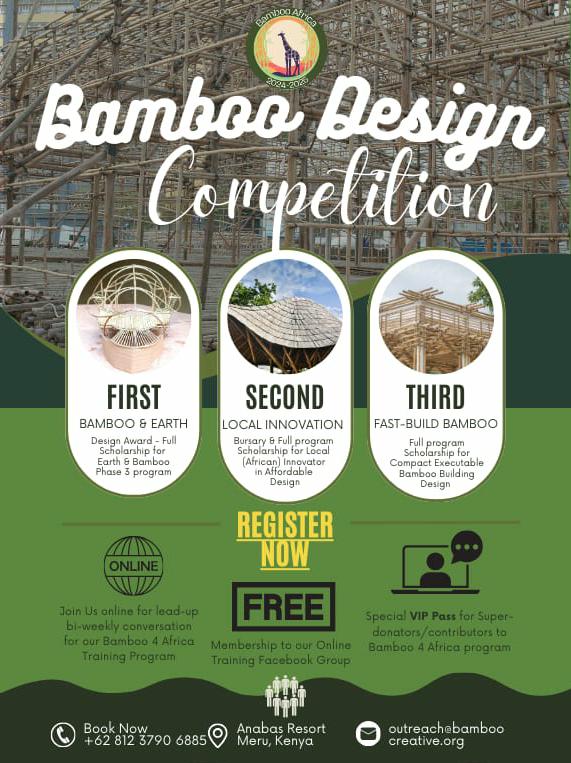
Additionally, a bamboo design competition will be launched in the coming month to bring together knowledge and expertise for designing an adaptive bamboo and traditional design for village communities affected by climate change. There are 3 competition categories: Bamboo & Earth; Local Innovation (Affordable Design); and, Fast-Build Bamboo. Please register your interest on the Expressions of Interest Google Form to receive the full details.
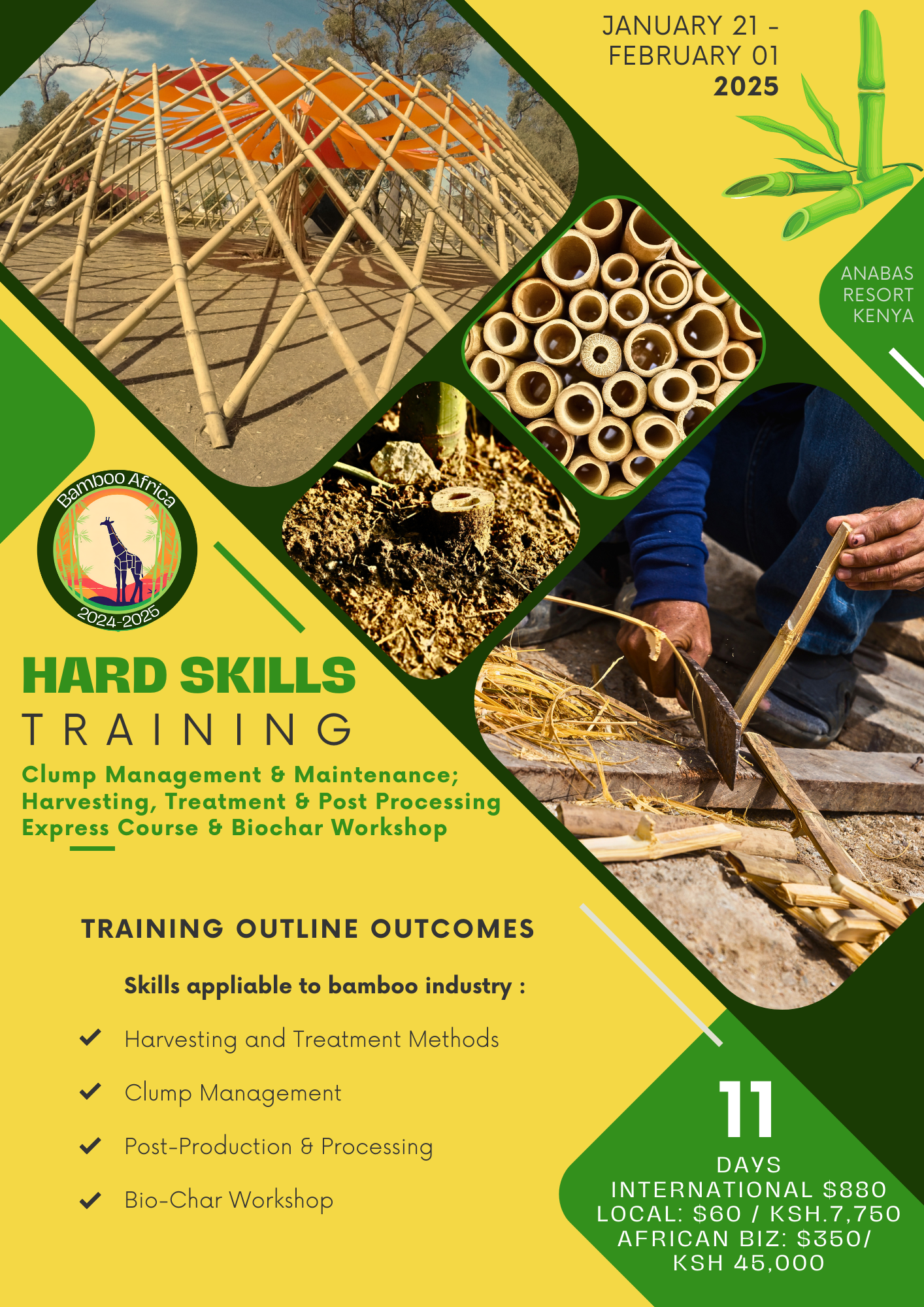
The Phase 1 program (September-October 2024) will focus on management, key-holing, surveying, coordinating bamboo harvests, and training in clump maintenance and biochar-making. We will also construct the VSD (Vertical Soak Diffusion) tower and conduct treatment workshops, aiming to produce enough treated bamboo poles for the January-February 2025 program. This will demonstrate the complete process from harvesting to treatment, ensuring a trained workforce ready to sustain bamboo production and utilization.
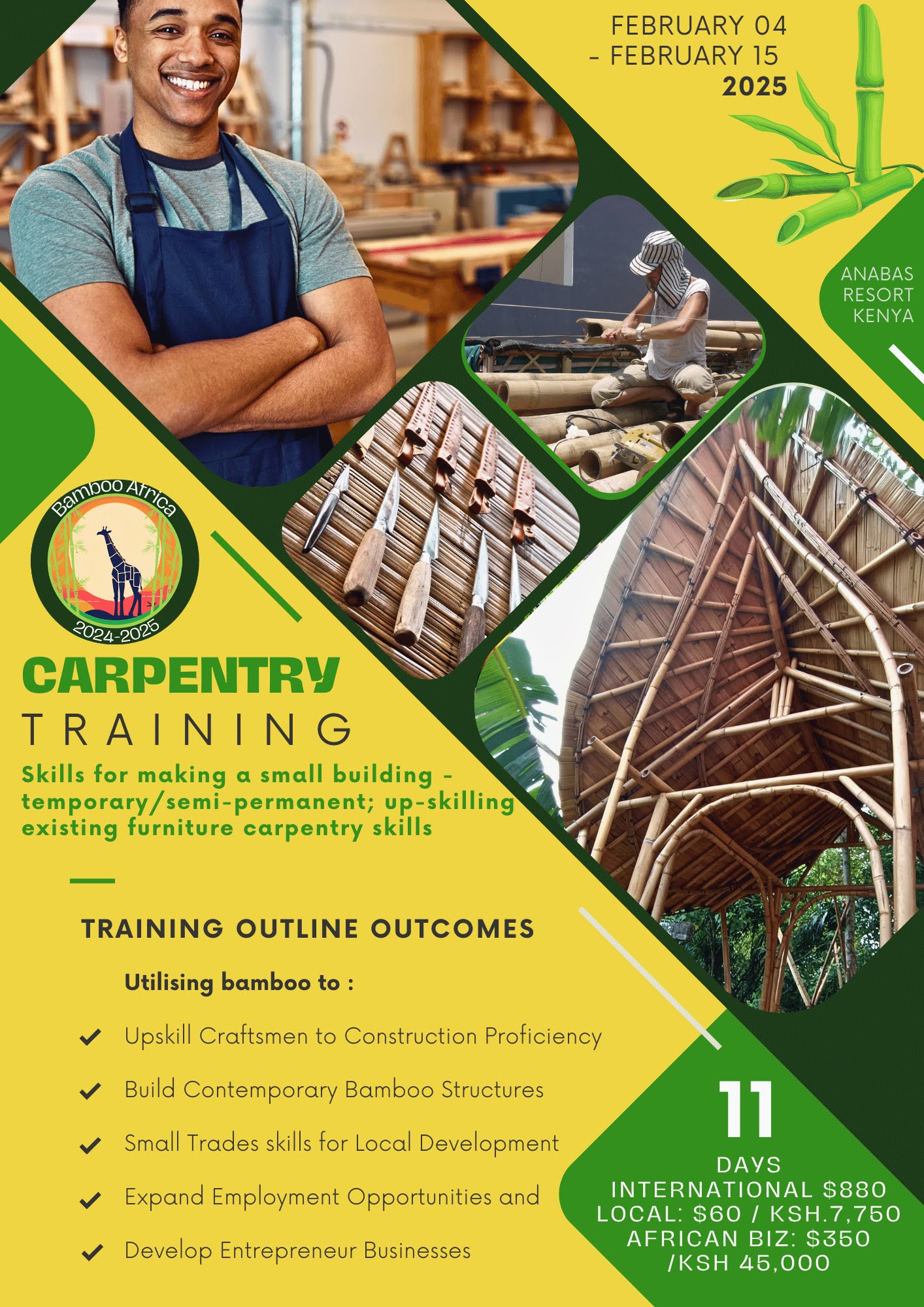
Phases 2 and 3 will include a shorter version of the Phase 1 course, and a bamboo hyperboloid workshop area will be constructed for additional training modules, including Carpentry for Small Buildings and the International Design and Building Collaboration program. Trainers from local polytechnics across Kenya will be invited, and our close collaboration with Eduard Odhiambo Nyamde from the Bamboo Resource Centre, Kenya, will connect the program with local educational and governmental levels. Eduard’s vision of bamboo as a cultural bridge across Africa resonates deeply with our mission. Integrating traditional building methods from Kenya and Ghana with innovative hyperbolic structures could offer a fast, stable, and culturally relevant solution for communities affected by climate change. We plan to explore this concept further during the January/February program.
We are enthusiastic about the potential of this program to make a significant impact in Kenya and other African countries. For more information, please visit this link: Https://Bamboo4Africa.org
Pre-purchase Video Documentary Training
Pre-Purchase our Exclusive Video Documentary of the Bamboo 4-Africa Training – going Live in September this year… for USD$50 – PLUS Join us online for the lead-up and interviews with our members and trainers to bring on skills in: Bamboo harvesting and maintenance; the importance and value of Biochar production and of growing bamboos in every household; small building carpentry training; and, online access to join the international collaboration on bringing together skills of bamboo building with traditional earth-architecture techniques from Ghana and Kenya. Through the training program, we will be empowering local women to harness the power of bamboo building methods, and to integrate these skills to reduce pressure on local forests.
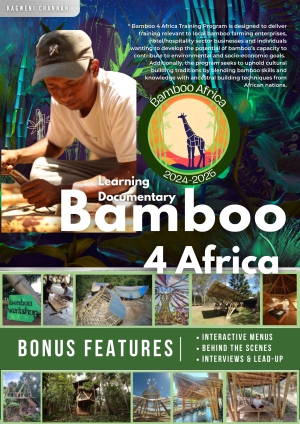
Pre-launch Crowdsourcing for the Bamboo4Africa Training – filmed and documented by Kagweni Channan at Anabas Resort, Kenya, the Documentary Film will cover all aspects of the 3-Phase training. Funds raised in the pre-purchase phase will contribute to the launch and sustainability of the Bamboo4 Africa Training Program. Fast build housing methods with bamboo and earth are set to be the spotlight of the International Collaboration phase 3 bamboo training in February-March 2025
The Crowdsourcing Price of USD $50 will be available for a limited time to the first 1000 purchases. The regular price of $125 will resume after the crowdsourcing stage. Our deadline for reaching our first funding target is 26th July ready for Phase 1 commencement in September 2024.
200 Hour Bamboo Locally Accredited Training (Kenya)
This training is part of a greater collaborative project to develop climate-adaptive family living systems (CAFLS) which are resilient village communities centred around access to sustainable technologies.
If you would like to sponsor the program, you can request our full funding proposal document.
Program Partner: BAMBOO RESOURCE CENTRE – KENYA
Regenerative Adaptation Villages – Climate Adapted Family Living Systems (CAFLS)
Creating Climate Adaptation Villages throughout Africa aims to bridge economic disparities, foster closer connections, and enhance community utilisation of bamboo. Beginning in 2020, community workers of the Sifa Bible Institute partnered with National Environment Management Authority (NEMA) to model a Climate Adapted Family Living System (CAFLS) in a one-quarter acre parcel of land through the Institute’s Agri-Business Development Program. Led by Edward Odhiambo Nyamde, The Bamboo Resource Centre was born in 2021 and through the NEMA Climate Adaptation Funding provided, has set set up outreach in nine communities in Kenya. The funding provided a hall in each community for meetings and trainings, a solar-powered water pump system for irrigation and kiosk for domestic use, a demo farm for showcasing Climate Smart Agriculture, drip-irrigation installation, and fencing with solar-powered security lighting as part of “Adaptation Village Hardware Installation”.
Bamboo Creative Bali and Bamboo Resource Centre in Kenya are partnering to start Adaptation Village Software Development Phases in each of the nine sites initially to build adaptive capacities and resilience targeting at least 2,000 households per Adaptation Village. (An Adaptation Village is a 10km radius around the Hardware Installation). We aim to deliver skills and technologies that empower these rural communities as a starting point and connect our programs at the socioeconomic level.
This Stage 1 project aims to introduce affordable bamboo treatment technologies, empower local communities through access to workplace training in management and maintenance of bamboo clumps, and to enable attendance of trainees from Kenya, as well as Uganda, Ghana, Cameroon, Rwanda, Zambia and other African countries (who are connected with this proposal through ongoing discussions since 2020) and together building a consortium to promote equity at the worker-level and develop a sound and just economic inclusive model. The methodology includes technology implementation, community engagement through knowledge sharing and up-skilling people to make commercializeable bamboo buildings for the eco-tourism sector and housing & products, linking development, R&D and monitoring. The expected outcomes include development of the local industry at the community level and provision of workforce trained in optimising the utilisation of locally available bamboo resources and by-products, improved living standards, increased self-sufficiency and development of local social enterprises, greater equity, and a strengthened global network. The proposal calls for funding support to host a local Bamboo Training Program in Kenya.
Objectives
Educational Enrichment: Provide practical skills training to empower individuals and communities.
Economic Empowerment: Create job opportunities in the bamboo sector and promote local entrepreneurship through helping develop a local treatment centre in Meru, Kenya and make a replaceable model communities can afford to develop themselves.
Ecological Sustainability: Implement Eco-friendly technologies and practices through educational activities to restore and preserve the environment and peoples’ sense of belonging and to build resilient communities connected by shared values and mutual support.
Community Connection: Strengthen social ties and foster a network for sustainable bamboo enterprises.
Cultural Preservation: Enable people to work an innovate close-to-home and mitigate non-sustainable urban migration – revitalizing traditional skills and knowledge, and integrating them with sustainable bamboo practices.
Methodology
Knowledge Sharing: Deliver training sessions on sustainable bamboo harvesting, treatment and building skills/practices, leveraging local expertise and traditional knowledge in natural building and supporting local enterprise development.
Technology Implementation: Demonstrating and distributing affordable, sustainable technologies (e.g., solar water pump, panels, and regenerative farming skills and tools for restoring fertility and increasing carbon sequestration through BioChar) to rural communities.
Commercial Engagement: Collaborate with local leaders and business organizations to ensure the project meets local market needs and meets the needs of the international Buyer community.
Community Compatibility: Working as a Sister-Community in consultation with local leadership to ensure culturally appropriate format, content and strategies.
Monitoring and Evaluation: Establish metrics for assessing the impact of the project, making adjustments as needed to ensure objectives are met.
Expected Outcomes
Improved Living Standards: Broadening application of bamboo skills to building and enhanced access to sustainable technologies and practices will improve the quality of life for rural communities.
Strengthened Global Network: A collaborative global effort will increase awareness of the Village Network’s products and foster solidarity and purchasing Will in an environment of shared responsibility for equitable development.
Increased Self-Sufficiency: Empowering communities through increasing economic activities thereby reducing poverty and dependency – better equipping them to manage local resources and sustain their livelihoods independently.
Greater Equity: A shift towards a fairer economic model enabling transparency and reducing inequalities promotes a more just and sustainable world.
Stage 1 Budget
| Item | Cost |
|---|---|
| Workshops and Training – September 2024; Jan/Feb 2025 | $110,000 |
| Sustainable Technologies | $150,000 |
| Community Engagement Activities | $30,000 |
| Monitoring and Evaluation | $20,000 |
| Administrative Costs | $10,000 |
| Total | $283,000 |
Creating regenerative villages throughout Africa offers a transformative opportunity for contributors to help bridge economic disparities, foster closer connections, and enhance community well-being and could be applied / transitioned to as a means for worldwide Regenerative Village development.
Bamboo 4 Africa Training Program Proposal Detail:
Please register your interest to receive full proposal details.
“Support African Communities to Access Bamboo Skills Training .”
We are preparing to bring Bamboo Building Skills to Africa. We want to up-skill local people to make bamboo construction viable in the local area. We are collaborating with local community groups and coordinators to enhance and develop knowledge and skills for utilizing bamboo resources and to integrate bamboo planting and maintenance with local community projects and initiatives to enhance local livelihoods. Our goal is to equip people with practical skills to utilize bamboo as a sustainable building material for everyone!
Let’s come together to build sustainable communities, preserve cultural heritage, and harness the power of bamboo for a greener, more equitable future.
🌐 Learn more or get involved: www.bamboo4africa.org
Register for more info: https://forms.gle/MUF4oGJkz6caScKs8
#BambooForAfrica #SustainableDevelopment #RegenerativeCommunities #ClimateResilience #BambooInnovation #EcoLeadership #Kenya #Africa
Make a one-time donation
AU$75 – Grants access to the Bamboo 4 Africa Video Documentary Film of the January-February 2025 (to be released by July 01 2025)
AU$150 – Grants access to the Video Documentary Film and Online Bamboo Group Live Training Sessions and Workshop Interviews & Discussion Group.
USD$450/ AU$675 – Grants 50% down-payment on future Bamboo Creative Bali 3 week training program in Bali or in a Sister Community of your choice (10% Discount – Valid for 5 years)
Make a monthly donation
1. USD$5 – Access to Video Documentary of Bamboo 4 Africa Kenya Training (May 2025)
2. USD$10 – Access to Video Training Sessions
3. USD$70 – Access to 3 week Bamboo Training Program (10% Discount Rate) including Accommodation
Make a yearly donation
1. USD$50: Bamboo Friends Membership – Receive Updates and Rewards – Be the first to know about our upcoming programs and product launches
2. USD$100: Online Training Group and Live Sessions and Special Deals in our Family Programs
3. USD$450: Bamboo Family Homestay Network Membership – Become a contributor in our Bamboo Adaptation Village Sister Network and accrue your yearly contributions in our Bamboo Homestay Inclusive Plan
Choose an amount
Or enter a custom amount
Your contribution is greatly appreciated. We will contact you by email with follow-up details.
Your contribution is appreciated.
Your contribution is appreciated.
FAQs
Who is this for?
Local youth, farmers, women’s groups, PWD groups, schools, CBOs/NGOs, gov & private sector, and international learners. No prior experience required.
Accommodation & meals
Free/basic camping is typically available. Simple meal packages may be offered onsite. See the registration page for the current options per venue.
Payment methods
We support local MPESA & bank options for Kenya partners, and card/PayPal options for international participants via our sign-up flow.
Documentary & online access
Support the training film (pre-sales) to help cover tools, travel, and scholarships. Backers get viewing access when released.
Contact
Questions? Message us and we’ll help you choose modules, arrange group bookings, or discuss partnerships.
- Sign-up & logistics: /b4a-sign-up-form/
- Memberships / Sponsorship: /b4amemberships/
- Email: Bamboo4Africa@gmail.com
- WhatsApp (Kenya): +254 703 874 281
Lead trainer: Jaye Irving (Barefoot Design, AU) • Coordinated by Bamboo Creative Bali with Kenyan partners incl. Riziki Youth.
Bamboo 4 Africa Training Program is set to launch in Meru, Kenya, this January! This initiative is more than just a training—it’s part of a broader vision to create a sister-village network of regenerative communities across Africa and beyond.
Kenya is home to abundant bamboo resources, yet the lack of accessible technologies and skills has limited its potential. Through Bamboo 4 Africa, we aim to change that. Participants will learn sustainable bamboo management, innovative treatment techniques using the affordable hyperboloid tower + Vertical Soak Diffusion (VSD) method, and construction skills for small, scalable buildings. By enhancing local knowledge and integrating traditional craftsmanship with modern techniques, we empower communities to transform bamboo into a high-value resource.
Our goal extends beyond Kenya. By training “mini-experts” in bamboo clump management, biochar production, and sustainable building practices, we’re laying the groundwork for a pan-African network of climate-resilient, regenerative villages. These communities will serve as hubs of ecological innovation, cultural preservation, and economic empowerment, aligned with global Sustainable Development Goals.
How You Can Support:
💡 Pre-purchase our Training Documentary Film for US$50 and witness the impact firsthand.
🌿 Attend, Sponsor a local participant or contribute to program funding through our initiative.
Project Background:
A conversation began between Joel Odongo and myself during COVID, where we shared our visions for community development. Initially, he invited me to TANU (Transformation Advocacy Network Uganda) in Soroti to teach bamboo skills and construct a community center using bamboo and recycled plastic. Our discussions led to the topic of cooking fuel and naturally, to our respective various local dishes made from peanuts, eggplant, cassava, banana, and chili. I shared my observations from the Philippines, where charcoal is commonly used for firewood, often resulting in deforestation by charcoal sellers—a situation similar to that in Uganda. I provided some video resources, and Joel and the TANU women’s group experimented with making briquettes from organic waste using a small 25-liter drum (all they had available, though the standard is typically a 44-gallon drum). They used cassava flour (glue) to bind powdered charcoal into briquettes. Subsequently, we addressed the health issues of cooking indoors, and after sharing more resources the group went on to build a smokeless stove (https://bamboocreative.org/outreach/bamboo4africa/uganda/).
I then invited Jackson Buzingo, a syntropic agroforestry trainer from Tanzania, via LinkedIn to join our conversation about bringing bamboo and syntropic agriculture training to Joel’s community. Around that time, I also made contact with Bamboo Resource Centre Kenya, who were eager to learn syntropic agriculture training to help farmers in their area adapt to more frequent flooding and crop loss. In exchange, they would bring bamboo seedlings to plant at TANU. I started a crowdfunding page on my website near the end of COVID. Unfortunately, the COVID-19 pandemic and the associated travel restrictions and testing requirements posed significant challenges, and the crowdfunding campaign did not gain the traction we had hoped for. However, I remained committed to the vision and have since been working to develop a bamboo program with local Balinese builders, while continuing to explore ways to bring knowledge and skills training around cultivating and utilizing bamboo to those unlikely to be able to afford access to it.
Our conversations continued on WhatsApp, with more people joining (now 40+ people), including Alemna in Ghana (One Burri), whom I found while researching traditional African housing using mud/clay; Tesfahun in Ethiopia, who was involved in a permaculture village project and syntropic farming training; and Mich (Mr. Micheni), who visited me in Bali last year during our May program. Also in May last year, one of our bamboo students expressed interest in bringing bamboo training to Egypt, which enabled me to consider actually being in Africa. I began planning to piggyback the Uganda/Kenya training onto that invite. The project quickly gained its own momentum. This was especially true with the involvement of Alex Traitler, another of our past bamboo students, and my first bamboo training teacher, Jaye Irving. His extensive knowledge and experience in bamboo cultivation and building is a veritable gold mine.
After four months of dedicated weekly online meetings, we are now ready to launch a comprehensive training program in Meru, Kenya at Anabas Resort that extends beyond the basic training offered by my company in Bali. We have called the training program “Bamboo 4 Africa” (www.Bamboo4Africa.org), and it will provide vital practical skills and knowledge on bamboo harvesting, management, treatment and carpentry, integrated with indigenous earth-building practices for constructing houses with bamboo. Our knowledge will be further developed during the training alongside One Buuri’s Sixtus Nsoh from Ghana and Sai Goutham from India. Our host’s daughter, Kagweni Channan, a journalist and documentary maker, will be our film-making collaborator alongside Alex Traitler, who will direct the skills-sharing side of the documentary-film and video training. The result will be an educative video series and a documentary of the training program, which will be completed and available for retail purchase next July 2025 after Phase 3 of the training is completed (March 2025).
As a Collective, our goal is to preserve the cultural skills and knowledge of bamboo inherent in ASEAN cultures and to dispel the stigma of bamboo being perceived solely as a “poor person’s building material—or just for the very rich.” By creating examples of attractive, affordable, and sustainable bamboo buildings, we emphasize innovation in bamboo treatment to enhance its longevity without the need for expensive industrial setups. With more than 70% of the world’s population living on less than USD$10 a day, finding low-cost building solutions that enable rural populations to maintain and uplift “village culture,” alleviate urban pressure, and conserve natural resources is crucial. This initiative aims to share the practical skills of bamboo building alongside affordable methods to enhance its utilization, as well as management and harvesting techniques to optimize bamboo resources, in a format that enables uptake by not only people in Africa but anywhere in the world. (The joys of digital downloading!) While also fostering a sister-village network and fair trade relations through connecting communities and sharing building practices, farming skills, and cultural and gastronomical celebrations.
Join us for a bamboo training program in Kenya in January 2025! 🌍🎋 by Natalie DavenportBamboo 4 Africa – has three parts.
First is Phase 1: The Industrial Training; a full-scale harvest, clump management and Treatment & Processing program plus Biochar Production.
Phase 2 of the Bamboo 4 Africa Training Program focuses on Bamboo Carpentry and Construction Skills; developing building skills for small construction projects (Module 2) – with a condensed training on Management, Harvesting and Treatment of bamboo (Module 1).
See: https://bamboo4africa.org/#program
Phase 3 is a Bamboo Design Collaboration Bamboo and Bamboo & Mud Cottage Build slated for mid 2025. We are forming our team for working on this project so please get in touch if you would like to become involved.
The Bamboo 4 Africa Documentary Film will be available during the Crowdfunding Stage at the special price of USD$50. As a bonus, supporters will have access to our Live Online Training Sessions via Facebook/Youtube. We hope to cover all the costs of the full training program and filming so others can access this knowledge. I have set the funding target at the bare minimum amount of funds needed. This amount is US$10,000/AU$15,000. It will get Jaye to Kenya and pay his flights, salary, insurance and tools. This will enable him to deliver 3 weeks training and harvest and treatment of the bamboo. We will use this bamboo for the Phase 2 & 3 of the training program. Kagweni, our media project partner on the ground in Kenya, can absorb the initial costs of filming. She is eager to learn the training herself. It was her father Mich who approached me in Bali. He wanted to build a small treatment facility in their hometown of Meru in Kenya. The treatment plant process, filmed through this documentary, will be located on his property. We have an agreement. Once our total funding goal is reached (US$125,000/AU$187,000), it will cover the budget outlined in our Project Funding Proposal. You can request access to the full proposal. Income from sales will be divided between the following groups. The Filming and Production Team headed by Kagz will receive 30%. Jaye and the Training Team will also receive 30%. The Future Workshops Fund is allocated 30%, and I will receive 10%.
I am offering additional add-on tiers to help reach the funding goal. The first add-on tier is a 2-3 hour private design/consult session with me. Disclaimer: I am NOT an architect. My expertise is experiential with 8 years hands-on. Another add-on tier will allow you to pre-purchase a 3 week in-person Bamboo Class. This training-only class will be with me and my team in Bali. I will use the funds at my discretion between the Bamboo 4 Africa training program costs. I will use them to maintain and develop my personal project goals. These are for Inclusive Regenerative Community Development Programs (See More). The third Add-On is a night or three’s stay in my or my daughter’s Bamboo Home in Bali. You can experience what it’s like living in a Bamboo House. Now that my daughter is living in Australia it’s free to have others come and stay. I plan to launch a second crowdfunding campaign in November to cover Phase 2 and the Training Documentary.
We are also partnering with the Bamboo Resource Centre Kenya to share the entire program’s knowledge. This knowledge will be integrated into their local institute’s comprehensive 200-hour training program. Our goal is to build momentum and develop a network of sister villages where future training sessions can be held. We aim to train trainers through an Eco-Cultural Leadership Program who can then train others and integrate the Bamboo 4 Africa Training Programs. This aligns with my company’s (Bamboo Creative Bali) and Bamboo Resource Centre Kenya’s Greater Vision. Aiming to establish Climate Adaptation Family Living Systems (CAFLS) Village Projects across Africa, there are already nine village hubs established in Kenya.
In Phase 3, we will work with Alemna and Sixtus from One Buuri in Ghana, Eduard, Jacklyne, and others in our Bamboo Africa WhatsApp Group. They will bring skilled artisans to learn bamboo building techniques. Together, we will integrate indigenous earth-building knowledge from Ghana with bamboo building during our International Collaboration Program. We aim to fund African youth and women to participate in the Bamboo 4 Africa Training Program.
Project Outline:
The Bamboo 4 Africa training program in Meru, Kenya aims to deliver instruction in clump management, harvesting, treatment, and small building construction. By enhancing the skills of existing craftsmen and women, (some of whom already possess experience in furniture-making, thanks to comprehensive training and resource programs led by INBAR in bamboo furniture carpentry, seedling development and planting programs) this program aspires to enhance local utilisation and improve management and quality of the region’s bamboo resources, while broadening the local uses and application in building small structures (applicable to restaurants/resorts/hotels) and contributing to local job creation and income generation.
Thanks to initiatives put in place by the Kenyan Government eight to ten years ago, thousands of bamboo seedlings were planted across private and public land in Meru County, Kenya. Nestled at the base of Mount Kenya, Meru boasts ample supply of Dendrocalamus Giganteus, a bamboo variety suitable for construction, furniture, and as a food product, yet lacks expertise in its optimal utilization. In collaboration with local partners, this project aims to empower Meru’s populace through comprehensive bamboo training. Initiated by Bamboo Creative Bali and supported by The Anabas Resort (venue/host in Meru), the project envisions establishing and enhancing the local bamboo industry through a phased approach.
(Potential Sponsors can request access to project funding document HERE)
In Asia, there is a shortage of skilled bamboo construction workers, many of whom are now employed in new developments of high-end resorts. Working on the skills and experience of our teachers in Bamboo Construction, we aim to assist in developing a workforce of people who can not only contribute to the development of bamboo as a locally-sourced, sustainable building material, but also in their potential employment and uptake of becoming skilled workers who can also train others.
As we embark on this journey, we are actively seeking support from various agencies, funding bodies, and stakeholders who share our vision for a sustainable future. In addition to outreach efforts, we aim to generate revenue through student fees for both in-person and online attendance, as well as through the pre-sale of the program documentary and future editions of the Bamboo Training Programs. This multifaceted approach reflects our commitment to creating a comprehensive and impactful program that can make a lasting difference in the lives of individuals and the environment.
We are launching a crowdfunding to cover our costs, and as part of our crowdfunding rewards, we are offering an opportunity for people to pre-purchase access to a general bamboo training program in Bali (with 50% deposit which will be donated to the Bamboo 4-Africa program). This provides an alternative for those unable to travel to Kenya, and for those who wish to take part in a training in Bali or one of our sister-villages as the project develops.
Additionally, a bamboo design competition will be launched in the coming month to bring together knowledge and expertise for designing an adaptive bamboo and traditional design for village communities affected by climate change. There are 3 competition categories: Bamboo & Earth; Local Innovation (Affordable Design); and, Fast-Build Bamboo. Please register your interest on the Expressions of Interest Google Form to receive the full details.
The Phase 1 program (September-October 2024) will focus on management, key-holing, surveying, coordinating bamboo harvests, and training in clump maintenance and biochar-making. We will also construct the VSD (Vertical Soak Diffusion) tower and conduct treatment workshops, aiming to produce enough treated bamboo poles for the January-February 2025 program. This will demonstrate the complete process from harvesting to treatment, ensuring a trained workforce ready to sustain bamboo production and utilization.
Phases 2 and 3 will include a shorter version of the Phase 1 course, and a bamboo hyperboloid workshop area will be constructed for additional training modules, including Carpentry for Small Buildings and the International Design and Building Collaboration program. Trainers from local polytechnics across Kenya will be invited, and our close collaboration with Eduard Odhiambo Nyamde from the Bamboo Resource Centre, Kenya, will connect the program with local educational and governmental levels. Eduard’s vision of bamboo as a cultural bridge across Africa resonates deeply with our mission. Integrating traditional building methods from Kenya and Ghana with innovative hyperbolic structures could offer a fast, stable, and culturally relevant solution for communities affected by climate change. We plan to explore this concept further during the January/February program.
We are enthusiastic about the potential of this program to make a significant impact in Kenya and other African countries. For more information, please visit this link: Https://Bamboo4Africa.org
Pre-purchase Video Documentary Training
Pre-Purchase our Exclusive Video Documentary of the Bamboo 4-Africa Training – going Live in September this year… for USD$50 – PLUS Join us online for the lead-up and interviews with our members and trainers to bring on skills in: Bamboo harvesting and maintenance; the importance and value of Biochar production and of growing bamboos in every household; small building carpentry training; and, online access to join the international collaboration on bringing together skills of bamboo building with traditional earth-architecture techniques from Ghana and Kenya. Through the training program, we will be empowering local women to harness the power of bamboo building methods, and to integrate these skills to reduce pressure on local forests.
Pre-launch Crowdsourcing for the Bamboo4Africa Training – filmed and documented by Kagweni Channan at Anabas Resort, Kenya, the Documentary Film will cover all aspects of the 3-Phase training. Funds raised in the pre-purchase phase will contribute to the launch and sustainability of the Bamboo4 Africa Training Program. Fast build housing methods with bamboo and earth are set to be the spotlight of the International Collaboration phase 3 bamboo training in February-March 2025
The Crowdsourcing Price of USD $50 will be available for a limited time to the first 1000 purchases. The regular price of $125 will resume after the crowdsourcing stage. Our deadline for reaching our first funding target is 26th July ready for Phase 1 commencement in September 2024.
200 Hour Bamboo Locally Accredited Training (Kenya)
This training is part of a greater collaborative project to develop climate-adaptive family living systems (CAFLS) which are resilient village communities centred around access to sustainable technologies.
If you would like to sponsor the program, you can request our full funding proposal document.
Program Partner: BAMBOO RESOURCE CENTRE – KENYA
Regenerative Adaptation Villages – Climate Adapted Family Living Systems (CAFLS)
Creating Climate Adaptation Villages throughout Africa aims to bridge economic disparities, foster closer connections, and enhance community utilisation of bamboo. Beginning in 2020, community workers of the Sifa Bible Institute partnered with National Environment Management Authority (NEMA) to model a Climate Adapted Family Living System (CAFLS) in a one-quarter acre parcel of land through the Institute’s Agri-Business Development Program. Led by Edward Odhiambo Nyamde, The Bamboo Resource Centre was born in 2021 and through the NEMA Climate Adaptation Funding provided, has set set up outreach in nine communities in Kenya. The funding provided a hall in each community for meetings and trainings, a solar-powered water pump system for irrigation and kiosk for domestic use, a demo farm for showcasing Climate Smart Agriculture, drip-irrigation installation, and fencing with solar-powered security lighting as part of “Adaptation Village Hardware Installation”.
Bamboo Creative Bali and Bamboo Resource Centre in Kenya are partnering to start Adaptation Village Software Development Phases in each of the nine sites initially to build adaptive capacities and resilience targeting at least 2,000 households per Adaptation Village. (An Adaptation Village is a 10km radius around the Hardware Installation). We aim to deliver skills and technologies that empower these rural communities as a starting point and connect our programs at the socioeconomic level.
This Stage 1 project aims to introduce affordable bamboo treatment technologies, empower local communities through access to workplace training in management and maintenance of bamboo clumps, and to enable attendance of trainees from Kenya, as well as Uganda, Ghana, Cameroon, Rwanda, Zambia and other African countries (who are connected with this proposal through ongoing discussions since 2020) and together building a consortium to promote equity at the worker-level and develop a sound and just economic inclusive model. The methodology includes technology implementation, community engagement through knowledge sharing and up-skilling people to make commercializeable bamboo buildings for the eco-tourism sector and housing & products, linking development, R&D and monitoring. The expected outcomes include development of the local industry at the community level and provision of workforce trained in optimising the utilisation of locally available bamboo resources and by-products, improved living standards, increased self-sufficiency and development of local social enterprises, greater equity, and a strengthened global network. The proposal calls for funding support to host a local Bamboo Training Program in Kenya.
Objectives
Educational Enrichment: Provide practical skills training to empower individuals and communities.
Economic Empowerment: Create job opportunities in the bamboo sector and promote local entrepreneurship through helping develop a local treatment centre in Meru, Kenya and make a replaceable model communities can afford to develop themselves.
Ecological Sustainability: Implement Eco-friendly technologies and practices through educational activities to restore and preserve the environment and peoples’ sense of belonging and to build resilient communities connected by shared values and mutual support.
Community Connection: Strengthen social ties and foster a network for sustainable bamboo enterprises.
Cultural Preservation: Enable people to work an innovate close-to-home and mitigate non-sustainable urban migration – revitalizing traditional skills and knowledge, and integrating them with sustainable bamboo practices.
Methodology
Knowledge Sharing: Deliver training sessions on sustainable bamboo harvesting, treatment and building skills/practices, leveraging local expertise and traditional knowledge in natural building and supporting local enterprise development.
Technology Implementation: Demonstrating and distributing affordable, sustainable technologies (e.g., solar water pump, panels, and regenerative farming skills and tools for restoring fertility and increasing carbon sequestration through BioChar) to rural communities.
Commercial Engagement: Collaborate with local leaders and business organizations to ensure the project meets local market needs and meets the needs of the international Buyer community.
Community Compatibility: Working as a Sister-Community in consultation with local leadership to ensure culturally appropriate format, content and strategies.
Monitoring and Evaluation: Establish metrics for assessing the impact of the project, making adjustments as needed to ensure objectives are met.
Expected Outcomes
Improved Living Standards: Broadening application of bamboo skills to building and enhanced access to sustainable technologies and practices will improve the quality of life for rural communities.
Strengthened Global Network: A collaborative global effort will increase awareness of the Village Network’s products and foster solidarity and purchasing Will in an environment of shared responsibility for equitable development.
Increased Self-Sufficiency: Empowering communities through increasing economic activities thereby reducing poverty and dependency – better equipping them to manage local resources and sustain their livelihoods independently.
Greater Equity: A shift towards a fairer economic model enabling transparency and reducing inequalities promotes a more just and sustainable world.
Stage 1 Budget
| Item | Cost |
|---|---|
| Workshops and Training – September 2024; Jan/Feb 2025 | $110,000 |
| Sustainable Technologies | $150,000 |
| Community Engagement Activities | $30,000 |
| Monitoring and Evaluation | $20,000 |
| Administrative Costs | $10,000 |
| Total | $283,000 |
Creating regenerative villages throughout Africa offers a transformative opportunity for contributors to help bridge economic disparities, foster closer connections, and enhance community well-being and could be applied / transitioned to as a means for worldwide Regenerative Village development.
Bamboo 4 Africa Training Program Proposal Detail:
Please register your interest to receive full proposal details.
“Support African Communities to Access Bamboo Skills Training .”
We are preparing to bring Bamboo Building Skills to Africa. We want to up-skill local people to make bamboo construction viable in the local area. We are collaborating with local community groups and coordinators to enhance and develop knowledge and skills for utilizing bamboo resources and to integrate bamboo planting and maintenance with local community projects and initiatives to enhance local livelihoods. Our goal is to equip people with practical skills to utilize bamboo as a sustainable building material for everyone!
Let’s come together to build sustainable communities, preserve cultural heritage, and harness the power of bamboo for a greener, more equitable future.
🌐 Learn more or get involved: www.bamboo4africa.org
Register for more info: https://forms.gle/MUF4oGJkz6caScKs8
#BambooForAfrica #SustainableDevelopment #RegenerativeCommunities #ClimateResilience #BambooInnovation #EcoLeadership #Kenya #Africa
Make a one-time donation
Your contribution is greatly appreciated. We will contact you by email with follow-up details.
DonateMake a monthly donation
Your contribution is appreciated.
Donate monthlyMake a yearly donation
Your contribution is appreciated.
Donate yearlyAccommodation & meals
Free/basic camping is typically available. Simple meal packages may be offered onsite. See the registration page for the current options per venue.
Payment methods
We support local MPESA & bank options for Kenya partners, and card/PayPal options for international participants via our sign-up flow.
Documentary & online access
Support the training film (pre-sales) to help cover tools, travel, and scholarships. Backers get viewing access when released.
Contact
Questions? Message us and we’ll help you choose modules, arrange group bookings, or discuss partnerships.
- Sign-up & logistics: /b4a-sign-up-form/
- Memberships / Sponsorship: /b4amemberships/
- Email: Bamboo4Africa@gmail.com
- WhatsApp (Kenya): +254 703 874 281
Lead trainer: Jaye Irving (Barefoot Design, AU) • Coordinated by Bamboo Creative Bali with Kenyan partners incl. Riziki Youth.
Bamboo 4 Africa Training Program is set to launch in Meru, Kenya, this January! This initiative is more than just a training—it’s part of a broader vision to create a sister-village network of regenerative communities across Africa and beyond.
Kenya is home to abundant bamboo resources, yet the lack of accessible technologies and skills has limited its potential. Through Bamboo 4 Africa, we aim to change that. Participants will learn sustainable bamboo management, innovative treatment techniques using the affordable hyperboloid tower + Vertical Soak Diffusion (VSD) method, and construction skills for small, scalable buildings. By enhancing local knowledge and integrating traditional craftsmanship with modern techniques, we empower communities to transform bamboo into a high-value resource.
Our goal extends beyond Kenya. By training “mini-experts” in bamboo clump management, biochar production, and sustainable building practices, we’re laying the groundwork for a pan-African network of climate-resilient, regenerative villages. These communities will serve as hubs of ecological innovation, cultural preservation, and economic empowerment, aligned with global Sustainable Development Goals.
How You Can Support:
💡 Pre-purchase our Training Documentary Film for US$50 and witness the impact firsthand.
🌿 Attend, Sponsor a local participant or contribute to program funding through our initiative.
Project Background:
A conversation began between Joel Odongo and myself during COVID, where we shared our visions for community development. Initially, he invited me to TANU (Transformation Advocacy Network Uganda) in Soroti to teach bamboo skills and construct a community center using bamboo and recycled plastic. Our discussions led to the topic of cooking fuel and naturally, to our respective various local dishes made from peanuts, eggplant, cassava, banana, and chili. I shared my observations from the Philippines, where charcoal is commonly used for firewood, often resulting in deforestation by charcoal sellers—a situation similar to that in Uganda. I provided some video resources, and Joel and the TANU women’s group experimented with making briquettes from organic waste using a small 25-liter drum (all they had available, though the standard is typically a 44-gallon drum). They used cassava flour (glue) to bind powdered charcoal into briquettes. Subsequently, we addressed the health issues of cooking indoors, and after sharing more resources the group went on to build a smokeless stove (https://bamboocreative.org/outreach/bamboo4africa/uganda/).
I then invited Jackson Buzingo, a syntropic agroforestry trainer from Tanzania, via LinkedIn to join our conversation about bringing bamboo and syntropic agriculture training to Joel’s community. Around that time, I also made contact with Bamboo Resource Centre Kenya, who were eager to learn syntropic agriculture training to help farmers in their area adapt to more frequent flooding and crop loss. In exchange, they would bring bamboo seedlings to plant at TANU. I started a crowdfunding page on my website near the end of COVID. Unfortunately, the COVID-19 pandemic and the associated travel restrictions and testing requirements posed significant challenges, and the crowdfunding campaign did not gain the traction we had hoped for. However, I remained committed to the vision and have since been working to develop a bamboo program with local Balinese builders, while continuing to explore ways to bring knowledge and skills training around cultivating and utilizing bamboo to those unlikely to be able to afford access to it.
Our conversations continued on WhatsApp, with more people joining (now 40+ people), including Alemna in Ghana (One Burri), whom I found while researching traditional African housing using mud/clay; Tesfahun in Ethiopia, who was involved in a permaculture village project and syntropic farming training; and Mich (Mr. Micheni), who visited me in Bali last year during our May program. Also in May last year, one of our bamboo students expressed interest in bringing bamboo training to Egypt, which enabled me to consider actually being in Africa. I began planning to piggyback the Uganda/Kenya training onto that invite. The project quickly gained its own momentum. This was especially true with the involvement of Alex Traitler, another of our past bamboo students, and my first bamboo training teacher, Jaye Irving. His extensive knowledge and experience in bamboo cultivation and building is a veritable gold mine.
After four months of dedicated weekly online meetings, we are now ready to launch a comprehensive training program in Meru, Kenya at Anabas Resort that extends beyond the basic training offered by my company in Bali. We have called the training program “Bamboo 4 Africa” (www.Bamboo4Africa.org), and it will provide vital practical skills and knowledge on bamboo harvesting, management, treatment and carpentry, integrated with indigenous earth-building practices for constructing houses with bamboo. Our knowledge will be further developed during the training alongside One Buuri’s Sixtus Nsoh from Ghana and Sai Goutham from India. Our host’s daughter, Kagweni Channan, a journalist and documentary maker, will be our film-making collaborator alongside Alex Traitler, who will direct the skills-sharing side of the documentary-film and video training. The result will be an educative video series and a documentary of the training program, which will be completed and available for retail purchase next July 2025 after Phase 3 of the training is completed (March 2025).
As a Collective, our goal is to preserve the cultural skills and knowledge of bamboo inherent in ASEAN cultures and to dispel the stigma of bamboo being perceived solely as a “poor person’s building material—or just for the very rich.” By creating examples of attractive, affordable, and sustainable bamboo buildings, we emphasize innovation in bamboo treatment to enhance its longevity without the need for expensive industrial setups. With more than 70% of the world’s population living on less than USD$10 a day, finding low-cost building solutions that enable rural populations to maintain and uplift “village culture,” alleviate urban pressure, and conserve natural resources is crucial. This initiative aims to share the practical skills of bamboo building alongside affordable methods to enhance its utilization, as well as management and harvesting techniques to optimize bamboo resources, in a format that enables uptake by not only people in Africa but anywhere in the world. (The joys of digital downloading!) While also fostering a sister-village network and fair trade relations through connecting communities and sharing building practices, farming skills, and cultural and gastronomical celebrations.
Join us for a bamboo training program in Kenya in January 2025! 🌍🎋 by Natalie DavenportBamboo 4 Africa – has three parts.
First is Phase 1: The Industrial Training; a full-scale harvest, clump management and Treatment & Processing program plus Biochar Production.
Phase 2 of the Bamboo 4 Africa Training Program focuses on Bamboo Carpentry and Construction Skills; developing building skills for small construction projects (Module 2) – with a condensed training on Management, Harvesting and Treatment of bamboo (Module 1).
See: https://bamboo4africa.org/#program
Phase 3 is a Bamboo Design Collaboration Bamboo and Bamboo & Mud Cottage Build slated for mid 2025. We are forming our team for working on this project so please get in touch if you would like to become involved.
The Bamboo 4 Africa Documentary Film will be available during the Crowdfunding Stage at the special price of USD$50. As a bonus, supporters will have access to our Live Online Training Sessions via Facebook/Youtube. We hope to cover all the costs of the full training program and filming so others can access this knowledge. I have set the funding target at the bare minimum amount of funds needed. This amount is US$10,000/AU$15,000. It will get Jaye to Kenya and pay his flights, salary, insurance and tools. This will enable him to deliver 3 weeks training and harvest and treatment of the bamboo. We will use this bamboo for the Phase 2 & 3 of the training program. Kagweni, our media project partner on the ground in Kenya, can absorb the initial costs of filming. She is eager to learn the training herself. It was her father Mich who approached me in Bali. He wanted to build a small treatment facility in their hometown of Meru in Kenya. The treatment plant process, filmed through this documentary, will be located on his property. We have an agreement. Once our total funding goal is reached (US$125,000/AU$187,000), it will cover the budget outlined in our Project Funding Proposal. You can request access to the full proposal. Income from sales will be divided between the following groups. The Filming and Production Team headed by Kagz will receive 30%. Jaye and the Training Team will also receive 30%. The Future Workshops Fund is allocated 30%, and I will receive 10%.
I am offering additional add-on tiers to help reach the funding goal. The first add-on tier is a 2-3 hour private design/consult session with me. Disclaimer: I am NOT an architect. My expertise is experiential with 8 years hands-on. Another add-on tier will allow you to pre-purchase a 3 week in-person Bamboo Class. This training-only class will be with me and my team in Bali. I will use the funds at my discretion between the Bamboo 4 Africa training program costs. I will use them to maintain and develop my personal project goals. These are for Inclusive Regenerative Community Development Programs (See More). The third Add-On is a night or three’s stay in my or my daughter’s Bamboo Home in Bali. You can experience what it’s like living in a Bamboo House. Now that my daughter is living in Australia it’s free to have others come and stay. I plan to launch a second crowdfunding campaign in November to cover Phase 2 and the Training Documentary.
We are also partnering with the Bamboo Resource Centre Kenya to share the entire program’s knowledge. This knowledge will be integrated into their local institute’s comprehensive 200-hour training program. Our goal is to build momentum and develop a network of sister villages where future training sessions can be held. We aim to train trainers through an Eco-Cultural Leadership Program who can then train others and integrate the Bamboo 4 Africa Training Programs. This aligns with my company’s (Bamboo Creative Bali) and Bamboo Resource Centre Kenya’s Greater Vision. Aiming to establish Climate Adaptation Family Living Systems (CAFLS) Village Projects across Africa, there are already nine village hubs established in Kenya.
In Phase 3, we will work with Alemna and Sixtus from One Buuri in Ghana, Eduard, Jacklyne, and others in our Bamboo Africa WhatsApp Group. They will bring skilled artisans to learn bamboo building techniques. Together, we will integrate indigenous earth-building knowledge from Ghana with bamboo building during our International Collaboration Program. We aim to fund African youth and women to participate in the Bamboo 4 Africa Training Program.
Project Outline:
The Bamboo 4 Africa training program in Meru, Kenya aims to deliver instruction in clump management, harvesting, treatment, and small building construction. By enhancing the skills of existing craftsmen and women, (some of whom already possess experience in furniture-making, thanks to comprehensive training and resource programs led by INBAR in bamboo furniture carpentry, seedling development and planting programs) this program aspires to enhance local utilisation and improve management and quality of the region’s bamboo resources, while broadening the local uses and application in building small structures (applicable to restaurants/resorts/hotels) and contributing to local job creation and income generation.
Thanks to initiatives put in place by the Kenyan Government eight to ten years ago, thousands of bamboo seedlings were planted across private and public land in Meru County, Kenya. Nestled at the base of Mount Kenya, Meru boasts ample supply of Dendrocalamus Giganteus, a bamboo variety suitable for construction, furniture, and as a food product, yet lacks expertise in its optimal utilization. In collaboration with local partners, this project aims to empower Meru’s populace through comprehensive bamboo training. Initiated by Bamboo Creative Bali and supported by The Anabas Resort (venue/host in Meru), the project envisions establishing and enhancing the local bamboo industry through a phased approach.
(Potential Sponsors can request access to project funding document HERE)
In Asia, there is a shortage of skilled bamboo construction workers, many of whom are now employed in new developments of high-end resorts. Working on the skills and experience of our teachers in Bamboo Construction, we aim to assist in developing a workforce of people who can not only contribute to the development of bamboo as a locally-sourced, sustainable building material, but also in their potential employment and uptake of becoming skilled workers who can also train others.
As we embark on this journey, we are actively seeking support from various agencies, funding bodies, and stakeholders who share our vision for a sustainable future. In addition to outreach efforts, we aim to generate revenue through student fees for both in-person and online attendance, as well as through the pre-sale of the program documentary and future editions of the Bamboo Training Programs. This multifaceted approach reflects our commitment to creating a comprehensive and impactful program that can make a lasting difference in the lives of individuals and the environment.
We are launching a crowdfunding to cover our costs, and as part of our crowdfunding rewards, we are offering an opportunity for people to pre-purchase access to a general bamboo training program in Bali (with 50% deposit which will be donated to the Bamboo 4-Africa program). This provides an alternative for those unable to travel to Kenya, and for those who wish to take part in a training in Bali or one of our sister-villages as the project develops.
Additionally, a bamboo design competition will be launched in the coming month to bring together knowledge and expertise for designing an adaptive bamboo and traditional design for village communities affected by climate change. There are 3 competition categories: Bamboo & Earth; Local Innovation (Affordable Design); and, Fast-Build Bamboo. Please register your interest on the Expressions of Interest Google Form to receive the full details.
The Phase 1 program (September-October 2024) will focus on management, key-holing, surveying, coordinating bamboo harvests, and training in clump maintenance and biochar-making. We will also construct the VSD (Vertical Soak Diffusion) tower and conduct treatment workshops, aiming to produce enough treated bamboo poles for the January-February 2025 program. This will demonstrate the complete process from harvesting to treatment, ensuring a trained workforce ready to sustain bamboo production and utilization.
Phases 2 and 3 will include a shorter version of the Phase 1 course, and a bamboo hyperboloid workshop area will be constructed for additional training modules, including Carpentry for Small Buildings and the International Design and Building Collaboration program. Trainers from local polytechnics across Kenya will be invited, and our close collaboration with Eduard Odhiambo Nyamde from the Bamboo Resource Centre, Kenya, will connect the program with local educational and governmental levels. Eduard’s vision of bamboo as a cultural bridge across Africa resonates deeply with our mission. Integrating traditional building methods from Kenya and Ghana with innovative hyperbolic structures could offer a fast, stable, and culturally relevant solution for communities affected by climate change. We plan to explore this concept further during the January/February program.
We are enthusiastic about the potential of this program to make a significant impact in Kenya and other African countries. For more information, please visit this link: Https://Bamboo4Africa.org
Pre-purchase Video Documentary Training
Pre-Purchase our Exclusive Video Documentary of the Bamboo 4-Africa Training – going Live in September this year… for USD$50 – PLUS Join us online for the lead-up and interviews with our members and trainers to bring on skills in: Bamboo harvesting and maintenance; the importance and value of Biochar production and of growing bamboos in every household; small building carpentry training; and, online access to join the international collaboration on bringing together skills of bamboo building with traditional earth-architecture techniques from Ghana and Kenya. Through the training program, we will be empowering local women to harness the power of bamboo building methods, and to integrate these skills to reduce pressure on local forests.
Pre-launch Crowdsourcing for the Bamboo4Africa Training – filmed and documented by Kagweni Channan at Anabas Resort, Kenya, the Documentary Film will cover all aspects of the 3-Phase training. Funds raised in the pre-purchase phase will contribute to the launch and sustainability of the Bamboo4 Africa Training Program. Fast build housing methods with bamboo and earth are set to be the spotlight of the International Collaboration phase 3 bamboo training in February-March 2025
The Crowdsourcing Price of USD $50 will be available for a limited time to the first 1000 purchases. The regular price of $125 will resume after the crowdsourcing stage. Our deadline for reaching our first funding target is 26th July ready for Phase 1 commencement in September 2024.
200 Hour Bamboo Locally Accredited Training (Kenya)
This training is part of a greater collaborative project to develop climate-adaptive family living systems (CAFLS) which are resilient village communities centred around access to sustainable technologies.
If you would like to sponsor the program, you can request our full funding proposal document.
Program Partner: BAMBOO RESOURCE CENTRE – KENYA
Regenerative Adaptation Villages – Climate Adapted Family Living Systems (CAFLS)
Creating Climate Adaptation Villages throughout Africa aims to bridge economic disparities, foster closer connections, and enhance community utilisation of bamboo. Beginning in 2020, community workers of the Sifa Bible Institute partnered with National Environment Management Authority (NEMA) to model a Climate Adapted Family Living System (CAFLS) in a one-quarter acre parcel of land through the Institute’s Agri-Business Development Program. Led by Edward Odhiambo Nyamde, The Bamboo Resource Centre was born in 2021 and through the NEMA Climate Adaptation Funding provided, has set set up outreach in nine communities in Kenya. The funding provided a hall in each community for meetings and trainings, a solar-powered water pump system for irrigation and kiosk for domestic use, a demo farm for showcasing Climate Smart Agriculture, drip-irrigation installation, and fencing with solar-powered security lighting as part of “Adaptation Village Hardware Installation”.
Bamboo Creative Bali and Bamboo Resource Centre in Kenya are partnering to start Adaptation Village Software Development Phases in each of the nine sites initially to build adaptive capacities and resilience targeting at least 2,000 households per Adaptation Village. (An Adaptation Village is a 10km radius around the Hardware Installation). We aim to deliver skills and technologies that empower these rural communities as a starting point and connect our programs at the socioeconomic level.
This Stage 1 project aims to introduce affordable bamboo treatment technologies, empower local communities through access to workplace training in management and maintenance of bamboo clumps, and to enable attendance of trainees from Kenya, as well as Uganda, Ghana, Cameroon, Rwanda, Zambia and other African countries (who are connected with this proposal through ongoing discussions since 2020) and together building a consortium to promote equity at the worker-level and develop a sound and just economic inclusive model. The methodology includes technology implementation, community engagement through knowledge sharing and up-skilling people to make commercializeable bamboo buildings for the eco-tourism sector and housing & products, linking development, R&D and monitoring. The expected outcomes include development of the local industry at the community level and provision of workforce trained in optimising the utilisation of locally available bamboo resources and by-products, improved living standards, increased self-sufficiency and development of local social enterprises, greater equity, and a strengthened global network. The proposal calls for funding support to host a local Bamboo Training Program in Kenya.
Objectives
Educational Enrichment: Provide practical skills training to empower individuals and communities.
Economic Empowerment: Create job opportunities in the bamboo sector and promote local entrepreneurship through helping develop a local treatment centre in Meru, Kenya and make a replaceable model communities can afford to develop themselves.
Ecological Sustainability: Implement Eco-friendly technologies and practices through educational activities to restore and preserve the environment and peoples’ sense of belonging and to build resilient communities connected by shared values and mutual support.
Community Connection: Strengthen social ties and foster a network for sustainable bamboo enterprises.
Cultural Preservation: Enable people to work an innovate close-to-home and mitigate non-sustainable urban migration – revitalizing traditional skills and knowledge, and integrating them with sustainable bamboo practices.
Methodology
Knowledge Sharing: Deliver training sessions on sustainable bamboo harvesting, treatment and building skills/practices, leveraging local expertise and traditional knowledge in natural building and supporting local enterprise development.
Technology Implementation: Demonstrating and distributing affordable, sustainable technologies (e.g., solar water pump, panels, and regenerative farming skills and tools for restoring fertility and increasing carbon sequestration through BioChar) to rural communities.
Commercial Engagement: Collaborate with local leaders and business organizations to ensure the project meets local market needs and meets the needs of the international Buyer community.
Community Compatibility: Working as a Sister-Community in consultation with local leadership to ensure culturally appropriate format, content and strategies.
Monitoring and Evaluation: Establish metrics for assessing the impact of the project, making adjustments as needed to ensure objectives are met.
Expected Outcomes
Improved Living Standards: Broadening application of bamboo skills to building and enhanced access to sustainable technologies and practices will improve the quality of life for rural communities.
Strengthened Global Network: A collaborative global effort will increase awareness of the Village Network’s products and foster solidarity and purchasing Will in an environment of shared responsibility for equitable development.
Increased Self-Sufficiency: Empowering communities through increasing economic activities thereby reducing poverty and dependency – better equipping them to manage local resources and sustain their livelihoods independently.
Greater Equity: A shift towards a fairer economic model enabling transparency and reducing inequalities promotes a more just and sustainable world.
Stage 1 Budget
| Item | Cost |
|---|---|
| Workshops and Training – September 2024; Jan/Feb 2025 | $110,000 |
| Sustainable Technologies | $150,000 |
| Community Engagement Activities | $30,000 |
| Monitoring and Evaluation | $20,000 |
| Administrative Costs | $10,000 |
| Total | $283,000 |
Creating regenerative villages throughout Africa offers a transformative opportunity for contributors to help bridge economic disparities, foster closer connections, and enhance community well-being and could be applied / transitioned to as a means for worldwide Regenerative Village development.
Bamboo 4 Africa Training Program Proposal Detail:
Please register your interest to receive full proposal details.
“Support African Communities to Access Bamboo Skills Training .”
We are preparing to bring Bamboo Building Skills to Africa. We want to up-skill local people to make bamboo construction viable in the local area. We are collaborating with local community groups and coordinators to enhance and develop knowledge and skills for utilizing bamboo resources and to integrate bamboo planting and maintenance with local community projects and initiatives to enhance local livelihoods. Our goal is to equip people with practical skills to utilize bamboo as a sustainable building material for everyone!
Let’s come together to build sustainable communities, preserve cultural heritage, and harness the power of bamboo for a greener, more equitable future.
🌐 Learn more or get involved: www.bamboo4africa.org
Register for more info: https://forms.gle/MUF4oGJkz6caScKs8
#BambooForAfrica #SustainableDevelopment #RegenerativeCommunities #ClimateResilience #BambooInnovation #EcoLeadership #Kenya #Africa
Make a one-time donation
Your contribution is greatly appreciated. We will contact you by email with follow-up details.
DonateMake a monthly donation
Your contribution is appreciated.
Donate monthlyMake a yearly donation
Your contribution is appreciated.
Donate yearlyFAQs
Who is this for?
Local youth, farmers, women’s groups, PWD groups, schools, CBOs/NGOs, gov & private sector, and international learners. No prior experience required.
Accommodation & meals
Free/basic camping is typically available. Simple meal packages may be offered onsite. See the registration page for the current options per venue.
Payment methods
We support local MPESA & bank options for Kenya partners, and card/PayPal options for international participants via our sign-up flow.
Documentary & online access
Support the training film (pre-sales) to help cover tools, travel, and scholarships. Backers get viewing access when released.
Contact
Questions? Message us and we’ll help you choose modules, arrange group bookings, or discuss partnerships.
- Sign-up & logistics: /b4a-sign-up-form/
- Memberships / Sponsorship: /b4amemberships/
- Email: Bamboo4Africa@gmail.com
- WhatsApp (Kenya): +254 703 874 281
Lead trainer: Jaye Irving (Barefoot Design, AU) • Coordinated by Bamboo Creative Bali with Kenyan partners incl. Riziki Youth.
Bamboo 4 Africa Training Program is set to launch in Meru, Kenya, this January! This initiative is more than just a training—it’s part of a broader vision to create a sister-village network of regenerative communities across Africa and beyond.
Kenya is home to abundant bamboo resources, yet the lack of accessible technologies and skills has limited its potential. Through Bamboo 4 Africa, we aim to change that. Participants will learn sustainable bamboo management, innovative treatment techniques using the affordable hyperboloid tower + Vertical Soak Diffusion (VSD) method, and construction skills for small, scalable buildings. By enhancing local knowledge and integrating traditional craftsmanship with modern techniques, we empower communities to transform bamboo into a high-value resource.
Our goal extends beyond Kenya. By training “mini-experts” in bamboo clump management, biochar production, and sustainable building practices, we’re laying the groundwork for a pan-African network of climate-resilient, regenerative villages. These communities will serve as hubs of ecological innovation, cultural preservation, and economic empowerment, aligned with global Sustainable Development Goals.
How You Can Support:
💡 Pre-purchase our Training Documentary Film for US$50 and witness the impact firsthand.
🌿 Attend, Sponsor a local participant or contribute to program funding through our initiative.
Project Background:
A conversation began between Joel Odongo and myself during COVID, where we shared our visions for community development. Initially, he invited me to TANU (Transformation Advocacy Network Uganda) in Soroti to teach bamboo skills and construct a community center using bamboo and recycled plastic. Our discussions led to the topic of cooking fuel and naturally, to our respective various local dishes made from peanuts, eggplant, cassava, banana, and chili. I shared my observations from the Philippines, where charcoal is commonly used for firewood, often resulting in deforestation by charcoal sellers—a situation similar to that in Uganda. I provided some video resources, and Joel and the TANU women’s group experimented with making briquettes from organic waste using a small 25-liter drum (all they had available, though the standard is typically a 44-gallon drum). They used cassava flour (glue) to bind powdered charcoal into briquettes. Subsequently, we addressed the health issues of cooking indoors, and after sharing more resources the group went on to build a smokeless stove (https://bamboocreative.org/outreach/bamboo4africa/uganda/).
I then invited Jackson Buzingo, a syntropic agroforestry trainer from Tanzania, via LinkedIn to join our conversation about bringing bamboo and syntropic agriculture training to Joel’s community. Around that time, I also made contact with Bamboo Resource Centre Kenya, who were eager to learn syntropic agriculture training to help farmers in their area adapt to more frequent flooding and crop loss. In exchange, they would bring bamboo seedlings to plant at TANU. I started a crowdfunding page on my website near the end of COVID. Unfortunately, the COVID-19 pandemic and the associated travel restrictions and testing requirements posed significant challenges, and the crowdfunding campaign did not gain the traction we had hoped for. However, I remained committed to the vision and have since been working to develop a bamboo program with local Balinese builders, while continuing to explore ways to bring knowledge and skills training around cultivating and utilizing bamboo to those unlikely to be able to afford access to it.
Our conversations continued on WhatsApp, with more people joining (now 40+ people), including Alemna in Ghana (One Burri), whom I found while researching traditional African housing using mud/clay; Tesfahun in Ethiopia, who was involved in a permaculture village project and syntropic farming training; and Mich (Mr. Micheni), who visited me in Bali last year during our May program. Also in May last year, one of our bamboo students expressed interest in bringing bamboo training to Egypt, which enabled me to consider actually being in Africa. I began planning to piggyback the Uganda/Kenya training onto that invite. The project quickly gained its own momentum. This was especially true with the involvement of Alex Traitler, another of our past bamboo students, and my first bamboo training teacher, Jaye Irving. His extensive knowledge and experience in bamboo cultivation and building is a veritable gold mine.
After four months of dedicated weekly online meetings, we are now ready to launch a comprehensive training program in Meru, Kenya at Anabas Resort that extends beyond the basic training offered by my company in Bali. We have called the training program “Bamboo 4 Africa” (www.Bamboo4Africa.org), and it will provide vital practical skills and knowledge on bamboo harvesting, management, treatment and carpentry, integrated with indigenous earth-building practices for constructing houses with bamboo. Our knowledge will be further developed during the training alongside One Buuri’s Sixtus Nsoh from Ghana and Sai Goutham from India. Our host’s daughter, Kagweni Channan, a journalist and documentary maker, will be our film-making collaborator alongside Alex Traitler, who will direct the skills-sharing side of the documentary-film and video training. The result will be an educative video series and a documentary of the training program, which will be completed and available for retail purchase next July 2025 after Phase 3 of the training is completed (March 2025).
As a Collective, our goal is to preserve the cultural skills and knowledge of bamboo inherent in ASEAN cultures and to dispel the stigma of bamboo being perceived solely as a “poor person’s building material—or just for the very rich.” By creating examples of attractive, affordable, and sustainable bamboo buildings, we emphasize innovation in bamboo treatment to enhance its longevity without the need for expensive industrial setups. With more than 70% of the world’s population living on less than USD$10 a day, finding low-cost building solutions that enable rural populations to maintain and uplift “village culture,” alleviate urban pressure, and conserve natural resources is crucial. This initiative aims to share the practical skills of bamboo building alongside affordable methods to enhance its utilization, as well as management and harvesting techniques to optimize bamboo resources, in a format that enables uptake by not only people in Africa but anywhere in the world. (The joys of digital downloading!) While also fostering a sister-village network and fair trade relations through connecting communities and sharing building practices, farming skills, and cultural and gastronomical celebrations.
Join us for a bamboo training program in Kenya in January 2025! 🌍🎋 by Natalie DavenportBamboo 4 Africa – has three parts.
First is Phase 1: The Industrial Training; a full-scale harvest, clump management and Treatment & Processing program plus Biochar Production.
Phase 2 of the Bamboo 4 Africa Training Program focuses on Bamboo Carpentry and Construction Skills; developing building skills for small construction projects (Module 2) – with a condensed training on Management, Harvesting and Treatment of bamboo (Module 1).
See: https://bamboo4africa.org/#program
Phase 3 is a Bamboo Design Collaboration Bamboo and Bamboo & Mud Cottage Build slated for mid 2025. We are forming our team for working on this project so please get in touch if you would like to become involved.
The Bamboo 4 Africa Documentary Film will be available during the Crowdfunding Stage at the special price of USD$50. As a bonus, supporters will have access to our Live Online Training Sessions via Facebook/Youtube. We hope to cover all the costs of the full training program and filming so others can access this knowledge. I have set the funding target at the bare minimum amount of funds needed. This amount is US$10,000/AU$15,000. It will get Jaye to Kenya and pay his flights, salary, insurance and tools. This will enable him to deliver 3 weeks training and harvest and treatment of the bamboo. We will use this bamboo for the Phase 2 & 3 of the training program. Kagweni, our media project partner on the ground in Kenya, can absorb the initial costs of filming. She is eager to learn the training herself. It was her father Mich who approached me in Bali. He wanted to build a small treatment facility in their hometown of Meru in Kenya. The treatment plant process, filmed through this documentary, will be located on his property. We have an agreement. Once our total funding goal is reached (US$125,000/AU$187,000), it will cover the budget outlined in our Project Funding Proposal. You can request access to the full proposal. Income from sales will be divided between the following groups. The Filming and Production Team headed by Kagz will receive 30%. Jaye and the Training Team will also receive 30%. The Future Workshops Fund is allocated 30%, and I will receive 10%.
I am offering additional add-on tiers to help reach the funding goal. The first add-on tier is a 2-3 hour private design/consult session with me. Disclaimer: I am NOT an architect. My expertise is experiential with 8 years hands-on. Another add-on tier will allow you to pre-purchase a 3 week in-person Bamboo Class. This training-only class will be with me and my team in Bali. I will use the funds at my discretion between the Bamboo 4 Africa training program costs. I will use them to maintain and develop my personal project goals. These are for Inclusive Regenerative Community Development Programs (See More). The third Add-On is a night or three’s stay in my or my daughter’s Bamboo Home in Bali. You can experience what it’s like living in a Bamboo House. Now that my daughter is living in Australia it’s free to have others come and stay. I plan to launch a second crowdfunding campaign in November to cover Phase 2 and the Training Documentary.
We are also partnering with the Bamboo Resource Centre Kenya to share the entire program’s knowledge. This knowledge will be integrated into their local institute’s comprehensive 200-hour training program. Our goal is to build momentum and develop a network of sister villages where future training sessions can be held. We aim to train trainers through an Eco-Cultural Leadership Program who can then train others and integrate the Bamboo 4 Africa Training Programs. This aligns with my company’s (Bamboo Creative Bali) and Bamboo Resource Centre Kenya’s Greater Vision. Aiming to establish Climate Adaptation Family Living Systems (CAFLS) Village Projects across Africa, there are already nine village hubs established in Kenya.
In Phase 3, we will work with Alemna and Sixtus from One Buuri in Ghana, Eduard, Jacklyne, and others in our Bamboo Africa WhatsApp Group. They will bring skilled artisans to learn bamboo building techniques. Together, we will integrate indigenous earth-building knowledge from Ghana with bamboo building during our International Collaboration Program. We aim to fund African youth and women to participate in the Bamboo 4 Africa Training Program.
Project Outline:
The Bamboo 4 Africa training program in Meru, Kenya aims to deliver instruction in clump management, harvesting, treatment, and small building construction. By enhancing the skills of existing craftsmen and women, (some of whom already possess experience in furniture-making, thanks to comprehensive training and resource programs led by INBAR in bamboo furniture carpentry, seedling development and planting programs) this program aspires to enhance local utilisation and improve management and quality of the region’s bamboo resources, while broadening the local uses and application in building small structures (applicable to restaurants/resorts/hotels) and contributing to local job creation and income generation.
Thanks to initiatives put in place by the Kenyan Government eight to ten years ago, thousands of bamboo seedlings were planted across private and public land in Meru County, Kenya. Nestled at the base of Mount Kenya, Meru boasts ample supply of Dendrocalamus Giganteus, a bamboo variety suitable for construction, furniture, and as a food product, yet lacks expertise in its optimal utilization. In collaboration with local partners, this project aims to empower Meru’s populace through comprehensive bamboo training. Initiated by Bamboo Creative Bali and supported by The Anabas Resort (venue/host in Meru), the project envisions establishing and enhancing the local bamboo industry through a phased approach.
(Potential Sponsors can request access to project funding document HERE)
In Asia, there is a shortage of skilled bamboo construction workers, many of whom are now employed in new developments of high-end resorts. Working on the skills and experience of our teachers in Bamboo Construction, we aim to assist in developing a workforce of people who can not only contribute to the development of bamboo as a locally-sourced, sustainable building material, but also in their potential employment and uptake of becoming skilled workers who can also train others.
As we embark on this journey, we are actively seeking support from various agencies, funding bodies, and stakeholders who share our vision for a sustainable future. In addition to outreach efforts, we aim to generate revenue through student fees for both in-person and online attendance, as well as through the pre-sale of the program documentary and future editions of the Bamboo Training Programs. This multifaceted approach reflects our commitment to creating a comprehensive and impactful program that can make a lasting difference in the lives of individuals and the environment.
We are launching a crowdfunding to cover our costs, and as part of our crowdfunding rewards, we are offering an opportunity for people to pre-purchase access to a general bamboo training program in Bali (with 50% deposit which will be donated to the Bamboo 4-Africa program). This provides an alternative for those unable to travel to Kenya, and for those who wish to take part in a training in Bali or one of our sister-villages as the project develops.
Additionally, a bamboo design competition will be launched in the coming month to bring together knowledge and expertise for designing an adaptive bamboo and traditional design for village communities affected by climate change. There are 3 competition categories: Bamboo & Earth; Local Innovation (Affordable Design); and, Fast-Build Bamboo. Please register your interest on the Expressions of Interest Google Form to receive the full details.
The Phase 1 program (September-October 2024) will focus on management, key-holing, surveying, coordinating bamboo harvests, and training in clump maintenance and biochar-making. We will also construct the VSD (Vertical Soak Diffusion) tower and conduct treatment workshops, aiming to produce enough treated bamboo poles for the January-February 2025 program. This will demonstrate the complete process from harvesting to treatment, ensuring a trained workforce ready to sustain bamboo production and utilization.
Phases 2 and 3 will include a shorter version of the Phase 1 course, and a bamboo hyperboloid workshop area will be constructed for additional training modules, including Carpentry for Small Buildings and the International Design and Building Collaboration program. Trainers from local polytechnics across Kenya will be invited, and our close collaboration with Eduard Odhiambo Nyamde from the Bamboo Resource Centre, Kenya, will connect the program with local educational and governmental levels. Eduard’s vision of bamboo as a cultural bridge across Africa resonates deeply with our mission. Integrating traditional building methods from Kenya and Ghana with innovative hyperbolic structures could offer a fast, stable, and culturally relevant solution for communities affected by climate change. We plan to explore this concept further during the January/February program.
We are enthusiastic about the potential of this program to make a significant impact in Kenya and other African countries. For more information, please visit this link: Https://Bamboo4Africa.org
Pre-purchase Video Documentary Training
Pre-Purchase our Exclusive Video Documentary of the Bamboo 4-Africa Training – going Live in September this year… for USD$50 – PLUS Join us online for the lead-up and interviews with our members and trainers to bring on skills in: Bamboo harvesting and maintenance; the importance and value of Biochar production and of growing bamboos in every household; small building carpentry training; and, online access to join the international collaboration on bringing together skills of bamboo building with traditional earth-architecture techniques from Ghana and Kenya. Through the training program, we will be empowering local women to harness the power of bamboo building methods, and to integrate these skills to reduce pressure on local forests.
Pre-launch Crowdsourcing for the Bamboo4Africa Training – filmed and documented by Kagweni Channan at Anabas Resort, Kenya, the Documentary Film will cover all aspects of the 3-Phase training. Funds raised in the pre-purchase phase will contribute to the launch and sustainability of the Bamboo4 Africa Training Program. Fast build housing methods with bamboo and earth are set to be the spotlight of the International Collaboration phase 3 bamboo training in February-March 2025
The Crowdsourcing Price of USD $50 will be available for a limited time to the first 1000 purchases. The regular price of $125 will resume after the crowdsourcing stage. Our deadline for reaching our first funding target is 26th July ready for Phase 1 commencement in September 2024.
200 Hour Bamboo Locally Accredited Training (Kenya)
This training is part of a greater collaborative project to develop climate-adaptive family living systems (CAFLS) which are resilient village communities centred around access to sustainable technologies.
If you would like to sponsor the program, you can request our full funding proposal document.
Program Partner: BAMBOO RESOURCE CENTRE – KENYA
Regenerative Adaptation Villages – Climate Adapted Family Living Systems (CAFLS)
Creating Climate Adaptation Villages throughout Africa aims to bridge economic disparities, foster closer connections, and enhance community utilisation of bamboo. Beginning in 2020, community workers of the Sifa Bible Institute partnered with National Environment Management Authority (NEMA) to model a Climate Adapted Family Living System (CAFLS) in a one-quarter acre parcel of land through the Institute’s Agri-Business Development Program. Led by Edward Odhiambo Nyamde, The Bamboo Resource Centre was born in 2021 and through the NEMA Climate Adaptation Funding provided, has set set up outreach in nine communities in Kenya. The funding provided a hall in each community for meetings and trainings, a solar-powered water pump system for irrigation and kiosk for domestic use, a demo farm for showcasing Climate Smart Agriculture, drip-irrigation installation, and fencing with solar-powered security lighting as part of “Adaptation Village Hardware Installation”.
Bamboo Creative Bali and Bamboo Resource Centre in Kenya are partnering to start Adaptation Village Software Development Phases in each of the nine sites initially to build adaptive capacities and resilience targeting at least 2,000 households per Adaptation Village. (An Adaptation Village is a 10km radius around the Hardware Installation). We aim to deliver skills and technologies that empower these rural communities as a starting point and connect our programs at the socioeconomic level.
This Stage 1 project aims to introduce affordable bamboo treatment technologies, empower local communities through access to workplace training in management and maintenance of bamboo clumps, and to enable attendance of trainees from Kenya, as well as Uganda, Ghana, Cameroon, Rwanda, Zambia and other African countries (who are connected with this proposal through ongoing discussions since 2020) and together building a consortium to promote equity at the worker-level and develop a sound and just economic inclusive model. The methodology includes technology implementation, community engagement through knowledge sharing and up-skilling people to make commercializeable bamboo buildings for the eco-tourism sector and housing & products, linking development, R&D and monitoring. The expected outcomes include development of the local industry at the community level and provision of workforce trained in optimising the utilisation of locally available bamboo resources and by-products, improved living standards, increased self-sufficiency and development of local social enterprises, greater equity, and a strengthened global network. The proposal calls for funding support to host a local Bamboo Training Program in Kenya.
Objectives
Educational Enrichment: Provide practical skills training to empower individuals and communities.
Economic Empowerment: Create job opportunities in the bamboo sector and promote local entrepreneurship through helping develop a local treatment centre in Meru, Kenya and make a replaceable model communities can afford to develop themselves.
Ecological Sustainability: Implement Eco-friendly technologies and practices through educational activities to restore and preserve the environment and peoples’ sense of belonging and to build resilient communities connected by shared values and mutual support.
Community Connection: Strengthen social ties and foster a network for sustainable bamboo enterprises.
Cultural Preservation: Enable people to work an innovate close-to-home and mitigate non-sustainable urban migration – revitalizing traditional skills and knowledge, and integrating them with sustainable bamboo practices.
Methodology
Knowledge Sharing: Deliver training sessions on sustainable bamboo harvesting, treatment and building skills/practices, leveraging local expertise and traditional knowledge in natural building and supporting local enterprise development.
Technology Implementation: Demonstrating and distributing affordable, sustainable technologies (e.g., solar water pump, panels, and regenerative farming skills and tools for restoring fertility and increasing carbon sequestration through BioChar) to rural communities.
Commercial Engagement: Collaborate with local leaders and business organizations to ensure the project meets local market needs and meets the needs of the international Buyer community.
Community Compatibility: Working as a Sister-Community in consultation with local leadership to ensure culturally appropriate format, content and strategies.
Monitoring and Evaluation: Establish metrics for assessing the impact of the project, making adjustments as needed to ensure objectives are met.
Expected Outcomes
Improved Living Standards: Broadening application of bamboo skills to building and enhanced access to sustainable technologies and practices will improve the quality of life for rural communities.
Strengthened Global Network: A collaborative global effort will increase awareness of the Village Network’s products and foster solidarity and purchasing Will in an environment of shared responsibility for equitable development.
Increased Self-Sufficiency: Empowering communities through increasing economic activities thereby reducing poverty and dependency – better equipping them to manage local resources and sustain their livelihoods independently.
Greater Equity: A shift towards a fairer economic model enabling transparency and reducing inequalities promotes a more just and sustainable world.
Stage 1 Budget
| Item | Cost |
|---|---|
| Workshops and Training – September 2024; Jan/Feb 2025 | $110,000 |
| Sustainable Technologies | $150,000 |
| Community Engagement Activities | $30,000 |
| Monitoring and Evaluation | $20,000 |
| Administrative Costs | $10,000 |
| Total | $283,000 |
Creating regenerative villages throughout Africa offers a transformative opportunity for contributors to help bridge economic disparities, foster closer connections, and enhance community well-being and could be applied / transitioned to as a means for worldwide Regenerative Village development.
Bamboo 4 Africa Training Program Proposal Detail:
Please register your interest to receive full proposal details.
“Support African Communities to Access Bamboo Skills Training .”
We are preparing to bring Bamboo Building Skills to Africa. We want to up-skill local people to make bamboo construction viable in the local area. We are collaborating with local community groups and coordinators to enhance and develop knowledge and skills for utilizing bamboo resources and to integrate bamboo planting and maintenance with local community projects and initiatives to enhance local livelihoods. Our goal is to equip people with practical skills to utilize bamboo as a sustainable building material for everyone!
Let’s come together to build sustainable communities, preserve cultural heritage, and harness the power of bamboo for a greener, more equitable future.
🌐 Learn more or get involved: www.bamboo4africa.org
Register for more info: https://forms.gle/MUF4oGJkz6caScKs8
#BambooForAfrica #SustainableDevelopment #RegenerativeCommunities #ClimateResilience #BambooInnovation #EcoLeadership #Kenya #Africa
Make a one-time donation
Your contribution is greatly appreciated. We will contact you by email with follow-up details.
DonateMake a monthly donation
Your contribution is appreciated.
Donate monthlyMake a yearly donation
Your contribution is appreciated.
Donate yearlyWho is this for?
Local youth, farmers, women’s groups, PWD groups, schools, CBOs/NGOs, gov & private sector, and international learners. No prior experience required.
Accommodation & meals
Free/basic camping is typically available. Simple meal packages may be offered onsite. See the registration page for the current options per venue.
Payment methods
We support local MPESA & bank options for Kenya partners, and card/PayPal options for international participants via our sign-up flow.
Documentary & online access
Support the training film (pre-sales) to help cover tools, travel, and scholarships. Backers get viewing access when released.
Contact
Questions? Message us and we’ll help you choose modules, arrange group bookings, or discuss partnerships.
- Sign-up & logistics: /b4a-sign-up-form/
- Memberships / Sponsorship: /b4amemberships/
- Email: Bamboo4Africa@gmail.com
- WhatsApp (Kenya): +254 703 874 281
Lead trainer: Jaye Irving (Barefoot Design, AU) • Coordinated by Bamboo Creative Bali with Kenyan partners incl. Riziki Youth.
Bamboo 4 Africa Training Program is set to launch in Meru, Kenya, this January! This initiative is more than just a training—it’s part of a broader vision to create a sister-village network of regenerative communities across Africa and beyond.
Kenya is home to abundant bamboo resources, yet the lack of accessible technologies and skills has limited its potential. Through Bamboo 4 Africa, we aim to change that. Participants will learn sustainable bamboo management, innovative treatment techniques using the affordable hyperboloid tower + Vertical Soak Diffusion (VSD) method, and construction skills for small, scalable buildings. By enhancing local knowledge and integrating traditional craftsmanship with modern techniques, we empower communities to transform bamboo into a high-value resource.
Our goal extends beyond Kenya. By training “mini-experts” in bamboo clump management, biochar production, and sustainable building practices, we’re laying the groundwork for a pan-African network of climate-resilient, regenerative villages. These communities will serve as hubs of ecological innovation, cultural preservation, and economic empowerment, aligned with global Sustainable Development Goals.
How You Can Support:
💡 Pre-purchase our Training Documentary Film for US$50 and witness the impact firsthand.
🌿 Attend, Sponsor a local participant or contribute to program funding through our initiative.
Project Background:
A conversation began between Joel Odongo and myself during COVID, where we shared our visions for community development. Initially, he invited me to TANU (Transformation Advocacy Network Uganda) in Soroti to teach bamboo skills and construct a community center using bamboo and recycled plastic. Our discussions led to the topic of cooking fuel and naturally, to our respective various local dishes made from peanuts, eggplant, cassava, banana, and chili. I shared my observations from the Philippines, where charcoal is commonly used for firewood, often resulting in deforestation by charcoal sellers—a situation similar to that in Uganda. I provided some video resources, and Joel and the TANU women’s group experimented with making briquettes from organic waste using a small 25-liter drum (all they had available, though the standard is typically a 44-gallon drum). They used cassava flour (glue) to bind powdered charcoal into briquettes. Subsequently, we addressed the health issues of cooking indoors, and after sharing more resources the group went on to build a smokeless stove (https://bamboocreative.org/outreach/bamboo4africa/uganda/).
I then invited Jackson Buzingo, a syntropic agroforestry trainer from Tanzania, via LinkedIn to join our conversation about bringing bamboo and syntropic agriculture training to Joel’s community. Around that time, I also made contact with Bamboo Resource Centre Kenya, who were eager to learn syntropic agriculture training to help farmers in their area adapt to more frequent flooding and crop loss. In exchange, they would bring bamboo seedlings to plant at TANU. I started a crowdfunding page on my website near the end of COVID. Unfortunately, the COVID-19 pandemic and the associated travel restrictions and testing requirements posed significant challenges, and the crowdfunding campaign did not gain the traction we had hoped for. However, I remained committed to the vision and have since been working to develop a bamboo program with local Balinese builders, while continuing to explore ways to bring knowledge and skills training around cultivating and utilizing bamboo to those unlikely to be able to afford access to it.
Our conversations continued on WhatsApp, with more people joining (now 40+ people), including Alemna in Ghana (One Burri), whom I found while researching traditional African housing using mud/clay; Tesfahun in Ethiopia, who was involved in a permaculture village project and syntropic farming training; and Mich (Mr. Micheni), who visited me in Bali last year during our May program. Also in May last year, one of our bamboo students expressed interest in bringing bamboo training to Egypt, which enabled me to consider actually being in Africa. I began planning to piggyback the Uganda/Kenya training onto that invite. The project quickly gained its own momentum. This was especially true with the involvement of Alex Traitler, another of our past bamboo students, and my first bamboo training teacher, Jaye Irving. His extensive knowledge and experience in bamboo cultivation and building is a veritable gold mine.
After four months of dedicated weekly online meetings, we are now ready to launch a comprehensive training program in Meru, Kenya at Anabas Resort that extends beyond the basic training offered by my company in Bali. We have called the training program “Bamboo 4 Africa” (www.Bamboo4Africa.org), and it will provide vital practical skills and knowledge on bamboo harvesting, management, treatment and carpentry, integrated with indigenous earth-building practices for constructing houses with bamboo. Our knowledge will be further developed during the training alongside One Buuri’s Sixtus Nsoh from Ghana and Sai Goutham from India. Our host’s daughter, Kagweni Channan, a journalist and documentary maker, will be our film-making collaborator alongside Alex Traitler, who will direct the skills-sharing side of the documentary-film and video training. The result will be an educative video series and a documentary of the training program, which will be completed and available for retail purchase next July 2025 after Phase 3 of the training is completed (March 2025).
As a Collective, our goal is to preserve the cultural skills and knowledge of bamboo inherent in ASEAN cultures and to dispel the stigma of bamboo being perceived solely as a “poor person’s building material—or just for the very rich.” By creating examples of attractive, affordable, and sustainable bamboo buildings, we emphasize innovation in bamboo treatment to enhance its longevity without the need for expensive industrial setups. With more than 70% of the world’s population living on less than USD$10 a day, finding low-cost building solutions that enable rural populations to maintain and uplift “village culture,” alleviate urban pressure, and conserve natural resources is crucial. This initiative aims to share the practical skills of bamboo building alongside affordable methods to enhance its utilization, as well as management and harvesting techniques to optimize bamboo resources, in a format that enables uptake by not only people in Africa but anywhere in the world. (The joys of digital downloading!) While also fostering a sister-village network and fair trade relations through connecting communities and sharing building practices, farming skills, and cultural and gastronomical celebrations.
Join us for a bamboo training program in Kenya in January 2025! 🌍🎋 by Natalie DavenportBamboo 4 Africa – has three parts.
First is Phase 1: The Industrial Training; a full-scale harvest, clump management and Treatment & Processing program plus Biochar Production.
Phase 2 of the Bamboo 4 Africa Training Program focuses on Bamboo Carpentry and Construction Skills; developing building skills for small construction projects (Module 2) – with a condensed training on Management, Harvesting and Treatment of bamboo (Module 1).
See: https://bamboo4africa.org/#program
Phase 3 is a Bamboo Design Collaboration Bamboo and Bamboo & Mud Cottage Build slated for mid 2025. We are forming our team for working on this project so please get in touch if you would like to become involved.
The Bamboo 4 Africa Documentary Film will be available during the Crowdfunding Stage at the special price of USD$50. As a bonus, supporters will have access to our Live Online Training Sessions via Facebook/Youtube. We hope to cover all the costs of the full training program and filming so others can access this knowledge. I have set the funding target at the bare minimum amount of funds needed. This amount is US$10,000/AU$15,000. It will get Jaye to Kenya and pay his flights, salary, insurance and tools. This will enable him to deliver 3 weeks training and harvest and treatment of the bamboo. We will use this bamboo for the Phase 2 & 3 of the training program. Kagweni, our media project partner on the ground in Kenya, can absorb the initial costs of filming. She is eager to learn the training herself. It was her father Mich who approached me in Bali. He wanted to build a small treatment facility in their hometown of Meru in Kenya. The treatment plant process, filmed through this documentary, will be located on his property. We have an agreement. Once our total funding goal is reached (US$125,000/AU$187,000), it will cover the budget outlined in our Project Funding Proposal. You can request access to the full proposal. Income from sales will be divided between the following groups. The Filming and Production Team headed by Kagz will receive 30%. Jaye and the Training Team will also receive 30%. The Future Workshops Fund is allocated 30%, and I will receive 10%.
I am offering additional add-on tiers to help reach the funding goal. The first add-on tier is a 2-3 hour private design/consult session with me. Disclaimer: I am NOT an architect. My expertise is experiential with 8 years hands-on. Another add-on tier will allow you to pre-purchase a 3 week in-person Bamboo Class. This training-only class will be with me and my team in Bali. I will use the funds at my discretion between the Bamboo 4 Africa training program costs. I will use them to maintain and develop my personal project goals. These are for Inclusive Regenerative Community Development Programs (See More). The third Add-On is a night or three’s stay in my or my daughter’s Bamboo Home in Bali. You can experience what it’s like living in a Bamboo House. Now that my daughter is living in Australia it’s free to have others come and stay. I plan to launch a second crowdfunding campaign in November to cover Phase 2 and the Training Documentary.
We are also partnering with the Bamboo Resource Centre Kenya to share the entire program’s knowledge. This knowledge will be integrated into their local institute’s comprehensive 200-hour training program. Our goal is to build momentum and develop a network of sister villages where future training sessions can be held. We aim to train trainers through an Eco-Cultural Leadership Program who can then train others and integrate the Bamboo 4 Africa Training Programs. This aligns with my company’s (Bamboo Creative Bali) and Bamboo Resource Centre Kenya’s Greater Vision. Aiming to establish Climate Adaptation Family Living Systems (CAFLS) Village Projects across Africa, there are already nine village hubs established in Kenya.
In Phase 3, we will work with Alemna and Sixtus from One Buuri in Ghana, Eduard, Jacklyne, and others in our Bamboo Africa WhatsApp Group. They will bring skilled artisans to learn bamboo building techniques. Together, we will integrate indigenous earth-building knowledge from Ghana with bamboo building during our International Collaboration Program. We aim to fund African youth and women to participate in the Bamboo 4 Africa Training Program.
Project Outline:
The Bamboo 4 Africa training program in Meru, Kenya aims to deliver instruction in clump management, harvesting, treatment, and small building construction. By enhancing the skills of existing craftsmen and women, (some of whom already possess experience in furniture-making, thanks to comprehensive training and resource programs led by INBAR in bamboo furniture carpentry, seedling development and planting programs) this program aspires to enhance local utilisation and improve management and quality of the region’s bamboo resources, while broadening the local uses and application in building small structures (applicable to restaurants/resorts/hotels) and contributing to local job creation and income generation.
Thanks to initiatives put in place by the Kenyan Government eight to ten years ago, thousands of bamboo seedlings were planted across private and public land in Meru County, Kenya. Nestled at the base of Mount Kenya, Meru boasts ample supply of Dendrocalamus Giganteus, a bamboo variety suitable for construction, furniture, and as a food product, yet lacks expertise in its optimal utilization. In collaboration with local partners, this project aims to empower Meru’s populace through comprehensive bamboo training. Initiated by Bamboo Creative Bali and supported by The Anabas Resort (venue/host in Meru), the project envisions establishing and enhancing the local bamboo industry through a phased approach.
(Potential Sponsors can request access to project funding document HERE)
In Asia, there is a shortage of skilled bamboo construction workers, many of whom are now employed in new developments of high-end resorts. Working on the skills and experience of our teachers in Bamboo Construction, we aim to assist in developing a workforce of people who can not only contribute to the development of bamboo as a locally-sourced, sustainable building material, but also in their potential employment and uptake of becoming skilled workers who can also train others.
As we embark on this journey, we are actively seeking support from various agencies, funding bodies, and stakeholders who share our vision for a sustainable future. In addition to outreach efforts, we aim to generate revenue through student fees for both in-person and online attendance, as well as through the pre-sale of the program documentary and future editions of the Bamboo Training Programs. This multifaceted approach reflects our commitment to creating a comprehensive and impactful program that can make a lasting difference in the lives of individuals and the environment.
We are launching a crowdfunding to cover our costs, and as part of our crowdfunding rewards, we are offering an opportunity for people to pre-purchase access to a general bamboo training program in Bali (with 50% deposit which will be donated to the Bamboo 4-Africa program). This provides an alternative for those unable to travel to Kenya, and for those who wish to take part in a training in Bali or one of our sister-villages as the project develops.
Additionally, a bamboo design competition will be launched in the coming month to bring together knowledge and expertise for designing an adaptive bamboo and traditional design for village communities affected by climate change. There are 3 competition categories: Bamboo & Earth; Local Innovation (Affordable Design); and, Fast-Build Bamboo. Please register your interest on the Expressions of Interest Google Form to receive the full details.
The Phase 1 program (September-October 2024) will focus on management, key-holing, surveying, coordinating bamboo harvests, and training in clump maintenance and biochar-making. We will also construct the VSD (Vertical Soak Diffusion) tower and conduct treatment workshops, aiming to produce enough treated bamboo poles for the January-February 2025 program. This will demonstrate the complete process from harvesting to treatment, ensuring a trained workforce ready to sustain bamboo production and utilization.
Phases 2 and 3 will include a shorter version of the Phase 1 course, and a bamboo hyperboloid workshop area will be constructed for additional training modules, including Carpentry for Small Buildings and the International Design and Building Collaboration program. Trainers from local polytechnics across Kenya will be invited, and our close collaboration with Eduard Odhiambo Nyamde from the Bamboo Resource Centre, Kenya, will connect the program with local educational and governmental levels. Eduard’s vision of bamboo as a cultural bridge across Africa resonates deeply with our mission. Integrating traditional building methods from Kenya and Ghana with innovative hyperbolic structures could offer a fast, stable, and culturally relevant solution for communities affected by climate change. We plan to explore this concept further during the January/February program.
We are enthusiastic about the potential of this program to make a significant impact in Kenya and other African countries. For more information, please visit this link: Https://Bamboo4Africa.org
Pre-purchase Video Documentary Training
Pre-Purchase our Exclusive Video Documentary of the Bamboo 4-Africa Training – going Live in September this year… for USD$50 – PLUS Join us online for the lead-up and interviews with our members and trainers to bring on skills in: Bamboo harvesting and maintenance; the importance and value of Biochar production and of growing bamboos in every household; small building carpentry training; and, online access to join the international collaboration on bringing together skills of bamboo building with traditional earth-architecture techniques from Ghana and Kenya. Through the training program, we will be empowering local women to harness the power of bamboo building methods, and to integrate these skills to reduce pressure on local forests.
Pre-launch Crowdsourcing for the Bamboo4Africa Training – filmed and documented by Kagweni Channan at Anabas Resort, Kenya, the Documentary Film will cover all aspects of the 3-Phase training. Funds raised in the pre-purchase phase will contribute to the launch and sustainability of the Bamboo4 Africa Training Program. Fast build housing methods with bamboo and earth are set to be the spotlight of the International Collaboration phase 3 bamboo training in February-March 2025
The Crowdsourcing Price of USD $50 will be available for a limited time to the first 1000 purchases. The regular price of $125 will resume after the crowdsourcing stage. Our deadline for reaching our first funding target is 26th July ready for Phase 1 commencement in September 2024.
200 Hour Bamboo Locally Accredited Training (Kenya)
This training is part of a greater collaborative project to develop climate-adaptive family living systems (CAFLS) which are resilient village communities centred around access to sustainable technologies.
If you would like to sponsor the program, you can request our full funding proposal document.
Program Partner: BAMBOO RESOURCE CENTRE – KENYA
Regenerative Adaptation Villages – Climate Adapted Family Living Systems (CAFLS)
Creating Climate Adaptation Villages throughout Africa aims to bridge economic disparities, foster closer connections, and enhance community utilisation of bamboo. Beginning in 2020, community workers of the Sifa Bible Institute partnered with National Environment Management Authority (NEMA) to model a Climate Adapted Family Living System (CAFLS) in a one-quarter acre parcel of land through the Institute’s Agri-Business Development Program. Led by Edward Odhiambo Nyamde, The Bamboo Resource Centre was born in 2021 and through the NEMA Climate Adaptation Funding provided, has set set up outreach in nine communities in Kenya. The funding provided a hall in each community for meetings and trainings, a solar-powered water pump system for irrigation and kiosk for domestic use, a demo farm for showcasing Climate Smart Agriculture, drip-irrigation installation, and fencing with solar-powered security lighting as part of “Adaptation Village Hardware Installation”.
Bamboo Creative Bali and Bamboo Resource Centre in Kenya are partnering to start Adaptation Village Software Development Phases in each of the nine sites initially to build adaptive capacities and resilience targeting at least 2,000 households per Adaptation Village. (An Adaptation Village is a 10km radius around the Hardware Installation). We aim to deliver skills and technologies that empower these rural communities as a starting point and connect our programs at the socioeconomic level.
This Stage 1 project aims to introduce affordable bamboo treatment technologies, empower local communities through access to workplace training in management and maintenance of bamboo clumps, and to enable attendance of trainees from Kenya, as well as Uganda, Ghana, Cameroon, Rwanda, Zambia and other African countries (who are connected with this proposal through ongoing discussions since 2020) and together building a consortium to promote equity at the worker-level and develop a sound and just economic inclusive model. The methodology includes technology implementation, community engagement through knowledge sharing and up-skilling people to make commercializeable bamboo buildings for the eco-tourism sector and housing & products, linking development, R&D and monitoring. The expected outcomes include development of the local industry at the community level and provision of workforce trained in optimising the utilisation of locally available bamboo resources and by-products, improved living standards, increased self-sufficiency and development of local social enterprises, greater equity, and a strengthened global network. The proposal calls for funding support to host a local Bamboo Training Program in Kenya.
Objectives
Educational Enrichment: Provide practical skills training to empower individuals and communities.
Economic Empowerment: Create job opportunities in the bamboo sector and promote local entrepreneurship through helping develop a local treatment centre in Meru, Kenya and make a replaceable model communities can afford to develop themselves.
Ecological Sustainability: Implement Eco-friendly technologies and practices through educational activities to restore and preserve the environment and peoples’ sense of belonging and to build resilient communities connected by shared values and mutual support.
Community Connection: Strengthen social ties and foster a network for sustainable bamboo enterprises.
Cultural Preservation: Enable people to work an innovate close-to-home and mitigate non-sustainable urban migration – revitalizing traditional skills and knowledge, and integrating them with sustainable bamboo practices.
Methodology
Knowledge Sharing: Deliver training sessions on sustainable bamboo harvesting, treatment and building skills/practices, leveraging local expertise and traditional knowledge in natural building and supporting local enterprise development.
Technology Implementation: Demonstrating and distributing affordable, sustainable technologies (e.g., solar water pump, panels, and regenerative farming skills and tools for restoring fertility and increasing carbon sequestration through BioChar) to rural communities.
Commercial Engagement: Collaborate with local leaders and business organizations to ensure the project meets local market needs and meets the needs of the international Buyer community.
Community Compatibility: Working as a Sister-Community in consultation with local leadership to ensure culturally appropriate format, content and strategies.
Monitoring and Evaluation: Establish metrics for assessing the impact of the project, making adjustments as needed to ensure objectives are met.
Expected Outcomes
Improved Living Standards: Broadening application of bamboo skills to building and enhanced access to sustainable technologies and practices will improve the quality of life for rural communities.
Strengthened Global Network: A collaborative global effort will increase awareness of the Village Network’s products and foster solidarity and purchasing Will in an environment of shared responsibility for equitable development.
Increased Self-Sufficiency: Empowering communities through increasing economic activities thereby reducing poverty and dependency – better equipping them to manage local resources and sustain their livelihoods independently.
Greater Equity: A shift towards a fairer economic model enabling transparency and reducing inequalities promotes a more just and sustainable world.
Stage 1 Budget
| Item | Cost |
|---|---|
| Workshops and Training – September 2024; Jan/Feb 2025 | $110,000 |
| Sustainable Technologies | $150,000 |
| Community Engagement Activities | $30,000 |
| Monitoring and Evaluation | $20,000 |
| Administrative Costs | $10,000 |
| Total | $283,000 |
Creating regenerative villages throughout Africa offers a transformative opportunity for contributors to help bridge economic disparities, foster closer connections, and enhance community well-being and could be applied / transitioned to as a means for worldwide Regenerative Village development.
Bamboo 4 Africa Training Program Proposal Detail:
Please register your interest to receive full proposal details.
“Support African Communities to Access Bamboo Skills Training .”
We are preparing to bring Bamboo Building Skills to Africa. We want to up-skill local people to make bamboo construction viable in the local area. We are collaborating with local community groups and coordinators to enhance and develop knowledge and skills for utilizing bamboo resources and to integrate bamboo planting and maintenance with local community projects and initiatives to enhance local livelihoods. Our goal is to equip people with practical skills to utilize bamboo as a sustainable building material for everyone!
Let’s come together to build sustainable communities, preserve cultural heritage, and harness the power of bamboo for a greener, more equitable future.
🌐 Learn more or get involved: www.bamboo4africa.org
Register for more info: https://forms.gle/MUF4oGJkz6caScKs8
#BambooForAfrica #SustainableDevelopment #RegenerativeCommunities #ClimateResilience #BambooInnovation #EcoLeadership #Kenya #Africa
Make a one-time donation
Your contribution is greatly appreciated. We will contact you by email with follow-up details.
DonateMake a monthly donation
Your contribution is appreciated.
Donate monthlyMake a yearly donation
Your contribution is appreciated.
Donate yearlyFAQs
Who is this for?
Local youth, farmers, women’s groups, PWD groups, schools, CBOs/NGOs, gov & private sector, and international learners. No prior experience required.
Accommodation & meals
Free/basic camping is typically available. Simple meal packages may be offered onsite. See the registration page for the current options per venue.
Payment methods
We support local MPESA & bank options for Kenya partners, and card/PayPal options for international participants via our sign-up flow.
Documentary & online access
Support the training film (pre-sales) to help cover tools, travel, and scholarships. Backers get viewing access when released.
Contact
Questions? Message us and we’ll help you choose modules, arrange group bookings, or discuss partnerships.
- Sign-up & logistics: /b4a-sign-up-form/
- Memberships / Sponsorship: /b4amemberships/
- Email: Bamboo4Africa@gmail.com
- WhatsApp (Kenya): +254 703 874 281
Lead trainer: Jaye Irving (Barefoot Design, AU) • Coordinated by Bamboo Creative Bali with Kenyan partners incl. Riziki Youth.
Bamboo 4 Africa Training Program is set to launch in Meru, Kenya, this January! This initiative is more than just a training—it’s part of a broader vision to create a sister-village network of regenerative communities across Africa and beyond.
Kenya is home to abundant bamboo resources, yet the lack of accessible technologies and skills has limited its potential. Through Bamboo 4 Africa, we aim to change that. Participants will learn sustainable bamboo management, innovative treatment techniques using the affordable hyperboloid tower + Vertical Soak Diffusion (VSD) method, and construction skills for small, scalable buildings. By enhancing local knowledge and integrating traditional craftsmanship with modern techniques, we empower communities to transform bamboo into a high-value resource.
Our goal extends beyond Kenya. By training “mini-experts” in bamboo clump management, biochar production, and sustainable building practices, we’re laying the groundwork for a pan-African network of climate-resilient, regenerative villages. These communities will serve as hubs of ecological innovation, cultural preservation, and economic empowerment, aligned with global Sustainable Development Goals.
How You Can Support:
💡 Pre-purchase our Training Documentary Film for US$50 and witness the impact firsthand.
🌿 Attend, Sponsor a local participant or contribute to program funding through our initiative.
Project Background:
A conversation began between Joel Odongo and myself during COVID, where we shared our visions for community development. Initially, he invited me to TANU (Transformation Advocacy Network Uganda) in Soroti to teach bamboo skills and construct a community center using bamboo and recycled plastic. Our discussions led to the topic of cooking fuel and naturally, to our respective various local dishes made from peanuts, eggplant, cassava, banana, and chili. I shared my observations from the Philippines, where charcoal is commonly used for firewood, often resulting in deforestation by charcoal sellers—a situation similar to that in Uganda. I provided some video resources, and Joel and the TANU women’s group experimented with making briquettes from organic waste using a small 25-liter drum (all they had available, though the standard is typically a 44-gallon drum). They used cassava flour (glue) to bind powdered charcoal into briquettes. Subsequently, we addressed the health issues of cooking indoors, and after sharing more resources the group went on to build a smokeless stove (https://bamboocreative.org/outreach/bamboo4africa/uganda/).
I then invited Jackson Buzingo, a syntropic agroforestry trainer from Tanzania, via LinkedIn to join our conversation about bringing bamboo and syntropic agriculture training to Joel’s community. Around that time, I also made contact with Bamboo Resource Centre Kenya, who were eager to learn syntropic agriculture training to help farmers in their area adapt to more frequent flooding and crop loss. In exchange, they would bring bamboo seedlings to plant at TANU. I started a crowdfunding page on my website near the end of COVID. Unfortunately, the COVID-19 pandemic and the associated travel restrictions and testing requirements posed significant challenges, and the crowdfunding campaign did not gain the traction we had hoped for. However, I remained committed to the vision and have since been working to develop a bamboo program with local Balinese builders, while continuing to explore ways to bring knowledge and skills training around cultivating and utilizing bamboo to those unlikely to be able to afford access to it.
Our conversations continued on WhatsApp, with more people joining (now 40+ people), including Alemna in Ghana (One Burri), whom I found while researching traditional African housing using mud/clay; Tesfahun in Ethiopia, who was involved in a permaculture village project and syntropic farming training; and Mich (Mr. Micheni), who visited me in Bali last year during our May program. Also in May last year, one of our bamboo students expressed interest in bringing bamboo training to Egypt, which enabled me to consider actually being in Africa. I began planning to piggyback the Uganda/Kenya training onto that invite. The project quickly gained its own momentum. This was especially true with the involvement of Alex Traitler, another of our past bamboo students, and my first bamboo training teacher, Jaye Irving. His extensive knowledge and experience in bamboo cultivation and building is a veritable gold mine.
After four months of dedicated weekly online meetings, we are now ready to launch a comprehensive training program in Meru, Kenya at Anabas Resort that extends beyond the basic training offered by my company in Bali. We have called the training program “Bamboo 4 Africa” (www.Bamboo4Africa.org), and it will provide vital practical skills and knowledge on bamboo harvesting, management, treatment and carpentry, integrated with indigenous earth-building practices for constructing houses with bamboo. Our knowledge will be further developed during the training alongside One Buuri’s Sixtus Nsoh from Ghana and Sai Goutham from India. Our host’s daughter, Kagweni Channan, a journalist and documentary maker, will be our film-making collaborator alongside Alex Traitler, who will direct the skills-sharing side of the documentary-film and video training. The result will be an educative video series and a documentary of the training program, which will be completed and available for retail purchase next July 2025 after Phase 3 of the training is completed (March 2025).
As a Collective, our goal is to preserve the cultural skills and knowledge of bamboo inherent in ASEAN cultures and to dispel the stigma of bamboo being perceived solely as a “poor person’s building material—or just for the very rich.” By creating examples of attractive, affordable, and sustainable bamboo buildings, we emphasize innovation in bamboo treatment to enhance its longevity without the need for expensive industrial setups. With more than 70% of the world’s population living on less than USD$10 a day, finding low-cost building solutions that enable rural populations to maintain and uplift “village culture,” alleviate urban pressure, and conserve natural resources is crucial. This initiative aims to share the practical skills of bamboo building alongside affordable methods to enhance its utilization, as well as management and harvesting techniques to optimize bamboo resources, in a format that enables uptake by not only people in Africa but anywhere in the world. (The joys of digital downloading!) While also fostering a sister-village network and fair trade relations through connecting communities and sharing building practices, farming skills, and cultural and gastronomical celebrations.
Join us for a bamboo training program in Kenya in January 2025! 🌍🎋 by Natalie DavenportBamboo 4 Africa – has three parts.
First is Phase 1: The Industrial Training; a full-scale harvest, clump management and Treatment & Processing program plus Biochar Production.
Phase 2 of the Bamboo 4 Africa Training Program focuses on Bamboo Carpentry and Construction Skills; developing building skills for small construction projects (Module 2) – with a condensed training on Management, Harvesting and Treatment of bamboo (Module 1).
See: https://bamboo4africa.org/#program
Phase 3 is a Bamboo Design Collaboration Bamboo and Bamboo & Mud Cottage Build slated for mid 2025. We are forming our team for working on this project so please get in touch if you would like to become involved.
The Bamboo 4 Africa Documentary Film will be available during the Crowdfunding Stage at the special price of USD$50. As a bonus, supporters will have access to our Live Online Training Sessions via Facebook/Youtube. We hope to cover all the costs of the full training program and filming so others can access this knowledge. I have set the funding target at the bare minimum amount of funds needed. This amount is US$10,000/AU$15,000. It will get Jaye to Kenya and pay his flights, salary, insurance and tools. This will enable him to deliver 3 weeks training and harvest and treatment of the bamboo. We will use this bamboo for the Phase 2 & 3 of the training program. Kagweni, our media project partner on the ground in Kenya, can absorb the initial costs of filming. She is eager to learn the training herself. It was her father Mich who approached me in Bali. He wanted to build a small treatment facility in their hometown of Meru in Kenya. The treatment plant process, filmed through this documentary, will be located on his property. We have an agreement. Once our total funding goal is reached (US$125,000/AU$187,000), it will cover the budget outlined in our Project Funding Proposal. You can request access to the full proposal. Income from sales will be divided between the following groups. The Filming and Production Team headed by Kagz will receive 30%. Jaye and the Training Team will also receive 30%. The Future Workshops Fund is allocated 30%, and I will receive 10%.
I am offering additional add-on tiers to help reach the funding goal. The first add-on tier is a 2-3 hour private design/consult session with me. Disclaimer: I am NOT an architect. My expertise is experiential with 8 years hands-on. Another add-on tier will allow you to pre-purchase a 3 week in-person Bamboo Class. This training-only class will be with me and my team in Bali. I will use the funds at my discretion between the Bamboo 4 Africa training program costs. I will use them to maintain and develop my personal project goals. These are for Inclusive Regenerative Community Development Programs (See More). The third Add-On is a night or three’s stay in my or my daughter’s Bamboo Home in Bali. You can experience what it’s like living in a Bamboo House. Now that my daughter is living in Australia it’s free to have others come and stay. I plan to launch a second crowdfunding campaign in November to cover Phase 2 and the Training Documentary.
We are also partnering with the Bamboo Resource Centre Kenya to share the entire program’s knowledge. This knowledge will be integrated into their local institute’s comprehensive 200-hour training program. Our goal is to build momentum and develop a network of sister villages where future training sessions can be held. We aim to train trainers through an Eco-Cultural Leadership Program who can then train others and integrate the Bamboo 4 Africa Training Programs. This aligns with my company’s (Bamboo Creative Bali) and Bamboo Resource Centre Kenya’s Greater Vision. Aiming to establish Climate Adaptation Family Living Systems (CAFLS) Village Projects across Africa, there are already nine village hubs established in Kenya.
In Phase 3, we will work with Alemna and Sixtus from One Buuri in Ghana, Eduard, Jacklyne, and others in our Bamboo Africa WhatsApp Group. They will bring skilled artisans to learn bamboo building techniques. Together, we will integrate indigenous earth-building knowledge from Ghana with bamboo building during our International Collaboration Program. We aim to fund African youth and women to participate in the Bamboo 4 Africa Training Program.
Project Outline:
The Bamboo 4 Africa training program in Meru, Kenya aims to deliver instruction in clump management, harvesting, treatment, and small building construction. By enhancing the skills of existing craftsmen and women, (some of whom already possess experience in furniture-making, thanks to comprehensive training and resource programs led by INBAR in bamboo furniture carpentry, seedling development and planting programs) this program aspires to enhance local utilisation and improve management and quality of the region’s bamboo resources, while broadening the local uses and application in building small structures (applicable to restaurants/resorts/hotels) and contributing to local job creation and income generation.
Thanks to initiatives put in place by the Kenyan Government eight to ten years ago, thousands of bamboo seedlings were planted across private and public land in Meru County, Kenya. Nestled at the base of Mount Kenya, Meru boasts ample supply of Dendrocalamus Giganteus, a bamboo variety suitable for construction, furniture, and as a food product, yet lacks expertise in its optimal utilization. In collaboration with local partners, this project aims to empower Meru’s populace through comprehensive bamboo training. Initiated by Bamboo Creative Bali and supported by The Anabas Resort (venue/host in Meru), the project envisions establishing and enhancing the local bamboo industry through a phased approach.
(Potential Sponsors can request access to project funding document HERE)
In Asia, there is a shortage of skilled bamboo construction workers, many of whom are now employed in new developments of high-end resorts. Working on the skills and experience of our teachers in Bamboo Construction, we aim to assist in developing a workforce of people who can not only contribute to the development of bamboo as a locally-sourced, sustainable building material, but also in their potential employment and uptake of becoming skilled workers who can also train others.
As we embark on this journey, we are actively seeking support from various agencies, funding bodies, and stakeholders who share our vision for a sustainable future. In addition to outreach efforts, we aim to generate revenue through student fees for both in-person and online attendance, as well as through the pre-sale of the program documentary and future editions of the Bamboo Training Programs. This multifaceted approach reflects our commitment to creating a comprehensive and impactful program that can make a lasting difference in the lives of individuals and the environment.
We are launching a crowdfunding to cover our costs, and as part of our crowdfunding rewards, we are offering an opportunity for people to pre-purchase access to a general bamboo training program in Bali (with 50% deposit which will be donated to the Bamboo 4-Africa program). This provides an alternative for those unable to travel to Kenya, and for those who wish to take part in a training in Bali or one of our sister-villages as the project develops.
Additionally, a bamboo design competition will be launched in the coming month to bring together knowledge and expertise for designing an adaptive bamboo and traditional design for village communities affected by climate change. There are 3 competition categories: Bamboo & Earth; Local Innovation (Affordable Design); and, Fast-Build Bamboo. Please register your interest on the Expressions of Interest Google Form to receive the full details.
The Phase 1 program (September-October 2024) will focus on management, key-holing, surveying, coordinating bamboo harvests, and training in clump maintenance and biochar-making. We will also construct the VSD (Vertical Soak Diffusion) tower and conduct treatment workshops, aiming to produce enough treated bamboo poles for the January-February 2025 program. This will demonstrate the complete process from harvesting to treatment, ensuring a trained workforce ready to sustain bamboo production and utilization.
Phases 2 and 3 will include a shorter version of the Phase 1 course, and a bamboo hyperboloid workshop area will be constructed for additional training modules, including Carpentry for Small Buildings and the International Design and Building Collaboration program. Trainers from local polytechnics across Kenya will be invited, and our close collaboration with Eduard Odhiambo Nyamde from the Bamboo Resource Centre, Kenya, will connect the program with local educational and governmental levels. Eduard’s vision of bamboo as a cultural bridge across Africa resonates deeply with our mission. Integrating traditional building methods from Kenya and Ghana with innovative hyperbolic structures could offer a fast, stable, and culturally relevant solution for communities affected by climate change. We plan to explore this concept further during the January/February program.
We are enthusiastic about the potential of this program to make a significant impact in Kenya and other African countries. For more information, please visit this link: Https://Bamboo4Africa.org
Pre-purchase Video Documentary Training
Pre-Purchase our Exclusive Video Documentary of the Bamboo 4-Africa Training – going Live in September this year… for USD$50 – PLUS Join us online for the lead-up and interviews with our members and trainers to bring on skills in: Bamboo harvesting and maintenance; the importance and value of Biochar production and of growing bamboos in every household; small building carpentry training; and, online access to join the international collaboration on bringing together skills of bamboo building with traditional earth-architecture techniques from Ghana and Kenya. Through the training program, we will be empowering local women to harness the power of bamboo building methods, and to integrate these skills to reduce pressure on local forests.
Pre-launch Crowdsourcing for the Bamboo4Africa Training – filmed and documented by Kagweni Channan at Anabas Resort, Kenya, the Documentary Film will cover all aspects of the 3-Phase training. Funds raised in the pre-purchase phase will contribute to the launch and sustainability of the Bamboo4 Africa Training Program. Fast build housing methods with bamboo and earth are set to be the spotlight of the International Collaboration phase 3 bamboo training in February-March 2025
The Crowdsourcing Price of USD $50 will be available for a limited time to the first 1000 purchases. The regular price of $125 will resume after the crowdsourcing stage. Our deadline for reaching our first funding target is 26th July ready for Phase 1 commencement in September 2024.
200 Hour Bamboo Locally Accredited Training (Kenya)
This training is part of a greater collaborative project to develop climate-adaptive family living systems (CAFLS) which are resilient village communities centred around access to sustainable technologies.
If you would like to sponsor the program, you can request our full funding proposal document.
Program Partner: BAMBOO RESOURCE CENTRE – KENYA
Regenerative Adaptation Villages – Climate Adapted Family Living Systems (CAFLS)
Creating Climate Adaptation Villages throughout Africa aims to bridge economic disparities, foster closer connections, and enhance community utilisation of bamboo. Beginning in 2020, community workers of the Sifa Bible Institute partnered with National Environment Management Authority (NEMA) to model a Climate Adapted Family Living System (CAFLS) in a one-quarter acre parcel of land through the Institute’s Agri-Business Development Program. Led by Edward Odhiambo Nyamde, The Bamboo Resource Centre was born in 2021 and through the NEMA Climate Adaptation Funding provided, has set set up outreach in nine communities in Kenya. The funding provided a hall in each community for meetings and trainings, a solar-powered water pump system for irrigation and kiosk for domestic use, a demo farm for showcasing Climate Smart Agriculture, drip-irrigation installation, and fencing with solar-powered security lighting as part of “Adaptation Village Hardware Installation”.
Bamboo Creative Bali and Bamboo Resource Centre in Kenya are partnering to start Adaptation Village Software Development Phases in each of the nine sites initially to build adaptive capacities and resilience targeting at least 2,000 households per Adaptation Village. (An Adaptation Village is a 10km radius around the Hardware Installation). We aim to deliver skills and technologies that empower these rural communities as a starting point and connect our programs at the socioeconomic level.
This Stage 1 project aims to introduce affordable bamboo treatment technologies, empower local communities through access to workplace training in management and maintenance of bamboo clumps, and to enable attendance of trainees from Kenya, as well as Uganda, Ghana, Cameroon, Rwanda, Zambia and other African countries (who are connected with this proposal through ongoing discussions since 2020) and together building a consortium to promote equity at the worker-level and develop a sound and just economic inclusive model. The methodology includes technology implementation, community engagement through knowledge sharing and up-skilling people to make commercializeable bamboo buildings for the eco-tourism sector and housing & products, linking development, R&D and monitoring. The expected outcomes include development of the local industry at the community level and provision of workforce trained in optimising the utilisation of locally available bamboo resources and by-products, improved living standards, increased self-sufficiency and development of local social enterprises, greater equity, and a strengthened global network. The proposal calls for funding support to host a local Bamboo Training Program in Kenya.
Objectives
Educational Enrichment: Provide practical skills training to empower individuals and communities.
Economic Empowerment: Create job opportunities in the bamboo sector and promote local entrepreneurship through helping develop a local treatment centre in Meru, Kenya and make a replaceable model communities can afford to develop themselves.
Ecological Sustainability: Implement Eco-friendly technologies and practices through educational activities to restore and preserve the environment and peoples’ sense of belonging and to build resilient communities connected by shared values and mutual support.
Community Connection: Strengthen social ties and foster a network for sustainable bamboo enterprises.
Cultural Preservation: Enable people to work an innovate close-to-home and mitigate non-sustainable urban migration – revitalizing traditional skills and knowledge, and integrating them with sustainable bamboo practices.
Methodology
Knowledge Sharing: Deliver training sessions on sustainable bamboo harvesting, treatment and building skills/practices, leveraging local expertise and traditional knowledge in natural building and supporting local enterprise development.
Technology Implementation: Demonstrating and distributing affordable, sustainable technologies (e.g., solar water pump, panels, and regenerative farming skills and tools for restoring fertility and increasing carbon sequestration through BioChar) to rural communities.
Commercial Engagement: Collaborate with local leaders and business organizations to ensure the project meets local market needs and meets the needs of the international Buyer community.
Community Compatibility: Working as a Sister-Community in consultation with local leadership to ensure culturally appropriate format, content and strategies.
Monitoring and Evaluation: Establish metrics for assessing the impact of the project, making adjustments as needed to ensure objectives are met.
Expected Outcomes
Improved Living Standards: Broadening application of bamboo skills to building and enhanced access to sustainable technologies and practices will improve the quality of life for rural communities.
Strengthened Global Network: A collaborative global effort will increase awareness of the Village Network’s products and foster solidarity and purchasing Will in an environment of shared responsibility for equitable development.
Increased Self-Sufficiency: Empowering communities through increasing economic activities thereby reducing poverty and dependency – better equipping them to manage local resources and sustain their livelihoods independently.
Greater Equity: A shift towards a fairer economic model enabling transparency and reducing inequalities promotes a more just and sustainable world.
Stage 1 Budget
| Item | Cost |
|---|---|
| Workshops and Training – September 2024; Jan/Feb 2025 | $110,000 |
| Sustainable Technologies | $150,000 |
| Community Engagement Activities | $30,000 |
| Monitoring and Evaluation | $20,000 |
| Administrative Costs | $10,000 |
| Total | $283,000 |
Creating regenerative villages throughout Africa offers a transformative opportunity for contributors to help bridge economic disparities, foster closer connections, and enhance community well-being and could be applied / transitioned to as a means for worldwide Regenerative Village development.
Bamboo 4 Africa Training Program Proposal Detail:
Please register your interest to receive full proposal details.
“Support African Communities to Access Bamboo Skills Training .”
We are preparing to bring Bamboo Building Skills to Africa. We want to up-skill local people to make bamboo construction viable in the local area. We are collaborating with local community groups and coordinators to enhance and develop knowledge and skills for utilizing bamboo resources and to integrate bamboo planting and maintenance with local community projects and initiatives to enhance local livelihoods. Our goal is to equip people with practical skills to utilize bamboo as a sustainable building material for everyone!
Let’s come together to build sustainable communities, preserve cultural heritage, and harness the power of bamboo for a greener, more equitable future.
🌐 Learn more or get involved: www.bamboo4africa.org
Register for more info: https://forms.gle/MUF4oGJkz6caScKs8
#BambooForAfrica #SustainableDevelopment #RegenerativeCommunities #ClimateResilience #BambooInnovation #EcoLeadership #Kenya #Africa
Make a one-time donation
Your contribution is greatly appreciated. We will contact you by email with follow-up details.
DonateMake a monthly donation
Your contribution is appreciated.
Donate monthlyMake a yearly donation
Your contribution is appreciated.
Donate yearlyAccommodation & meals
Free/basic camping is typically available. Simple meal packages may be offered onsite. See the registration page for the current options per venue.
Payment methods
We support local MPESA & bank options for Kenya partners, and card/PayPal options for international participants via our sign-up flow.
Documentary & online access
Support the training film (pre-sales) to help cover tools, travel, and scholarships. Backers get viewing access when released.
Contact
Questions? Message us and we’ll help you choose modules, arrange group bookings, or discuss partnerships.
- Sign-up & logistics: /b4a-sign-up-form/
- Memberships / Sponsorship: /b4amemberships/
- Email: Bamboo4Africa@gmail.com
- WhatsApp (Kenya): +254 703 874 281
Lead trainer: Jaye Irving (Barefoot Design, AU) • Coordinated by Bamboo Creative Bali with Kenyan partners incl. Riziki Youth.
Bamboo 4 Africa Training Program is set to launch in Meru, Kenya, this January! This initiative is more than just a training—it’s part of a broader vision to create a sister-village network of regenerative communities across Africa and beyond.
Kenya is home to abundant bamboo resources, yet the lack of accessible technologies and skills has limited its potential. Through Bamboo 4 Africa, we aim to change that. Participants will learn sustainable bamboo management, innovative treatment techniques using the affordable hyperboloid tower + Vertical Soak Diffusion (VSD) method, and construction skills for small, scalable buildings. By enhancing local knowledge and integrating traditional craftsmanship with modern techniques, we empower communities to transform bamboo into a high-value resource.
Our goal extends beyond Kenya. By training “mini-experts” in bamboo clump management, biochar production, and sustainable building practices, we’re laying the groundwork for a pan-African network of climate-resilient, regenerative villages. These communities will serve as hubs of ecological innovation, cultural preservation, and economic empowerment, aligned with global Sustainable Development Goals.
How You Can Support:
💡 Pre-purchase our Training Documentary Film for US$50 and witness the impact firsthand.
🌿 Attend, Sponsor a local participant or contribute to program funding through our initiative.
Project Background:
A conversation began between Joel Odongo and myself during COVID, where we shared our visions for community development. Initially, he invited me to TANU (Transformation Advocacy Network Uganda) in Soroti to teach bamboo skills and construct a community center using bamboo and recycled plastic. Our discussions led to the topic of cooking fuel and naturally, to our respective various local dishes made from peanuts, eggplant, cassava, banana, and chili. I shared my observations from the Philippines, where charcoal is commonly used for firewood, often resulting in deforestation by charcoal sellers—a situation similar to that in Uganda. I provided some video resources, and Joel and the TANU women’s group experimented with making briquettes from organic waste using a small 25-liter drum (all they had available, though the standard is typically a 44-gallon drum). They used cassava flour (glue) to bind powdered charcoal into briquettes. Subsequently, we addressed the health issues of cooking indoors, and after sharing more resources the group went on to build a smokeless stove (https://bamboocreative.org/outreach/bamboo4africa/uganda/).
I then invited Jackson Buzingo, a syntropic agroforestry trainer from Tanzania, via LinkedIn to join our conversation about bringing bamboo and syntropic agriculture training to Joel’s community. Around that time, I also made contact with Bamboo Resource Centre Kenya, who were eager to learn syntropic agriculture training to help farmers in their area adapt to more frequent flooding and crop loss. In exchange, they would bring bamboo seedlings to plant at TANU. I started a crowdfunding page on my website near the end of COVID. Unfortunately, the COVID-19 pandemic and the associated travel restrictions and testing requirements posed significant challenges, and the crowdfunding campaign did not gain the traction we had hoped for. However, I remained committed to the vision and have since been working to develop a bamboo program with local Balinese builders, while continuing to explore ways to bring knowledge and skills training around cultivating and utilizing bamboo to those unlikely to be able to afford access to it.
Our conversations continued on WhatsApp, with more people joining (now 40+ people), including Alemna in Ghana (One Burri), whom I found while researching traditional African housing using mud/clay; Tesfahun in Ethiopia, who was involved in a permaculture village project and syntropic farming training; and Mich (Mr. Micheni), who visited me in Bali last year during our May program. Also in May last year, one of our bamboo students expressed interest in bringing bamboo training to Egypt, which enabled me to consider actually being in Africa. I began planning to piggyback the Uganda/Kenya training onto that invite. The project quickly gained its own momentum. This was especially true with the involvement of Alex Traitler, another of our past bamboo students, and my first bamboo training teacher, Jaye Irving. His extensive knowledge and experience in bamboo cultivation and building is a veritable gold mine.
After four months of dedicated weekly online meetings, we are now ready to launch a comprehensive training program in Meru, Kenya at Anabas Resort that extends beyond the basic training offered by my company in Bali. We have called the training program “Bamboo 4 Africa” (www.Bamboo4Africa.org), and it will provide vital practical skills and knowledge on bamboo harvesting, management, treatment and carpentry, integrated with indigenous earth-building practices for constructing houses with bamboo. Our knowledge will be further developed during the training alongside One Buuri’s Sixtus Nsoh from Ghana and Sai Goutham from India. Our host’s daughter, Kagweni Channan, a journalist and documentary maker, will be our film-making collaborator alongside Alex Traitler, who will direct the skills-sharing side of the documentary-film and video training. The result will be an educative video series and a documentary of the training program, which will be completed and available for retail purchase next July 2025 after Phase 3 of the training is completed (March 2025).
As a Collective, our goal is to preserve the cultural skills and knowledge of bamboo inherent in ASEAN cultures and to dispel the stigma of bamboo being perceived solely as a “poor person’s building material—or just for the very rich.” By creating examples of attractive, affordable, and sustainable bamboo buildings, we emphasize innovation in bamboo treatment to enhance its longevity without the need for expensive industrial setups. With more than 70% of the world’s population living on less than USD$10 a day, finding low-cost building solutions that enable rural populations to maintain and uplift “village culture,” alleviate urban pressure, and conserve natural resources is crucial. This initiative aims to share the practical skills of bamboo building alongside affordable methods to enhance its utilization, as well as management and harvesting techniques to optimize bamboo resources, in a format that enables uptake by not only people in Africa but anywhere in the world. (The joys of digital downloading!) While also fostering a sister-village network and fair trade relations through connecting communities and sharing building practices, farming skills, and cultural and gastronomical celebrations.
Join us for a bamboo training program in Kenya in January 2025! 🌍🎋 by Natalie DavenportBamboo 4 Africa – has three parts.
First is Phase 1: The Industrial Training; a full-scale harvest, clump management and Treatment & Processing program plus Biochar Production.
Phase 2 of the Bamboo 4 Africa Training Program focuses on Bamboo Carpentry and Construction Skills; developing building skills for small construction projects (Module 2) – with a condensed training on Management, Harvesting and Treatment of bamboo (Module 1).
See: https://bamboo4africa.org/#program
Phase 3 is a Bamboo Design Collaboration Bamboo and Bamboo & Mud Cottage Build slated for mid 2025. We are forming our team for working on this project so please get in touch if you would like to become involved.
The Bamboo 4 Africa Documentary Film will be available during the Crowdfunding Stage at the special price of USD$50. As a bonus, supporters will have access to our Live Online Training Sessions via Facebook/Youtube. We hope to cover all the costs of the full training program and filming so others can access this knowledge. I have set the funding target at the bare minimum amount of funds needed. This amount is US$10,000/AU$15,000. It will get Jaye to Kenya and pay his flights, salary, insurance and tools. This will enable him to deliver 3 weeks training and harvest and treatment of the bamboo. We will use this bamboo for the Phase 2 & 3 of the training program. Kagweni, our media project partner on the ground in Kenya, can absorb the initial costs of filming. She is eager to learn the training herself. It was her father Mich who approached me in Bali. He wanted to build a small treatment facility in their hometown of Meru in Kenya. The treatment plant process, filmed through this documentary, will be located on his property. We have an agreement. Once our total funding goal is reached (US$125,000/AU$187,000), it will cover the budget outlined in our Project Funding Proposal. You can request access to the full proposal. Income from sales will be divided between the following groups. The Filming and Production Team headed by Kagz will receive 30%. Jaye and the Training Team will also receive 30%. The Future Workshops Fund is allocated 30%, and I will receive 10%.
I am offering additional add-on tiers to help reach the funding goal. The first add-on tier is a 2-3 hour private design/consult session with me. Disclaimer: I am NOT an architect. My expertise is experiential with 8 years hands-on. Another add-on tier will allow you to pre-purchase a 3 week in-person Bamboo Class. This training-only class will be with me and my team in Bali. I will use the funds at my discretion between the Bamboo 4 Africa training program costs. I will use them to maintain and develop my personal project goals. These are for Inclusive Regenerative Community Development Programs (See More). The third Add-On is a night or three’s stay in my or my daughter’s Bamboo Home in Bali. You can experience what it’s like living in a Bamboo House. Now that my daughter is living in Australia it’s free to have others come and stay. I plan to launch a second crowdfunding campaign in November to cover Phase 2 and the Training Documentary.
We are also partnering with the Bamboo Resource Centre Kenya to share the entire program’s knowledge. This knowledge will be integrated into their local institute’s comprehensive 200-hour training program. Our goal is to build momentum and develop a network of sister villages where future training sessions can be held. We aim to train trainers through an Eco-Cultural Leadership Program who can then train others and integrate the Bamboo 4 Africa Training Programs. This aligns with my company’s (Bamboo Creative Bali) and Bamboo Resource Centre Kenya’s Greater Vision. Aiming to establish Climate Adaptation Family Living Systems (CAFLS) Village Projects across Africa, there are already nine village hubs established in Kenya.
In Phase 3, we will work with Alemna and Sixtus from One Buuri in Ghana, Eduard, Jacklyne, and others in our Bamboo Africa WhatsApp Group. They will bring skilled artisans to learn bamboo building techniques. Together, we will integrate indigenous earth-building knowledge from Ghana with bamboo building during our International Collaboration Program. We aim to fund African youth and women to participate in the Bamboo 4 Africa Training Program.
Project Outline:
The Bamboo 4 Africa training program in Meru, Kenya aims to deliver instruction in clump management, harvesting, treatment, and small building construction. By enhancing the skills of existing craftsmen and women, (some of whom already possess experience in furniture-making, thanks to comprehensive training and resource programs led by INBAR in bamboo furniture carpentry, seedling development and planting programs) this program aspires to enhance local utilisation and improve management and quality of the region’s bamboo resources, while broadening the local uses and application in building small structures (applicable to restaurants/resorts/hotels) and contributing to local job creation and income generation.
Thanks to initiatives put in place by the Kenyan Government eight to ten years ago, thousands of bamboo seedlings were planted across private and public land in Meru County, Kenya. Nestled at the base of Mount Kenya, Meru boasts ample supply of Dendrocalamus Giganteus, a bamboo variety suitable for construction, furniture, and as a food product, yet lacks expertise in its optimal utilization. In collaboration with local partners, this project aims to empower Meru’s populace through comprehensive bamboo training. Initiated by Bamboo Creative Bali and supported by The Anabas Resort (venue/host in Meru), the project envisions establishing and enhancing the local bamboo industry through a phased approach.
(Potential Sponsors can request access to project funding document HERE)
In Asia, there is a shortage of skilled bamboo construction workers, many of whom are now employed in new developments of high-end resorts. Working on the skills and experience of our teachers in Bamboo Construction, we aim to assist in developing a workforce of people who can not only contribute to the development of bamboo as a locally-sourced, sustainable building material, but also in their potential employment and uptake of becoming skilled workers who can also train others.
As we embark on this journey, we are actively seeking support from various agencies, funding bodies, and stakeholders who share our vision for a sustainable future. In addition to outreach efforts, we aim to generate revenue through student fees for both in-person and online attendance, as well as through the pre-sale of the program documentary and future editions of the Bamboo Training Programs. This multifaceted approach reflects our commitment to creating a comprehensive and impactful program that can make a lasting difference in the lives of individuals and the environment.
We are launching a crowdfunding to cover our costs, and as part of our crowdfunding rewards, we are offering an opportunity for people to pre-purchase access to a general bamboo training program in Bali (with 50% deposit which will be donated to the Bamboo 4-Africa program). This provides an alternative for those unable to travel to Kenya, and for those who wish to take part in a training in Bali or one of our sister-villages as the project develops.
Additionally, a bamboo design competition will be launched in the coming month to bring together knowledge and expertise for designing an adaptive bamboo and traditional design for village communities affected by climate change. There are 3 competition categories: Bamboo & Earth; Local Innovation (Affordable Design); and, Fast-Build Bamboo. Please register your interest on the Expressions of Interest Google Form to receive the full details.
The Phase 1 program (September-October 2024) will focus on management, key-holing, surveying, coordinating bamboo harvests, and training in clump maintenance and biochar-making. We will also construct the VSD (Vertical Soak Diffusion) tower and conduct treatment workshops, aiming to produce enough treated bamboo poles for the January-February 2025 program. This will demonstrate the complete process from harvesting to treatment, ensuring a trained workforce ready to sustain bamboo production and utilization.
Phases 2 and 3 will include a shorter version of the Phase 1 course, and a bamboo hyperboloid workshop area will be constructed for additional training modules, including Carpentry for Small Buildings and the International Design and Building Collaboration program. Trainers from local polytechnics across Kenya will be invited, and our close collaboration with Eduard Odhiambo Nyamde from the Bamboo Resource Centre, Kenya, will connect the program with local educational and governmental levels. Eduard’s vision of bamboo as a cultural bridge across Africa resonates deeply with our mission. Integrating traditional building methods from Kenya and Ghana with innovative hyperbolic structures could offer a fast, stable, and culturally relevant solution for communities affected by climate change. We plan to explore this concept further during the January/February program.
We are enthusiastic about the potential of this program to make a significant impact in Kenya and other African countries. For more information, please visit this link: Https://Bamboo4Africa.org
Pre-purchase Video Documentary Training
Pre-Purchase our Exclusive Video Documentary of the Bamboo 4-Africa Training – going Live in September this year… for USD$50 – PLUS Join us online for the lead-up and interviews with our members and trainers to bring on skills in: Bamboo harvesting and maintenance; the importance and value of Biochar production and of growing bamboos in every household; small building carpentry training; and, online access to join the international collaboration on bringing together skills of bamboo building with traditional earth-architecture techniques from Ghana and Kenya. Through the training program, we will be empowering local women to harness the power of bamboo building methods, and to integrate these skills to reduce pressure on local forests.
Pre-launch Crowdsourcing for the Bamboo4Africa Training – filmed and documented by Kagweni Channan at Anabas Resort, Kenya, the Documentary Film will cover all aspects of the 3-Phase training. Funds raised in the pre-purchase phase will contribute to the launch and sustainability of the Bamboo4 Africa Training Program. Fast build housing methods with bamboo and earth are set to be the spotlight of the International Collaboration phase 3 bamboo training in February-March 2025
The Crowdsourcing Price of USD $50 will be available for a limited time to the first 1000 purchases. The regular price of $125 will resume after the crowdsourcing stage. Our deadline for reaching our first funding target is 26th July ready for Phase 1 commencement in September 2024.
200 Hour Bamboo Locally Accredited Training (Kenya)
This training is part of a greater collaborative project to develop climate-adaptive family living systems (CAFLS) which are resilient village communities centred around access to sustainable technologies.
If you would like to sponsor the program, you can request our full funding proposal document.
Program Partner: BAMBOO RESOURCE CENTRE – KENYA
Regenerative Adaptation Villages – Climate Adapted Family Living Systems (CAFLS)
Creating Climate Adaptation Villages throughout Africa aims to bridge economic disparities, foster closer connections, and enhance community utilisation of bamboo. Beginning in 2020, community workers of the Sifa Bible Institute partnered with National Environment Management Authority (NEMA) to model a Climate Adapted Family Living System (CAFLS) in a one-quarter acre parcel of land through the Institute’s Agri-Business Development Program. Led by Edward Odhiambo Nyamde, The Bamboo Resource Centre was born in 2021 and through the NEMA Climate Adaptation Funding provided, has set set up outreach in nine communities in Kenya. The funding provided a hall in each community for meetings and trainings, a solar-powered water pump system for irrigation and kiosk for domestic use, a demo farm for showcasing Climate Smart Agriculture, drip-irrigation installation, and fencing with solar-powered security lighting as part of “Adaptation Village Hardware Installation”.
Bamboo Creative Bali and Bamboo Resource Centre in Kenya are partnering to start Adaptation Village Software Development Phases in each of the nine sites initially to build adaptive capacities and resilience targeting at least 2,000 households per Adaptation Village. (An Adaptation Village is a 10km radius around the Hardware Installation). We aim to deliver skills and technologies that empower these rural communities as a starting point and connect our programs at the socioeconomic level.
This Stage 1 project aims to introduce affordable bamboo treatment technologies, empower local communities through access to workplace training in management and maintenance of bamboo clumps, and to enable attendance of trainees from Kenya, as well as Uganda, Ghana, Cameroon, Rwanda, Zambia and other African countries (who are connected with this proposal through ongoing discussions since 2020) and together building a consortium to promote equity at the worker-level and develop a sound and just economic inclusive model. The methodology includes technology implementation, community engagement through knowledge sharing and up-skilling people to make commercializeable bamboo buildings for the eco-tourism sector and housing & products, linking development, R&D and monitoring. The expected outcomes include development of the local industry at the community level and provision of workforce trained in optimising the utilisation of locally available bamboo resources and by-products, improved living standards, increased self-sufficiency and development of local social enterprises, greater equity, and a strengthened global network. The proposal calls for funding support to host a local Bamboo Training Program in Kenya.
Objectives
Educational Enrichment: Provide practical skills training to empower individuals and communities.
Economic Empowerment: Create job opportunities in the bamboo sector and promote local entrepreneurship through helping develop a local treatment centre in Meru, Kenya and make a replaceable model communities can afford to develop themselves.
Ecological Sustainability: Implement Eco-friendly technologies and practices through educational activities to restore and preserve the environment and peoples’ sense of belonging and to build resilient communities connected by shared values and mutual support.
Community Connection: Strengthen social ties and foster a network for sustainable bamboo enterprises.
Cultural Preservation: Enable people to work an innovate close-to-home and mitigate non-sustainable urban migration – revitalizing traditional skills and knowledge, and integrating them with sustainable bamboo practices.
Methodology
Knowledge Sharing: Deliver training sessions on sustainable bamboo harvesting, treatment and building skills/practices, leveraging local expertise and traditional knowledge in natural building and supporting local enterprise development.
Technology Implementation: Demonstrating and distributing affordable, sustainable technologies (e.g., solar water pump, panels, and regenerative farming skills and tools for restoring fertility and increasing carbon sequestration through BioChar) to rural communities.
Commercial Engagement: Collaborate with local leaders and business organizations to ensure the project meets local market needs and meets the needs of the international Buyer community.
Community Compatibility: Working as a Sister-Community in consultation with local leadership to ensure culturally appropriate format, content and strategies.
Monitoring and Evaluation: Establish metrics for assessing the impact of the project, making adjustments as needed to ensure objectives are met.
Expected Outcomes
Improved Living Standards: Broadening application of bamboo skills to building and enhanced access to sustainable technologies and practices will improve the quality of life for rural communities.
Strengthened Global Network: A collaborative global effort will increase awareness of the Village Network’s products and foster solidarity and purchasing Will in an environment of shared responsibility for equitable development.
Increased Self-Sufficiency: Empowering communities through increasing economic activities thereby reducing poverty and dependency – better equipping them to manage local resources and sustain their livelihoods independently.
Greater Equity: A shift towards a fairer economic model enabling transparency and reducing inequalities promotes a more just and sustainable world.
Stage 1 Budget
| Item | Cost |
|---|---|
| Workshops and Training – September 2024; Jan/Feb 2025 | $110,000 |
| Sustainable Technologies | $150,000 |
| Community Engagement Activities | $30,000 |
| Monitoring and Evaluation | $20,000 |
| Administrative Costs | $10,000 |
| Total | $283,000 |
Creating regenerative villages throughout Africa offers a transformative opportunity for contributors to help bridge economic disparities, foster closer connections, and enhance community well-being and could be applied / transitioned to as a means for worldwide Regenerative Village development.
Bamboo 4 Africa Training Program Proposal Detail:
Please register your interest to receive full proposal details.
“Support African Communities to Access Bamboo Skills Training .”
We are preparing to bring Bamboo Building Skills to Africa. We want to up-skill local people to make bamboo construction viable in the local area. We are collaborating with local community groups and coordinators to enhance and develop knowledge and skills for utilizing bamboo resources and to integrate bamboo planting and maintenance with local community projects and initiatives to enhance local livelihoods. Our goal is to equip people with practical skills to utilize bamboo as a sustainable building material for everyone!
Let’s come together to build sustainable communities, preserve cultural heritage, and harness the power of bamboo for a greener, more equitable future.
🌐 Learn more or get involved: www.bamboo4africa.org
Register for more info: https://forms.gle/MUF4oGJkz6caScKs8
#BambooForAfrica #SustainableDevelopment #RegenerativeCommunities #ClimateResilience #BambooInnovation #EcoLeadership #Kenya #Africa
Make a one-time donation
Your contribution is greatly appreciated. We will contact you by email with follow-up details.
DonateMake a monthly donation
Your contribution is appreciated.
Donate monthlyMake a yearly donation
Your contribution is appreciated.
Donate yearlyWho is this for?
Local youth, farmers, women’s groups, PWD groups, schools, CBOs/NGOs, gov & private sector, and international learners. No prior experience required.
Accommodation & meals
Free/basic camping is typically available. Simple meal packages may be offered onsite. See the registration page for the current options per venue.
Payment methods
We support local MPESA & bank options for Kenya partners, and card/PayPal options for international participants via our sign-up flow.
Documentary & online access
Support the training film (pre-sales) to help cover tools, travel, and scholarships. Backers get viewing access when released.
Contact
Questions? Message us and we’ll help you choose modules, arrange group bookings, or discuss partnerships.
- Sign-up & logistics: /b4a-sign-up-form/
- Memberships / Sponsorship: /b4amemberships/
- Email: Bamboo4Africa@gmail.com
- WhatsApp (Kenya): +254 703 874 281
Lead trainer: Jaye Irving (Barefoot Design, AU) • Coordinated by Bamboo Creative Bali with Kenyan partners incl. Riziki Youth.
Bamboo 4 Africa Training Program is set to launch in Meru, Kenya, this January! This initiative is more than just a training—it’s part of a broader vision to create a sister-village network of regenerative communities across Africa and beyond.
Kenya is home to abundant bamboo resources, yet the lack of accessible technologies and skills has limited its potential. Through Bamboo 4 Africa, we aim to change that. Participants will learn sustainable bamboo management, innovative treatment techniques using the affordable hyperboloid tower + Vertical Soak Diffusion (VSD) method, and construction skills for small, scalable buildings. By enhancing local knowledge and integrating traditional craftsmanship with modern techniques, we empower communities to transform bamboo into a high-value resource.
Our goal extends beyond Kenya. By training “mini-experts” in bamboo clump management, biochar production, and sustainable building practices, we’re laying the groundwork for a pan-African network of climate-resilient, regenerative villages. These communities will serve as hubs of ecological innovation, cultural preservation, and economic empowerment, aligned with global Sustainable Development Goals.
How You Can Support:
💡 Pre-purchase our Training Documentary Film for US$50 and witness the impact firsthand.
🌿 Attend, Sponsor a local participant or contribute to program funding through our initiative.
Project Background:
A conversation began between Joel Odongo and myself during COVID, where we shared our visions for community development. Initially, he invited me to TANU (Transformation Advocacy Network Uganda) in Soroti to teach bamboo skills and construct a community center using bamboo and recycled plastic. Our discussions led to the topic of cooking fuel and naturally, to our respective various local dishes made from peanuts, eggplant, cassava, banana, and chili. I shared my observations from the Philippines, where charcoal is commonly used for firewood, often resulting in deforestation by charcoal sellers—a situation similar to that in Uganda. I provided some video resources, and Joel and the TANU women’s group experimented with making briquettes from organic waste using a small 25-liter drum (all they had available, though the standard is typically a 44-gallon drum). They used cassava flour (glue) to bind powdered charcoal into briquettes. Subsequently, we addressed the health issues of cooking indoors, and after sharing more resources the group went on to build a smokeless stove (https://bamboocreative.org/outreach/bamboo4africa/uganda/).
I then invited Jackson Buzingo, a syntropic agroforestry trainer from Tanzania, via LinkedIn to join our conversation about bringing bamboo and syntropic agriculture training to Joel’s community. Around that time, I also made contact with Bamboo Resource Centre Kenya, who were eager to learn syntropic agriculture training to help farmers in their area adapt to more frequent flooding and crop loss. In exchange, they would bring bamboo seedlings to plant at TANU. I started a crowdfunding page on my website near the end of COVID. Unfortunately, the COVID-19 pandemic and the associated travel restrictions and testing requirements posed significant challenges, and the crowdfunding campaign did not gain the traction we had hoped for. However, I remained committed to the vision and have since been working to develop a bamboo program with local Balinese builders, while continuing to explore ways to bring knowledge and skills training around cultivating and utilizing bamboo to those unlikely to be able to afford access to it.
Our conversations continued on WhatsApp, with more people joining (now 40+ people), including Alemna in Ghana (One Burri), whom I found while researching traditional African housing using mud/clay; Tesfahun in Ethiopia, who was involved in a permaculture village project and syntropic farming training; and Mich (Mr. Micheni), who visited me in Bali last year during our May program. Also in May last year, one of our bamboo students expressed interest in bringing bamboo training to Egypt, which enabled me to consider actually being in Africa. I began planning to piggyback the Uganda/Kenya training onto that invite. The project quickly gained its own momentum. This was especially true with the involvement of Alex Traitler, another of our past bamboo students, and my first bamboo training teacher, Jaye Irving. His extensive knowledge and experience in bamboo cultivation and building is a veritable gold mine.
After four months of dedicated weekly online meetings, we are now ready to launch a comprehensive training program in Meru, Kenya at Anabas Resort that extends beyond the basic training offered by my company in Bali. We have called the training program “Bamboo 4 Africa” (www.Bamboo4Africa.org), and it will provide vital practical skills and knowledge on bamboo harvesting, management, treatment and carpentry, integrated with indigenous earth-building practices for constructing houses with bamboo. Our knowledge will be further developed during the training alongside One Buuri’s Sixtus Nsoh from Ghana and Sai Goutham from India. Our host’s daughter, Kagweni Channan, a journalist and documentary maker, will be our film-making collaborator alongside Alex Traitler, who will direct the skills-sharing side of the documentary-film and video training. The result will be an educative video series and a documentary of the training program, which will be completed and available for retail purchase next July 2025 after Phase 3 of the training is completed (March 2025).
As a Collective, our goal is to preserve the cultural skills and knowledge of bamboo inherent in ASEAN cultures and to dispel the stigma of bamboo being perceived solely as a “poor person’s building material—or just for the very rich.” By creating examples of attractive, affordable, and sustainable bamboo buildings, we emphasize innovation in bamboo treatment to enhance its longevity without the need for expensive industrial setups. With more than 70% of the world’s population living on less than USD$10 a day, finding low-cost building solutions that enable rural populations to maintain and uplift “village culture,” alleviate urban pressure, and conserve natural resources is crucial. This initiative aims to share the practical skills of bamboo building alongside affordable methods to enhance its utilization, as well as management and harvesting techniques to optimize bamboo resources, in a format that enables uptake by not only people in Africa but anywhere in the world. (The joys of digital downloading!) While also fostering a sister-village network and fair trade relations through connecting communities and sharing building practices, farming skills, and cultural and gastronomical celebrations.
Join us for a bamboo training program in Kenya in January 2025! 🌍🎋 by Natalie DavenportBamboo 4 Africa – has three parts.
First is Phase 1: The Industrial Training; a full-scale harvest, clump management and Treatment & Processing program plus Biochar Production.
Phase 2 of the Bamboo 4 Africa Training Program focuses on Bamboo Carpentry and Construction Skills; developing building skills for small construction projects (Module 2) – with a condensed training on Management, Harvesting and Treatment of bamboo (Module 1).
See: https://bamboo4africa.org/#program
Phase 3 is a Bamboo Design Collaboration Bamboo and Bamboo & Mud Cottage Build slated for mid 2025. We are forming our team for working on this project so please get in touch if you would like to become involved.
The Bamboo 4 Africa Documentary Film will be available during the Crowdfunding Stage at the special price of USD$50. As a bonus, supporters will have access to our Live Online Training Sessions via Facebook/Youtube. We hope to cover all the costs of the full training program and filming so others can access this knowledge. I have set the funding target at the bare minimum amount of funds needed. This amount is US$10,000/AU$15,000. It will get Jaye to Kenya and pay his flights, salary, insurance and tools. This will enable him to deliver 3 weeks training and harvest and treatment of the bamboo. We will use this bamboo for the Phase 2 & 3 of the training program. Kagweni, our media project partner on the ground in Kenya, can absorb the initial costs of filming. She is eager to learn the training herself. It was her father Mich who approached me in Bali. He wanted to build a small treatment facility in their hometown of Meru in Kenya. The treatment plant process, filmed through this documentary, will be located on his property. We have an agreement. Once our total funding goal is reached (US$125,000/AU$187,000), it will cover the budget outlined in our Project Funding Proposal. You can request access to the full proposal. Income from sales will be divided between the following groups. The Filming and Production Team headed by Kagz will receive 30%. Jaye and the Training Team will also receive 30%. The Future Workshops Fund is allocated 30%, and I will receive 10%.
I am offering additional add-on tiers to help reach the funding goal. The first add-on tier is a 2-3 hour private design/consult session with me. Disclaimer: I am NOT an architect. My expertise is experiential with 8 years hands-on. Another add-on tier will allow you to pre-purchase a 3 week in-person Bamboo Class. This training-only class will be with me and my team in Bali. I will use the funds at my discretion between the Bamboo 4 Africa training program costs. I will use them to maintain and develop my personal project goals. These are for Inclusive Regenerative Community Development Programs (See More). The third Add-On is a night or three’s stay in my or my daughter’s Bamboo Home in Bali. You can experience what it’s like living in a Bamboo House. Now that my daughter is living in Australia it’s free to have others come and stay. I plan to launch a second crowdfunding campaign in November to cover Phase 2 and the Training Documentary.
We are also partnering with the Bamboo Resource Centre Kenya to share the entire program’s knowledge. This knowledge will be integrated into their local institute’s comprehensive 200-hour training program. Our goal is to build momentum and develop a network of sister villages where future training sessions can be held. We aim to train trainers through an Eco-Cultural Leadership Program who can then train others and integrate the Bamboo 4 Africa Training Programs. This aligns with my company’s (Bamboo Creative Bali) and Bamboo Resource Centre Kenya’s Greater Vision. Aiming to establish Climate Adaptation Family Living Systems (CAFLS) Village Projects across Africa, there are already nine village hubs established in Kenya.
In Phase 3, we will work with Alemna and Sixtus from One Buuri in Ghana, Eduard, Jacklyne, and others in our Bamboo Africa WhatsApp Group. They will bring skilled artisans to learn bamboo building techniques. Together, we will integrate indigenous earth-building knowledge from Ghana with bamboo building during our International Collaboration Program. We aim to fund African youth and women to participate in the Bamboo 4 Africa Training Program.
Project Outline:
The Bamboo 4 Africa training program in Meru, Kenya aims to deliver instruction in clump management, harvesting, treatment, and small building construction. By enhancing the skills of existing craftsmen and women, (some of whom already possess experience in furniture-making, thanks to comprehensive training and resource programs led by INBAR in bamboo furniture carpentry, seedling development and planting programs) this program aspires to enhance local utilisation and improve management and quality of the region’s bamboo resources, while broadening the local uses and application in building small structures (applicable to restaurants/resorts/hotels) and contributing to local job creation and income generation.
Thanks to initiatives put in place by the Kenyan Government eight to ten years ago, thousands of bamboo seedlings were planted across private and public land in Meru County, Kenya. Nestled at the base of Mount Kenya, Meru boasts ample supply of Dendrocalamus Giganteus, a bamboo variety suitable for construction, furniture, and as a food product, yet lacks expertise in its optimal utilization. In collaboration with local partners, this project aims to empower Meru’s populace through comprehensive bamboo training. Initiated by Bamboo Creative Bali and supported by The Anabas Resort (venue/host in Meru), the project envisions establishing and enhancing the local bamboo industry through a phased approach.
(Potential Sponsors can request access to project funding document HERE)
In Asia, there is a shortage of skilled bamboo construction workers, many of whom are now employed in new developments of high-end resorts. Working on the skills and experience of our teachers in Bamboo Construction, we aim to assist in developing a workforce of people who can not only contribute to the development of bamboo as a locally-sourced, sustainable building material, but also in their potential employment and uptake of becoming skilled workers who can also train others.
As we embark on this journey, we are actively seeking support from various agencies, funding bodies, and stakeholders who share our vision for a sustainable future. In addition to outreach efforts, we aim to generate revenue through student fees for both in-person and online attendance, as well as through the pre-sale of the program documentary and future editions of the Bamboo Training Programs. This multifaceted approach reflects our commitment to creating a comprehensive and impactful program that can make a lasting difference in the lives of individuals and the environment.
We are launching a crowdfunding to cover our costs, and as part of our crowdfunding rewards, we are offering an opportunity for people to pre-purchase access to a general bamboo training program in Bali (with 50% deposit which will be donated to the Bamboo 4-Africa program). This provides an alternative for those unable to travel to Kenya, and for those who wish to take part in a training in Bali or one of our sister-villages as the project develops.
Additionally, a bamboo design competition will be launched in the coming month to bring together knowledge and expertise for designing an adaptive bamboo and traditional design for village communities affected by climate change. There are 3 competition categories: Bamboo & Earth; Local Innovation (Affordable Design); and, Fast-Build Bamboo. Please register your interest on the Expressions of Interest Google Form to receive the full details.
The Phase 1 program (September-October 2024) will focus on management, key-holing, surveying, coordinating bamboo harvests, and training in clump maintenance and biochar-making. We will also construct the VSD (Vertical Soak Diffusion) tower and conduct treatment workshops, aiming to produce enough treated bamboo poles for the January-February 2025 program. This will demonstrate the complete process from harvesting to treatment, ensuring a trained workforce ready to sustain bamboo production and utilization.
Phases 2 and 3 will include a shorter version of the Phase 1 course, and a bamboo hyperboloid workshop area will be constructed for additional training modules, including Carpentry for Small Buildings and the International Design and Building Collaboration program. Trainers from local polytechnics across Kenya will be invited, and our close collaboration with Eduard Odhiambo Nyamde from the Bamboo Resource Centre, Kenya, will connect the program with local educational and governmental levels. Eduard’s vision of bamboo as a cultural bridge across Africa resonates deeply with our mission. Integrating traditional building methods from Kenya and Ghana with innovative hyperbolic structures could offer a fast, stable, and culturally relevant solution for communities affected by climate change. We plan to explore this concept further during the January/February program.
We are enthusiastic about the potential of this program to make a significant impact in Kenya and other African countries. For more information, please visit this link: Https://Bamboo4Africa.org
Pre-purchase Video Documentary Training
Pre-Purchase our Exclusive Video Documentary of the Bamboo 4-Africa Training – going Live in September this year… for USD$50 – PLUS Join us online for the lead-up and interviews with our members and trainers to bring on skills in: Bamboo harvesting and maintenance; the importance and value of Biochar production and of growing bamboos in every household; small building carpentry training; and, online access to join the international collaboration on bringing together skills of bamboo building with traditional earth-architecture techniques from Ghana and Kenya. Through the training program, we will be empowering local women to harness the power of bamboo building methods, and to integrate these skills to reduce pressure on local forests.
Pre-launch Crowdsourcing for the Bamboo4Africa Training – filmed and documented by Kagweni Channan at Anabas Resort, Kenya, the Documentary Film will cover all aspects of the 3-Phase training. Funds raised in the pre-purchase phase will contribute to the launch and sustainability of the Bamboo4 Africa Training Program. Fast build housing methods with bamboo and earth are set to be the spotlight of the International Collaboration phase 3 bamboo training in February-March 2025
The Crowdsourcing Price of USD $50 will be available for a limited time to the first 1000 purchases. The regular price of $125 will resume after the crowdsourcing stage. Our deadline for reaching our first funding target is 26th July ready for Phase 1 commencement in September 2024.
200 Hour Bamboo Locally Accredited Training (Kenya)
This training is part of a greater collaborative project to develop climate-adaptive family living systems (CAFLS) which are resilient village communities centred around access to sustainable technologies.
If you would like to sponsor the program, you can request our full funding proposal document.
Program Partner: BAMBOO RESOURCE CENTRE – KENYA
Regenerative Adaptation Villages – Climate Adapted Family Living Systems (CAFLS)
Creating Climate Adaptation Villages throughout Africa aims to bridge economic disparities, foster closer connections, and enhance community utilisation of bamboo. Beginning in 2020, community workers of the Sifa Bible Institute partnered with National Environment Management Authority (NEMA) to model a Climate Adapted Family Living System (CAFLS) in a one-quarter acre parcel of land through the Institute’s Agri-Business Development Program. Led by Edward Odhiambo Nyamde, The Bamboo Resource Centre was born in 2021 and through the NEMA Climate Adaptation Funding provided, has set set up outreach in nine communities in Kenya. The funding provided a hall in each community for meetings and trainings, a solar-powered water pump system for irrigation and kiosk for domestic use, a demo farm for showcasing Climate Smart Agriculture, drip-irrigation installation, and fencing with solar-powered security lighting as part of “Adaptation Village Hardware Installation”.
Bamboo Creative Bali and Bamboo Resource Centre in Kenya are partnering to start Adaptation Village Software Development Phases in each of the nine sites initially to build adaptive capacities and resilience targeting at least 2,000 households per Adaptation Village. (An Adaptation Village is a 10km radius around the Hardware Installation). We aim to deliver skills and technologies that empower these rural communities as a starting point and connect our programs at the socioeconomic level.
This Stage 1 project aims to introduce affordable bamboo treatment technologies, empower local communities through access to workplace training in management and maintenance of bamboo clumps, and to enable attendance of trainees from Kenya, as well as Uganda, Ghana, Cameroon, Rwanda, Zambia and other African countries (who are connected with this proposal through ongoing discussions since 2020) and together building a consortium to promote equity at the worker-level and develop a sound and just economic inclusive model. The methodology includes technology implementation, community engagement through knowledge sharing and up-skilling people to make commercializeable bamboo buildings for the eco-tourism sector and housing & products, linking development, R&D and monitoring. The expected outcomes include development of the local industry at the community level and provision of workforce trained in optimising the utilisation of locally available bamboo resources and by-products, improved living standards, increased self-sufficiency and development of local social enterprises, greater equity, and a strengthened global network. The proposal calls for funding support to host a local Bamboo Training Program in Kenya.
Objectives
Educational Enrichment: Provide practical skills training to empower individuals and communities.
Economic Empowerment: Create job opportunities in the bamboo sector and promote local entrepreneurship through helping develop a local treatment centre in Meru, Kenya and make a replaceable model communities can afford to develop themselves.
Ecological Sustainability: Implement Eco-friendly technologies and practices through educational activities to restore and preserve the environment and peoples’ sense of belonging and to build resilient communities connected by shared values and mutual support.
Community Connection: Strengthen social ties and foster a network for sustainable bamboo enterprises.
Cultural Preservation: Enable people to work an innovate close-to-home and mitigate non-sustainable urban migration – revitalizing traditional skills and knowledge, and integrating them with sustainable bamboo practices.
Methodology
Knowledge Sharing: Deliver training sessions on sustainable bamboo harvesting, treatment and building skills/practices, leveraging local expertise and traditional knowledge in natural building and supporting local enterprise development.
Technology Implementation: Demonstrating and distributing affordable, sustainable technologies (e.g., solar water pump, panels, and regenerative farming skills and tools for restoring fertility and increasing carbon sequestration through BioChar) to rural communities.
Commercial Engagement: Collaborate with local leaders and business organizations to ensure the project meets local market needs and meets the needs of the international Buyer community.
Community Compatibility: Working as a Sister-Community in consultation with local leadership to ensure culturally appropriate format, content and strategies.
Monitoring and Evaluation: Establish metrics for assessing the impact of the project, making adjustments as needed to ensure objectives are met.
Expected Outcomes
Improved Living Standards: Broadening application of bamboo skills to building and enhanced access to sustainable technologies and practices will improve the quality of life for rural communities.
Strengthened Global Network: A collaborative global effort will increase awareness of the Village Network’s products and foster solidarity and purchasing Will in an environment of shared responsibility for equitable development.
Increased Self-Sufficiency: Empowering communities through increasing economic activities thereby reducing poverty and dependency – better equipping them to manage local resources and sustain their livelihoods independently.
Greater Equity: A shift towards a fairer economic model enabling transparency and reducing inequalities promotes a more just and sustainable world.
Stage 1 Budget
| Item | Cost |
|---|---|
| Workshops and Training – September 2024; Jan/Feb 2025 | $110,000 |
| Sustainable Technologies | $150,000 |
| Community Engagement Activities | $30,000 |
| Monitoring and Evaluation | $20,000 |
| Administrative Costs | $10,000 |
| Total | $283,000 |
Creating regenerative villages throughout Africa offers a transformative opportunity for contributors to help bridge economic disparities, foster closer connections, and enhance community well-being and could be applied / transitioned to as a means for worldwide Regenerative Village development.
Bamboo 4 Africa Training Program Proposal Detail:
Please register your interest to receive full proposal details.
“Support African Communities to Access Bamboo Skills Training .”
We are preparing to bring Bamboo Building Skills to Africa. We want to up-skill local people to make bamboo construction viable in the local area. We are collaborating with local community groups and coordinators to enhance and develop knowledge and skills for utilizing bamboo resources and to integrate bamboo planting and maintenance with local community projects and initiatives to enhance local livelihoods. Our goal is to equip people with practical skills to utilize bamboo as a sustainable building material for everyone!
Let’s come together to build sustainable communities, preserve cultural heritage, and harness the power of bamboo for a greener, more equitable future.
🌐 Learn more or get involved: www.bamboo4africa.org
Register for more info: https://forms.gle/MUF4oGJkz6caScKs8
#BambooForAfrica #SustainableDevelopment #RegenerativeCommunities #ClimateResilience #BambooInnovation #EcoLeadership #Kenya #Africa
Make a one-time donation
Your contribution is greatly appreciated. We will contact you by email with follow-up details.
DonateMake a monthly donation
Your contribution is appreciated.
Donate monthlyMake a yearly donation
Your contribution is appreciated.
Donate yearlyFAQs
Who is this for?
Local youth, farmers, women’s groups, PWD groups, schools, CBOs/NGOs, gov & private sector, and international learners. No prior experience required.
Accommodation & meals
Free/basic camping is typically available. Simple meal packages may be offered onsite. See the registration page for the current options per venue.
Payment methods
We support local MPESA & bank options for Kenya partners, and card/PayPal options for international participants via our sign-up flow.
Documentary & online access
Support the training film (pre-sales) to help cover tools, travel, and scholarships. Backers get viewing access when released.
Contact
Questions? Message us and we’ll help you choose modules, arrange group bookings, or discuss partnerships.
- Sign-up & logistics: /b4a-sign-up-form/
- Memberships / Sponsorship: /b4amemberships/
- Email: Bamboo4Africa@gmail.com
- WhatsApp (Kenya): +254 703 874 281
Lead trainer: Jaye Irving (Barefoot Design, AU) • Coordinated by Bamboo Creative Bali with Kenyan partners incl. Riziki Youth.
Bamboo 4 Africa Training Program is set to launch in Meru, Kenya, this January! This initiative is more than just a training—it’s part of a broader vision to create a sister-village network of regenerative communities across Africa and beyond.
Kenya is home to abundant bamboo resources, yet the lack of accessible technologies and skills has limited its potential. Through Bamboo 4 Africa, we aim to change that. Participants will learn sustainable bamboo management, innovative treatment techniques using the affordable hyperboloid tower + Vertical Soak Diffusion (VSD) method, and construction skills for small, scalable buildings. By enhancing local knowledge and integrating traditional craftsmanship with modern techniques, we empower communities to transform bamboo into a high-value resource.
Our goal extends beyond Kenya. By training “mini-experts” in bamboo clump management, biochar production, and sustainable building practices, we’re laying the groundwork for a pan-African network of climate-resilient, regenerative villages. These communities will serve as hubs of ecological innovation, cultural preservation, and economic empowerment, aligned with global Sustainable Development Goals.
How You Can Support:
💡 Pre-purchase our Training Documentary Film for US$50 and witness the impact firsthand.
🌿 Attend, Sponsor a local participant or contribute to program funding through our initiative.
Project Background:
A conversation began between Joel Odongo and myself during COVID, where we shared our visions for community development. Initially, he invited me to TANU (Transformation Advocacy Network Uganda) in Soroti to teach bamboo skills and construct a community center using bamboo and recycled plastic. Our discussions led to the topic of cooking fuel and naturally, to our respective various local dishes made from peanuts, eggplant, cassava, banana, and chili. I shared my observations from the Philippines, where charcoal is commonly used for firewood, often resulting in deforestation by charcoal sellers—a situation similar to that in Uganda. I provided some video resources, and Joel and the TANU women’s group experimented with making briquettes from organic waste using a small 25-liter drum (all they had available, though the standard is typically a 44-gallon drum). They used cassava flour (glue) to bind powdered charcoal into briquettes. Subsequently, we addressed the health issues of cooking indoors, and after sharing more resources the group went on to build a smokeless stove (https://bamboocreative.org/outreach/bamboo4africa/uganda/).
I then invited Jackson Buzingo, a syntropic agroforestry trainer from Tanzania, via LinkedIn to join our conversation about bringing bamboo and syntropic agriculture training to Joel’s community. Around that time, I also made contact with Bamboo Resource Centre Kenya, who were eager to learn syntropic agriculture training to help farmers in their area adapt to more frequent flooding and crop loss. In exchange, they would bring bamboo seedlings to plant at TANU. I started a crowdfunding page on my website near the end of COVID. Unfortunately, the COVID-19 pandemic and the associated travel restrictions and testing requirements posed significant challenges, and the crowdfunding campaign did not gain the traction we had hoped for. However, I remained committed to the vision and have since been working to develop a bamboo program with local Balinese builders, while continuing to explore ways to bring knowledge and skills training around cultivating and utilizing bamboo to those unlikely to be able to afford access to it.
Our conversations continued on WhatsApp, with more people joining (now 40+ people), including Alemna in Ghana (One Burri), whom I found while researching traditional African housing using mud/clay; Tesfahun in Ethiopia, who was involved in a permaculture village project and syntropic farming training; and Mich (Mr. Micheni), who visited me in Bali last year during our May program. Also in May last year, one of our bamboo students expressed interest in bringing bamboo training to Egypt, which enabled me to consider actually being in Africa. I began planning to piggyback the Uganda/Kenya training onto that invite. The project quickly gained its own momentum. This was especially true with the involvement of Alex Traitler, another of our past bamboo students, and my first bamboo training teacher, Jaye Irving. His extensive knowledge and experience in bamboo cultivation and building is a veritable gold mine.
After four months of dedicated weekly online meetings, we are now ready to launch a comprehensive training program in Meru, Kenya at Anabas Resort that extends beyond the basic training offered by my company in Bali. We have called the training program “Bamboo 4 Africa” (www.Bamboo4Africa.org), and it will provide vital practical skills and knowledge on bamboo harvesting, management, treatment and carpentry, integrated with indigenous earth-building practices for constructing houses with bamboo. Our knowledge will be further developed during the training alongside One Buuri’s Sixtus Nsoh from Ghana and Sai Goutham from India. Our host’s daughter, Kagweni Channan, a journalist and documentary maker, will be our film-making collaborator alongside Alex Traitler, who will direct the skills-sharing side of the documentary-film and video training. The result will be an educative video series and a documentary of the training program, which will be completed and available for retail purchase next July 2025 after Phase 3 of the training is completed (March 2025).
As a Collective, our goal is to preserve the cultural skills and knowledge of bamboo inherent in ASEAN cultures and to dispel the stigma of bamboo being perceived solely as a “poor person’s building material—or just for the very rich.” By creating examples of attractive, affordable, and sustainable bamboo buildings, we emphasize innovation in bamboo treatment to enhance its longevity without the need for expensive industrial setups. With more than 70% of the world’s population living on less than USD$10 a day, finding low-cost building solutions that enable rural populations to maintain and uplift “village culture,” alleviate urban pressure, and conserve natural resources is crucial. This initiative aims to share the practical skills of bamboo building alongside affordable methods to enhance its utilization, as well as management and harvesting techniques to optimize bamboo resources, in a format that enables uptake by not only people in Africa but anywhere in the world. (The joys of digital downloading!) While also fostering a sister-village network and fair trade relations through connecting communities and sharing building practices, farming skills, and cultural and gastronomical celebrations.
Join us for a bamboo training program in Kenya in January 2025! 🌍🎋 by Natalie DavenportBamboo 4 Africa – has three parts.
First is Phase 1: The Industrial Training; a full-scale harvest, clump management and Treatment & Processing program plus Biochar Production.
Phase 2 of the Bamboo 4 Africa Training Program focuses on Bamboo Carpentry and Construction Skills; developing building skills for small construction projects (Module 2) – with a condensed training on Management, Harvesting and Treatment of bamboo (Module 1).
See: https://bamboo4africa.org/#program
Phase 3 is a Bamboo Design Collaboration Bamboo and Bamboo & Mud Cottage Build slated for mid 2025. We are forming our team for working on this project so please get in touch if you would like to become involved.
The Bamboo 4 Africa Documentary Film will be available during the Crowdfunding Stage at the special price of USD$50. As a bonus, supporters will have access to our Live Online Training Sessions via Facebook/Youtube. We hope to cover all the costs of the full training program and filming so others can access this knowledge. I have set the funding target at the bare minimum amount of funds needed. This amount is US$10,000/AU$15,000. It will get Jaye to Kenya and pay his flights, salary, insurance and tools. This will enable him to deliver 3 weeks training and harvest and treatment of the bamboo. We will use this bamboo for the Phase 2 & 3 of the training program. Kagweni, our media project partner on the ground in Kenya, can absorb the initial costs of filming. She is eager to learn the training herself. It was her father Mich who approached me in Bali. He wanted to build a small treatment facility in their hometown of Meru in Kenya. The treatment plant process, filmed through this documentary, will be located on his property. We have an agreement. Once our total funding goal is reached (US$125,000/AU$187,000), it will cover the budget outlined in our Project Funding Proposal. You can request access to the full proposal. Income from sales will be divided between the following groups. The Filming and Production Team headed by Kagz will receive 30%. Jaye and the Training Team will also receive 30%. The Future Workshops Fund is allocated 30%, and I will receive 10%.
I am offering additional add-on tiers to help reach the funding goal. The first add-on tier is a 2-3 hour private design/consult session with me. Disclaimer: I am NOT an architect. My expertise is experiential with 8 years hands-on. Another add-on tier will allow you to pre-purchase a 3 week in-person Bamboo Class. This training-only class will be with me and my team in Bali. I will use the funds at my discretion between the Bamboo 4 Africa training program costs. I will use them to maintain and develop my personal project goals. These are for Inclusive Regenerative Community Development Programs (See More). The third Add-On is a night or three’s stay in my or my daughter’s Bamboo Home in Bali. You can experience what it’s like living in a Bamboo House. Now that my daughter is living in Australia it’s free to have others come and stay. I plan to launch a second crowdfunding campaign in November to cover Phase 2 and the Training Documentary.
We are also partnering with the Bamboo Resource Centre Kenya to share the entire program’s knowledge. This knowledge will be integrated into their local institute’s comprehensive 200-hour training program. Our goal is to build momentum and develop a network of sister villages where future training sessions can be held. We aim to train trainers through an Eco-Cultural Leadership Program who can then train others and integrate the Bamboo 4 Africa Training Programs. This aligns with my company’s (Bamboo Creative Bali) and Bamboo Resource Centre Kenya’s Greater Vision. Aiming to establish Climate Adaptation Family Living Systems (CAFLS) Village Projects across Africa, there are already nine village hubs established in Kenya.
In Phase 3, we will work with Alemna and Sixtus from One Buuri in Ghana, Eduard, Jacklyne, and others in our Bamboo Africa WhatsApp Group. They will bring skilled artisans to learn bamboo building techniques. Together, we will integrate indigenous earth-building knowledge from Ghana with bamboo building during our International Collaboration Program. We aim to fund African youth and women to participate in the Bamboo 4 Africa Training Program.
Project Outline:
The Bamboo 4 Africa training program in Meru, Kenya aims to deliver instruction in clump management, harvesting, treatment, and small building construction. By enhancing the skills of existing craftsmen and women, (some of whom already possess experience in furniture-making, thanks to comprehensive training and resource programs led by INBAR in bamboo furniture carpentry, seedling development and planting programs) this program aspires to enhance local utilisation and improve management and quality of the region’s bamboo resources, while broadening the local uses and application in building small structures (applicable to restaurants/resorts/hotels) and contributing to local job creation and income generation.
Thanks to initiatives put in place by the Kenyan Government eight to ten years ago, thousands of bamboo seedlings were planted across private and public land in Meru County, Kenya. Nestled at the base of Mount Kenya, Meru boasts ample supply of Dendrocalamus Giganteus, a bamboo variety suitable for construction, furniture, and as a food product, yet lacks expertise in its optimal utilization. In collaboration with local partners, this project aims to empower Meru’s populace through comprehensive bamboo training. Initiated by Bamboo Creative Bali and supported by The Anabas Resort (venue/host in Meru), the project envisions establishing and enhancing the local bamboo industry through a phased approach.
(Potential Sponsors can request access to project funding document HERE)
In Asia, there is a shortage of skilled bamboo construction workers, many of whom are now employed in new developments of high-end resorts. Working on the skills and experience of our teachers in Bamboo Construction, we aim to assist in developing a workforce of people who can not only contribute to the development of bamboo as a locally-sourced, sustainable building material, but also in their potential employment and uptake of becoming skilled workers who can also train others.
As we embark on this journey, we are actively seeking support from various agencies, funding bodies, and stakeholders who share our vision for a sustainable future. In addition to outreach efforts, we aim to generate revenue through student fees for both in-person and online attendance, as well as through the pre-sale of the program documentary and future editions of the Bamboo Training Programs. This multifaceted approach reflects our commitment to creating a comprehensive and impactful program that can make a lasting difference in the lives of individuals and the environment.
We are launching a crowdfunding to cover our costs, and as part of our crowdfunding rewards, we are offering an opportunity for people to pre-purchase access to a general bamboo training program in Bali (with 50% deposit which will be donated to the Bamboo 4-Africa program). This provides an alternative for those unable to travel to Kenya, and for those who wish to take part in a training in Bali or one of our sister-villages as the project develops.
Additionally, a bamboo design competition will be launched in the coming month to bring together knowledge and expertise for designing an adaptive bamboo and traditional design for village communities affected by climate change. There are 3 competition categories: Bamboo & Earth; Local Innovation (Affordable Design); and, Fast-Build Bamboo. Please register your interest on the Expressions of Interest Google Form to receive the full details.
The Phase 1 program (September-October 2024) will focus on management, key-holing, surveying, coordinating bamboo harvests, and training in clump maintenance and biochar-making. We will also construct the VSD (Vertical Soak Diffusion) tower and conduct treatment workshops, aiming to produce enough treated bamboo poles for the January-February 2025 program. This will demonstrate the complete process from harvesting to treatment, ensuring a trained workforce ready to sustain bamboo production and utilization.
Phases 2 and 3 will include a shorter version of the Phase 1 course, and a bamboo hyperboloid workshop area will be constructed for additional training modules, including Carpentry for Small Buildings and the International Design and Building Collaboration program. Trainers from local polytechnics across Kenya will be invited, and our close collaboration with Eduard Odhiambo Nyamde from the Bamboo Resource Centre, Kenya, will connect the program with local educational and governmental levels. Eduard’s vision of bamboo as a cultural bridge across Africa resonates deeply with our mission. Integrating traditional building methods from Kenya and Ghana with innovative hyperbolic structures could offer a fast, stable, and culturally relevant solution for communities affected by climate change. We plan to explore this concept further during the January/February program.
We are enthusiastic about the potential of this program to make a significant impact in Kenya and other African countries. For more information, please visit this link: Https://Bamboo4Africa.org
Pre-purchase Video Documentary Training
Pre-Purchase our Exclusive Video Documentary of the Bamboo 4-Africa Training – going Live in September this year… for USD$50 – PLUS Join us online for the lead-up and interviews with our members and trainers to bring on skills in: Bamboo harvesting and maintenance; the importance and value of Biochar production and of growing bamboos in every household; small building carpentry training; and, online access to join the international collaboration on bringing together skills of bamboo building with traditional earth-architecture techniques from Ghana and Kenya. Through the training program, we will be empowering local women to harness the power of bamboo building methods, and to integrate these skills to reduce pressure on local forests.
Pre-launch Crowdsourcing for the Bamboo4Africa Training – filmed and documented by Kagweni Channan at Anabas Resort, Kenya, the Documentary Film will cover all aspects of the 3-Phase training. Funds raised in the pre-purchase phase will contribute to the launch and sustainability of the Bamboo4 Africa Training Program. Fast build housing methods with bamboo and earth are set to be the spotlight of the International Collaboration phase 3 bamboo training in February-March 2025
The Crowdsourcing Price of USD $50 will be available for a limited time to the first 1000 purchases. The regular price of $125 will resume after the crowdsourcing stage. Our deadline for reaching our first funding target is 26th July ready for Phase 1 commencement in September 2024.
200 Hour Bamboo Locally Accredited Training (Kenya)
This training is part of a greater collaborative project to develop climate-adaptive family living systems (CAFLS) which are resilient village communities centred around access to sustainable technologies.
If you would like to sponsor the program, you can request our full funding proposal document.
Program Partner: BAMBOO RESOURCE CENTRE – KENYA
Regenerative Adaptation Villages – Climate Adapted Family Living Systems (CAFLS)
Creating Climate Adaptation Villages throughout Africa aims to bridge economic disparities, foster closer connections, and enhance community utilisation of bamboo. Beginning in 2020, community workers of the Sifa Bible Institute partnered with National Environment Management Authority (NEMA) to model a Climate Adapted Family Living System (CAFLS) in a one-quarter acre parcel of land through the Institute’s Agri-Business Development Program. Led by Edward Odhiambo Nyamde, The Bamboo Resource Centre was born in 2021 and through the NEMA Climate Adaptation Funding provided, has set set up outreach in nine communities in Kenya. The funding provided a hall in each community for meetings and trainings, a solar-powered water pump system for irrigation and kiosk for domestic use, a demo farm for showcasing Climate Smart Agriculture, drip-irrigation installation, and fencing with solar-powered security lighting as part of “Adaptation Village Hardware Installation”.
Bamboo Creative Bali and Bamboo Resource Centre in Kenya are partnering to start Adaptation Village Software Development Phases in each of the nine sites initially to build adaptive capacities and resilience targeting at least 2,000 households per Adaptation Village. (An Adaptation Village is a 10km radius around the Hardware Installation). We aim to deliver skills and technologies that empower these rural communities as a starting point and connect our programs at the socioeconomic level.
This Stage 1 project aims to introduce affordable bamboo treatment technologies, empower local communities through access to workplace training in management and maintenance of bamboo clumps, and to enable attendance of trainees from Kenya, as well as Uganda, Ghana, Cameroon, Rwanda, Zambia and other African countries (who are connected with this proposal through ongoing discussions since 2020) and together building a consortium to promote equity at the worker-level and develop a sound and just economic inclusive model. The methodology includes technology implementation, community engagement through knowledge sharing and up-skilling people to make commercializeable bamboo buildings for the eco-tourism sector and housing & products, linking development, R&D and monitoring. The expected outcomes include development of the local industry at the community level and provision of workforce trained in optimising the utilisation of locally available bamboo resources and by-products, improved living standards, increased self-sufficiency and development of local social enterprises, greater equity, and a strengthened global network. The proposal calls for funding support to host a local Bamboo Training Program in Kenya.
Objectives
Educational Enrichment: Provide practical skills training to empower individuals and communities.
Economic Empowerment: Create job opportunities in the bamboo sector and promote local entrepreneurship through helping develop a local treatment centre in Meru, Kenya and make a replaceable model communities can afford to develop themselves.
Ecological Sustainability: Implement Eco-friendly technologies and practices through educational activities to restore and preserve the environment and peoples’ sense of belonging and to build resilient communities connected by shared values and mutual support.
Community Connection: Strengthen social ties and foster a network for sustainable bamboo enterprises.
Cultural Preservation: Enable people to work an innovate close-to-home and mitigate non-sustainable urban migration – revitalizing traditional skills and knowledge, and integrating them with sustainable bamboo practices.
Methodology
Knowledge Sharing: Deliver training sessions on sustainable bamboo harvesting, treatment and building skills/practices, leveraging local expertise and traditional knowledge in natural building and supporting local enterprise development.
Technology Implementation: Demonstrating and distributing affordable, sustainable technologies (e.g., solar water pump, panels, and regenerative farming skills and tools for restoring fertility and increasing carbon sequestration through BioChar) to rural communities.
Commercial Engagement: Collaborate with local leaders and business organizations to ensure the project meets local market needs and meets the needs of the international Buyer community.
Community Compatibility: Working as a Sister-Community in consultation with local leadership to ensure culturally appropriate format, content and strategies.
Monitoring and Evaluation: Establish metrics for assessing the impact of the project, making adjustments as needed to ensure objectives are met.
Expected Outcomes
Improved Living Standards: Broadening application of bamboo skills to building and enhanced access to sustainable technologies and practices will improve the quality of life for rural communities.
Strengthened Global Network: A collaborative global effort will increase awareness of the Village Network’s products and foster solidarity and purchasing Will in an environment of shared responsibility for equitable development.
Increased Self-Sufficiency: Empowering communities through increasing economic activities thereby reducing poverty and dependency – better equipping them to manage local resources and sustain their livelihoods independently.
Greater Equity: A shift towards a fairer economic model enabling transparency and reducing inequalities promotes a more just and sustainable world.
Stage 1 Budget
| Item | Cost |
|---|---|
| Workshops and Training – September 2024; Jan/Feb 2025 | $110,000 |
| Sustainable Technologies | $150,000 |
| Community Engagement Activities | $30,000 |
| Monitoring and Evaluation | $20,000 |
| Administrative Costs | $10,000 |
| Total | $283,000 |
Creating regenerative villages throughout Africa offers a transformative opportunity for contributors to help bridge economic disparities, foster closer connections, and enhance community well-being and could be applied / transitioned to as a means for worldwide Regenerative Village development.
Bamboo 4 Africa Training Program Proposal Detail:
Please register your interest to receive full proposal details.
“Support African Communities to Access Bamboo Skills Training .”
We are preparing to bring Bamboo Building Skills to Africa. We want to up-skill local people to make bamboo construction viable in the local area. We are collaborating with local community groups and coordinators to enhance and develop knowledge and skills for utilizing bamboo resources and to integrate bamboo planting and maintenance with local community projects and initiatives to enhance local livelihoods. Our goal is to equip people with practical skills to utilize bamboo as a sustainable building material for everyone!
Let’s come together to build sustainable communities, preserve cultural heritage, and harness the power of bamboo for a greener, more equitable future.
🌐 Learn more or get involved: www.bamboo4africa.org
Register for more info: https://forms.gle/MUF4oGJkz6caScKs8
#BambooForAfrica #SustainableDevelopment #RegenerativeCommunities #ClimateResilience #BambooInnovation #EcoLeadership #Kenya #Africa
Make a one-time donation
Your contribution is greatly appreciated. We will contact you by email with follow-up details.
DonateMake a monthly donation
Your contribution is appreciated.
Donate monthlyMake a yearly donation
Your contribution is appreciated.
Donate yearlyBamboo4Africa — Training, Documentary & Community (2025–26)
Practical bamboo skills for farmers, youth & artisans: clump management, low-cost treatment (VSD), carpentry & small eco-builds — creating local income and climate-positive housing.
Program Schedule (Kenya)
Module 1 — Hard Skills (Kericho)
Dates: 6–18 October 2025 (arrive the day before or earlier by arrangement)
Venue: Chesumot Tea Estate (KAISUGU) — Kericho
- Clump assessment, selective harvesting, propagation
- Low-cost treatment (VSD) & drying
- Basic post-processing: splits, pelupuh, panels
Module 2 — Carpentry & Construction (Rungiri)
Dates: 21–25 October 2025 (5 days)
- Build a hyperboloid treatment tower (VSD)
- Starter carpentry: joints, jigs, fixtures
- Biochar processing from thinnings
Phase 3 — Design-Build Eco-Festival (Naivasha)
Dates: Jan–Feb 2026 (6 weeks)
- Cross-cultural designs; community builds
- Small eco-structures & interiors
- Showcase & networking
What you’ll learn (Core Modules)
Clump Management & Harvesting
Species ID, spacing, thinning, selective harvest calendars; propagation; soil care; turning thinnings into biochar for farm use or sale.
Low-Cost Treatment (VSD)
Vertical soak diffusion with a hyperboloid tower; solution ratios; safety; drying and storage; QA for structural use.
Post-Processing & Carpentry
Drying racks, pelupuh/splits, woven panels; jigs, fish-mouth joints, basic framing; small eco-structures and interiors.
Costs & Payments
One source of truth: We keep all live pricing, venue & ticketing on the registration page. Use the buttons below for the latest details.
Payment methods
We support local MPESA & bank options for Kenya partners, and card/PayPal options for international participants via our sign-up flow.
Documentary & online access
Support the training film (pre-sales) to help cover tools, travel, and scholarships. Backers get viewing access when released.
Contact
Questions? Message us and we’ll help you choose modules, arrange group bookings, or discuss partnerships.
- Sign-up & logistics: /b4a-sign-up-form/
- Memberships / Sponsorship: /b4amemberships/
- Email: Bamboo4Africa@gmail.com
- WhatsApp (Kenya): +254 703 874 281
Lead trainer: Jaye Irving (Barefoot Design, AU) • Coordinated by Bamboo Creative Bali with Kenyan partners incl. Riziki Youth.
Bamboo 4 Africa Training Program is set to launch in Meru, Kenya, this January! This initiative is more than just a training—it’s part of a broader vision to create a sister-village network of regenerative communities across Africa and beyond.
Kenya is home to abundant bamboo resources, yet the lack of accessible technologies and skills has limited its potential. Through Bamboo 4 Africa, we aim to change that. Participants will learn sustainable bamboo management, innovative treatment techniques using the affordable hyperboloid tower + Vertical Soak Diffusion (VSD) method, and construction skills for small, scalable buildings. By enhancing local knowledge and integrating traditional craftsmanship with modern techniques, we empower communities to transform bamboo into a high-value resource.
Our goal extends beyond Kenya. By training “mini-experts” in bamboo clump management, biochar production, and sustainable building practices, we’re laying the groundwork for a pan-African network of climate-resilient, regenerative villages. These communities will serve as hubs of ecological innovation, cultural preservation, and economic empowerment, aligned with global Sustainable Development Goals.
How You Can Support:
💡 Pre-purchase our Training Documentary Film for US$50 and witness the impact firsthand.
🌿 Attend, Sponsor a local participant or contribute to program funding through our initiative.
Project Background:
A conversation began between Joel Odongo and myself during COVID, where we shared our visions for community development. Initially, he invited me to TANU (Transformation Advocacy Network Uganda) in Soroti to teach bamboo skills and construct a community center using bamboo and recycled plastic. Our discussions led to the topic of cooking fuel and naturally, to our respective various local dishes made from peanuts, eggplant, cassava, banana, and chili. I shared my observations from the Philippines, where charcoal is commonly used for firewood, often resulting in deforestation by charcoal sellers—a situation similar to that in Uganda. I provided some video resources, and Joel and the TANU women’s group experimented with making briquettes from organic waste using a small 25-liter drum (all they had available, though the standard is typically a 44-gallon drum). They used cassava flour (glue) to bind powdered charcoal into briquettes. Subsequently, we addressed the health issues of cooking indoors, and after sharing more resources the group went on to build a smokeless stove (https://bamboocreative.org/outreach/bamboo4africa/uganda/).
I then invited Jackson Buzingo, a syntropic agroforestry trainer from Tanzania, via LinkedIn to join our conversation about bringing bamboo and syntropic agriculture training to Joel’s community. Around that time, I also made contact with Bamboo Resource Centre Kenya, who were eager to learn syntropic agriculture training to help farmers in their area adapt to more frequent flooding and crop loss. In exchange, they would bring bamboo seedlings to plant at TANU. I started a crowdfunding page on my website near the end of COVID. Unfortunately, the COVID-19 pandemic and the associated travel restrictions and testing requirements posed significant challenges, and the crowdfunding campaign did not gain the traction we had hoped for. However, I remained committed to the vision and have since been working to develop a bamboo program with local Balinese builders, while continuing to explore ways to bring knowledge and skills training around cultivating and utilizing bamboo to those unlikely to be able to afford access to it.
Our conversations continued on WhatsApp, with more people joining (now 40+ people), including Alemna in Ghana (One Burri), whom I found while researching traditional African housing using mud/clay; Tesfahun in Ethiopia, who was involved in a permaculture village project and syntropic farming training; and Mich (Mr. Micheni), who visited me in Bali last year during our May program. Also in May last year, one of our bamboo students expressed interest in bringing bamboo training to Egypt, which enabled me to consider actually being in Africa. I began planning to piggyback the Uganda/Kenya training onto that invite. The project quickly gained its own momentum. This was especially true with the involvement of Alex Traitler, another of our past bamboo students, and my first bamboo training teacher, Jaye Irving. His extensive knowledge and experience in bamboo cultivation and building is a veritable gold mine.
After four months of dedicated weekly online meetings, we are now ready to launch a comprehensive training program in Meru, Kenya at Anabas Resort that extends beyond the basic training offered by my company in Bali. We have called the training program “Bamboo 4 Africa” (www.Bamboo4Africa.org), and it will provide vital practical skills and knowledge on bamboo harvesting, management, treatment and carpentry, integrated with indigenous earth-building practices for constructing houses with bamboo. Our knowledge will be further developed during the training alongside One Buuri’s Sixtus Nsoh from Ghana and Sai Goutham from India. Our host’s daughter, Kagweni Channan, a journalist and documentary maker, will be our film-making collaborator alongside Alex Traitler, who will direct the skills-sharing side of the documentary-film and video training. The result will be an educative video series and a documentary of the training program, which will be completed and available for retail purchase next July 2025 after Phase 3 of the training is completed (March 2025).
As a Collective, our goal is to preserve the cultural skills and knowledge of bamboo inherent in ASEAN cultures and to dispel the stigma of bamboo being perceived solely as a “poor person’s building material—or just for the very rich.” By creating examples of attractive, affordable, and sustainable bamboo buildings, we emphasize innovation in bamboo treatment to enhance its longevity without the need for expensive industrial setups. With more than 70% of the world’s population living on less than USD$10 a day, finding low-cost building solutions that enable rural populations to maintain and uplift “village culture,” alleviate urban pressure, and conserve natural resources is crucial. This initiative aims to share the practical skills of bamboo building alongside affordable methods to enhance its utilization, as well as management and harvesting techniques to optimize bamboo resources, in a format that enables uptake by not only people in Africa but anywhere in the world. (The joys of digital downloading!) While also fostering a sister-village network and fair trade relations through connecting communities and sharing building practices, farming skills, and cultural and gastronomical celebrations.
Join us for a bamboo training program in Kenya in January 2025! 🌍🎋 by Natalie DavenportBamboo 4 Africa – has three parts.
First is Phase 1: The Industrial Training; a full-scale harvest, clump management and Treatment & Processing program plus Biochar Production.
Phase 2 of the Bamboo 4 Africa Training Program focuses on Bamboo Carpentry and Construction Skills; developing building skills for small construction projects (Module 2) – with a condensed training on Management, Harvesting and Treatment of bamboo (Module 1).
See: https://bamboo4africa.org/#program
Phase 3 is a Bamboo Design Collaboration Bamboo and Bamboo & Mud Cottage Build slated for mid 2025. We are forming our team for working on this project so please get in touch if you would like to become involved.
The Bamboo 4 Africa Documentary Film will be available during the Crowdfunding Stage at the special price of USD$50. As a bonus, supporters will have access to our Live Online Training Sessions via Facebook/Youtube. We hope to cover all the costs of the full training program and filming so others can access this knowledge. I have set the funding target at the bare minimum amount of funds needed. This amount is US$10,000/AU$15,000. It will get Jaye to Kenya and pay his flights, salary, insurance and tools. This will enable him to deliver 3 weeks training and harvest and treatment of the bamboo. We will use this bamboo for the Phase 2 & 3 of the training program. Kagweni, our media project partner on the ground in Kenya, can absorb the initial costs of filming. She is eager to learn the training herself. It was her father Mich who approached me in Bali. He wanted to build a small treatment facility in their hometown of Meru in Kenya. The treatment plant process, filmed through this documentary, will be located on his property. We have an agreement. Once our total funding goal is reached (US$125,000/AU$187,000), it will cover the budget outlined in our Project Funding Proposal. You can request access to the full proposal. Income from sales will be divided between the following groups. The Filming and Production Team headed by Kagz will receive 30%. Jaye and the Training Team will also receive 30%. The Future Workshops Fund is allocated 30%, and I will receive 10%.
I am offering additional add-on tiers to help reach the funding goal. The first add-on tier is a 2-3 hour private design/consult session with me. Disclaimer: I am NOT an architect. My expertise is experiential with 8 years hands-on. Another add-on tier will allow you to pre-purchase a 3 week in-person Bamboo Class. This training-only class will be with me and my team in Bali. I will use the funds at my discretion between the Bamboo 4 Africa training program costs. I will use them to maintain and develop my personal project goals. These are for Inclusive Regenerative Community Development Programs (See More). The third Add-On is a night or three’s stay in my or my daughter’s Bamboo Home in Bali. You can experience what it’s like living in a Bamboo House. Now that my daughter is living in Australia it’s free to have others come and stay. I plan to launch a second crowdfunding campaign in November to cover Phase 2 and the Training Documentary.
We are also partnering with the Bamboo Resource Centre Kenya to share the entire program’s knowledge. This knowledge will be integrated into their local institute’s comprehensive 200-hour training program. Our goal is to build momentum and develop a network of sister villages where future training sessions can be held. We aim to train trainers through an Eco-Cultural Leadership Program who can then train others and integrate the Bamboo 4 Africa Training Programs. This aligns with my company’s (Bamboo Creative Bali) and Bamboo Resource Centre Kenya’s Greater Vision. Aiming to establish Climate Adaptation Family Living Systems (CAFLS) Village Projects across Africa, there are already nine village hubs established in Kenya.
In Phase 3, we will work with Alemna and Sixtus from One Buuri in Ghana, Eduard, Jacklyne, and others in our Bamboo Africa WhatsApp Group. They will bring skilled artisans to learn bamboo building techniques. Together, we will integrate indigenous earth-building knowledge from Ghana with bamboo building during our International Collaboration Program. We aim to fund African youth and women to participate in the Bamboo 4 Africa Training Program.
Project Outline:
The Bamboo 4 Africa training program in Meru, Kenya aims to deliver instruction in clump management, harvesting, treatment, and small building construction. By enhancing the skills of existing craftsmen and women, (some of whom already possess experience in furniture-making, thanks to comprehensive training and resource programs led by INBAR in bamboo furniture carpentry, seedling development and planting programs) this program aspires to enhance local utilisation and improve management and quality of the region’s bamboo resources, while broadening the local uses and application in building small structures (applicable to restaurants/resorts/hotels) and contributing to local job creation and income generation.
Thanks to initiatives put in place by the Kenyan Government eight to ten years ago, thousands of bamboo seedlings were planted across private and public land in Meru County, Kenya. Nestled at the base of Mount Kenya, Meru boasts ample supply of Dendrocalamus Giganteus, a bamboo variety suitable for construction, furniture, and as a food product, yet lacks expertise in its optimal utilization. In collaboration with local partners, this project aims to empower Meru’s populace through comprehensive bamboo training. Initiated by Bamboo Creative Bali and supported by The Anabas Resort (venue/host in Meru), the project envisions establishing and enhancing the local bamboo industry through a phased approach.
(Potential Sponsors can request access to project funding document HERE)
In Asia, there is a shortage of skilled bamboo construction workers, many of whom are now employed in new developments of high-end resorts. Working on the skills and experience of our teachers in Bamboo Construction, we aim to assist in developing a workforce of people who can not only contribute to the development of bamboo as a locally-sourced, sustainable building material, but also in their potential employment and uptake of becoming skilled workers who can also train others.
As we embark on this journey, we are actively seeking support from various agencies, funding bodies, and stakeholders who share our vision for a sustainable future. In addition to outreach efforts, we aim to generate revenue through student fees for both in-person and online attendance, as well as through the pre-sale of the program documentary and future editions of the Bamboo Training Programs. This multifaceted approach reflects our commitment to creating a comprehensive and impactful program that can make a lasting difference in the lives of individuals and the environment.
We are launching a crowdfunding to cover our costs, and as part of our crowdfunding rewards, we are offering an opportunity for people to pre-purchase access to a general bamboo training program in Bali (with 50% deposit which will be donated to the Bamboo 4-Africa program). This provides an alternative for those unable to travel to Kenya, and for those who wish to take part in a training in Bali or one of our sister-villages as the project develops.
Additionally, a bamboo design competition will be launched in the coming month to bring together knowledge and expertise for designing an adaptive bamboo and traditional design for village communities affected by climate change. There are 3 competition categories: Bamboo & Earth; Local Innovation (Affordable Design); and, Fast-Build Bamboo. Please register your interest on the Expressions of Interest Google Form to receive the full details.
The Phase 1 program (September-October 2024) will focus on management, key-holing, surveying, coordinating bamboo harvests, and training in clump maintenance and biochar-making. We will also construct the VSD (Vertical Soak Diffusion) tower and conduct treatment workshops, aiming to produce enough treated bamboo poles for the January-February 2025 program. This will demonstrate the complete process from harvesting to treatment, ensuring a trained workforce ready to sustain bamboo production and utilization.
Phases 2 and 3 will include a shorter version of the Phase 1 course, and a bamboo hyperboloid workshop area will be constructed for additional training modules, including Carpentry for Small Buildings and the International Design and Building Collaboration program. Trainers from local polytechnics across Kenya will be invited, and our close collaboration with Eduard Odhiambo Nyamde from the Bamboo Resource Centre, Kenya, will connect the program with local educational and governmental levels. Eduard’s vision of bamboo as a cultural bridge across Africa resonates deeply with our mission. Integrating traditional building methods from Kenya and Ghana with innovative hyperbolic structures could offer a fast, stable, and culturally relevant solution for communities affected by climate change. We plan to explore this concept further during the January/February program.
We are enthusiastic about the potential of this program to make a significant impact in Kenya and other African countries. For more information, please visit this link: Https://Bamboo4Africa.org
Pre-purchase Video Documentary Training
Pre-Purchase our Exclusive Video Documentary of the Bamboo 4-Africa Training – going Live in September this year… for USD$50 – PLUS Join us online for the lead-up and interviews with our members and trainers to bring on skills in: Bamboo harvesting and maintenance; the importance and value of Biochar production and of growing bamboos in every household; small building carpentry training; and, online access to join the international collaboration on bringing together skills of bamboo building with traditional earth-architecture techniques from Ghana and Kenya. Through the training program, we will be empowering local women to harness the power of bamboo building methods, and to integrate these skills to reduce pressure on local forests.
Pre-launch Crowdsourcing for the Bamboo4Africa Training – filmed and documented by Kagweni Channan at Anabas Resort, Kenya, the Documentary Film will cover all aspects of the 3-Phase training. Funds raised in the pre-purchase phase will contribute to the launch and sustainability of the Bamboo4 Africa Training Program. Fast build housing methods with bamboo and earth are set to be the spotlight of the International Collaboration phase 3 bamboo training in February-March 2025
The Crowdsourcing Price of USD $50 will be available for a limited time to the first 1000 purchases. The regular price of $125 will resume after the crowdsourcing stage. Our deadline for reaching our first funding target is 26th July ready for Phase 1 commencement in September 2024.
200 Hour Bamboo Locally Accredited Training (Kenya)
This training is part of a greater collaborative project to develop climate-adaptive family living systems (CAFLS) which are resilient village communities centred around access to sustainable technologies.
If you would like to sponsor the program, you can request our full funding proposal document.
Program Partner: BAMBOO RESOURCE CENTRE – KENYA
Regenerative Adaptation Villages – Climate Adapted Family Living Systems (CAFLS)
Creating Climate Adaptation Villages throughout Africa aims to bridge economic disparities, foster closer connections, and enhance community utilisation of bamboo. Beginning in 2020, community workers of the Sifa Bible Institute partnered with National Environment Management Authority (NEMA) to model a Climate Adapted Family Living System (CAFLS) in a one-quarter acre parcel of land through the Institute’s Agri-Business Development Program. Led by Edward Odhiambo Nyamde, The Bamboo Resource Centre was born in 2021 and through the NEMA Climate Adaptation Funding provided, has set set up outreach in nine communities in Kenya. The funding provided a hall in each community for meetings and trainings, a solar-powered water pump system for irrigation and kiosk for domestic use, a demo farm for showcasing Climate Smart Agriculture, drip-irrigation installation, and fencing with solar-powered security lighting as part of “Adaptation Village Hardware Installation”.
Bamboo Creative Bali and Bamboo Resource Centre in Kenya are partnering to start Adaptation Village Software Development Phases in each of the nine sites initially to build adaptive capacities and resilience targeting at least 2,000 households per Adaptation Village. (An Adaptation Village is a 10km radius around the Hardware Installation). We aim to deliver skills and technologies that empower these rural communities as a starting point and connect our programs at the socioeconomic level.
This Stage 1 project aims to introduce affordable bamboo treatment technologies, empower local communities through access to workplace training in management and maintenance of bamboo clumps, and to enable attendance of trainees from Kenya, as well as Uganda, Ghana, Cameroon, Rwanda, Zambia and other African countries (who are connected with this proposal through ongoing discussions since 2020) and together building a consortium to promote equity at the worker-level and develop a sound and just economic inclusive model. The methodology includes technology implementation, community engagement through knowledge sharing and up-skilling people to make commercializeable bamboo buildings for the eco-tourism sector and housing & products, linking development, R&D and monitoring. The expected outcomes include development of the local industry at the community level and provision of workforce trained in optimising the utilisation of locally available bamboo resources and by-products, improved living standards, increased self-sufficiency and development of local social enterprises, greater equity, and a strengthened global network. The proposal calls for funding support to host a local Bamboo Training Program in Kenya.
Objectives
Educational Enrichment: Provide practical skills training to empower individuals and communities.
Economic Empowerment: Create job opportunities in the bamboo sector and promote local entrepreneurship through helping develop a local treatment centre in Meru, Kenya and make a replaceable model communities can afford to develop themselves.
Ecological Sustainability: Implement Eco-friendly technologies and practices through educational activities to restore and preserve the environment and peoples’ sense of belonging and to build resilient communities connected by shared values and mutual support.
Community Connection: Strengthen social ties and foster a network for sustainable bamboo enterprises.
Cultural Preservation: Enable people to work an innovate close-to-home and mitigate non-sustainable urban migration – revitalizing traditional skills and knowledge, and integrating them with sustainable bamboo practices.
Methodology
Knowledge Sharing: Deliver training sessions on sustainable bamboo harvesting, treatment and building skills/practices, leveraging local expertise and traditional knowledge in natural building and supporting local enterprise development.
Technology Implementation: Demonstrating and distributing affordable, sustainable technologies (e.g., solar water pump, panels, and regenerative farming skills and tools for restoring fertility and increasing carbon sequestration through BioChar) to rural communities.
Commercial Engagement: Collaborate with local leaders and business organizations to ensure the project meets local market needs and meets the needs of the international Buyer community.
Community Compatibility: Working as a Sister-Community in consultation with local leadership to ensure culturally appropriate format, content and strategies.
Monitoring and Evaluation: Establish metrics for assessing the impact of the project, making adjustments as needed to ensure objectives are met.
Expected Outcomes
Improved Living Standards: Broadening application of bamboo skills to building and enhanced access to sustainable technologies and practices will improve the quality of life for rural communities.
Strengthened Global Network: A collaborative global effort will increase awareness of the Village Network’s products and foster solidarity and purchasing Will in an environment of shared responsibility for equitable development.
Increased Self-Sufficiency: Empowering communities through increasing economic activities thereby reducing poverty and dependency – better equipping them to manage local resources and sustain their livelihoods independently.
Greater Equity: A shift towards a fairer economic model enabling transparency and reducing inequalities promotes a more just and sustainable world.
Stage 1 Budget
| Item | Cost |
|---|---|
| Workshops and Training – September 2024; Jan/Feb 2025 | $110,000 |
| Sustainable Technologies | $150,000 |
| Community Engagement Activities | $30,000 |
| Monitoring and Evaluation | $20,000 |
| Administrative Costs | $10,000 |
| Total | $283,000 |
Creating regenerative villages throughout Africa offers a transformative opportunity for contributors to help bridge economic disparities, foster closer connections, and enhance community well-being and could be applied / transitioned to as a means for worldwide Regenerative Village development.
Bamboo 4 Africa Training Program Proposal Detail:
Please register your interest to receive full proposal details.
“Support African Communities to Access Bamboo Skills Training .”
We are preparing to bring Bamboo Building Skills to Africa. We want to up-skill local people to make bamboo construction viable in the local area. We are collaborating with local community groups and coordinators to enhance and develop knowledge and skills for utilizing bamboo resources and to integrate bamboo planting and maintenance with local community projects and initiatives to enhance local livelihoods. Our goal is to equip people with practical skills to utilize bamboo as a sustainable building material for everyone!
Let’s come together to build sustainable communities, preserve cultural heritage, and harness the power of bamboo for a greener, more equitable future.
🌐 Learn more or get involved: www.bamboo4africa.org
Register for more info: https://forms.gle/MUF4oGJkz6caScKs8
#BambooForAfrica #SustainableDevelopment #RegenerativeCommunities #ClimateResilience #BambooInnovation #EcoLeadership #Kenya #Africa
Make a one-time donation
Your contribution is greatly appreciated. We will contact you by email with follow-up details.
DonateMake a monthly donation
Your contribution is appreciated.
Donate monthlyMake a yearly donation
Your contribution is appreciated.
Donate yearlyAccommodation & meals
Free/basic camping is typically available. Simple meal packages may be offered onsite. See the registration page for the current options per venue.
Payment methods
We support local MPESA & bank options for Kenya partners, and card/PayPal options for international participants via our sign-up flow.
Documentary & online access
Support the training film (pre-sales) to help cover tools, travel, and scholarships. Backers get viewing access when released.
Contact
Questions? Message us and we’ll help you choose modules, arrange group bookings, or discuss partnerships.
- Sign-up & logistics: /b4a-sign-up-form/
- Memberships / Sponsorship: /b4amemberships/
- Email: Bamboo4Africa@gmail.com
- WhatsApp (Kenya): +254 703 874 281
Lead trainer: Jaye Irving (Barefoot Design, AU) • Coordinated by Bamboo Creative Bali with Kenyan partners incl. Riziki Youth.
Bamboo 4 Africa Training Program is set to launch in Meru, Kenya, this January! This initiative is more than just a training—it’s part of a broader vision to create a sister-village network of regenerative communities across Africa and beyond.
Kenya is home to abundant bamboo resources, yet the lack of accessible technologies and skills has limited its potential. Through Bamboo 4 Africa, we aim to change that. Participants will learn sustainable bamboo management, innovative treatment techniques using the affordable hyperboloid tower + Vertical Soak Diffusion (VSD) method, and construction skills for small, scalable buildings. By enhancing local knowledge and integrating traditional craftsmanship with modern techniques, we empower communities to transform bamboo into a high-value resource.
Our goal extends beyond Kenya. By training “mini-experts” in bamboo clump management, biochar production, and sustainable building practices, we’re laying the groundwork for a pan-African network of climate-resilient, regenerative villages. These communities will serve as hubs of ecological innovation, cultural preservation, and economic empowerment, aligned with global Sustainable Development Goals.
How You Can Support:
💡 Pre-purchase our Training Documentary Film for US$50 and witness the impact firsthand.
🌿 Attend, Sponsor a local participant or contribute to program funding through our initiative.
Project Background:
A conversation began between Joel Odongo and myself during COVID, where we shared our visions for community development. Initially, he invited me to TANU (Transformation Advocacy Network Uganda) in Soroti to teach bamboo skills and construct a community center using bamboo and recycled plastic. Our discussions led to the topic of cooking fuel and naturally, to our respective various local dishes made from peanuts, eggplant, cassava, banana, and chili. I shared my observations from the Philippines, where charcoal is commonly used for firewood, often resulting in deforestation by charcoal sellers—a situation similar to that in Uganda. I provided some video resources, and Joel and the TANU women’s group experimented with making briquettes from organic waste using a small 25-liter drum (all they had available, though the standard is typically a 44-gallon drum). They used cassava flour (glue) to bind powdered charcoal into briquettes. Subsequently, we addressed the health issues of cooking indoors, and after sharing more resources the group went on to build a smokeless stove (https://bamboocreative.org/outreach/bamboo4africa/uganda/).
I then invited Jackson Buzingo, a syntropic agroforestry trainer from Tanzania, via LinkedIn to join our conversation about bringing bamboo and syntropic agriculture training to Joel’s community. Around that time, I also made contact with Bamboo Resource Centre Kenya, who were eager to learn syntropic agriculture training to help farmers in their area adapt to more frequent flooding and crop loss. In exchange, they would bring bamboo seedlings to plant at TANU. I started a crowdfunding page on my website near the end of COVID. Unfortunately, the COVID-19 pandemic and the associated travel restrictions and testing requirements posed significant challenges, and the crowdfunding campaign did not gain the traction we had hoped for. However, I remained committed to the vision and have since been working to develop a bamboo program with local Balinese builders, while continuing to explore ways to bring knowledge and skills training around cultivating and utilizing bamboo to those unlikely to be able to afford access to it.
Our conversations continued on WhatsApp, with more people joining (now 40+ people), including Alemna in Ghana (One Burri), whom I found while researching traditional African housing using mud/clay; Tesfahun in Ethiopia, who was involved in a permaculture village project and syntropic farming training; and Mich (Mr. Micheni), who visited me in Bali last year during our May program. Also in May last year, one of our bamboo students expressed interest in bringing bamboo training to Egypt, which enabled me to consider actually being in Africa. I began planning to piggyback the Uganda/Kenya training onto that invite. The project quickly gained its own momentum. This was especially true with the involvement of Alex Traitler, another of our past bamboo students, and my first bamboo training teacher, Jaye Irving. His extensive knowledge and experience in bamboo cultivation and building is a veritable gold mine.
After four months of dedicated weekly online meetings, we are now ready to launch a comprehensive training program in Meru, Kenya at Anabas Resort that extends beyond the basic training offered by my company in Bali. We have called the training program “Bamboo 4 Africa” (www.Bamboo4Africa.org), and it will provide vital practical skills and knowledge on bamboo harvesting, management, treatment and carpentry, integrated with indigenous earth-building practices for constructing houses with bamboo. Our knowledge will be further developed during the training alongside One Buuri’s Sixtus Nsoh from Ghana and Sai Goutham from India. Our host’s daughter, Kagweni Channan, a journalist and documentary maker, will be our film-making collaborator alongside Alex Traitler, who will direct the skills-sharing side of the documentary-film and video training. The result will be an educative video series and a documentary of the training program, which will be completed and available for retail purchase next July 2025 after Phase 3 of the training is completed (March 2025).
As a Collective, our goal is to preserve the cultural skills and knowledge of bamboo inherent in ASEAN cultures and to dispel the stigma of bamboo being perceived solely as a “poor person’s building material—or just for the very rich.” By creating examples of attractive, affordable, and sustainable bamboo buildings, we emphasize innovation in bamboo treatment to enhance its longevity without the need for expensive industrial setups. With more than 70% of the world’s population living on less than USD$10 a day, finding low-cost building solutions that enable rural populations to maintain and uplift “village culture,” alleviate urban pressure, and conserve natural resources is crucial. This initiative aims to share the practical skills of bamboo building alongside affordable methods to enhance its utilization, as well as management and harvesting techniques to optimize bamboo resources, in a format that enables uptake by not only people in Africa but anywhere in the world. (The joys of digital downloading!) While also fostering a sister-village network and fair trade relations through connecting communities and sharing building practices, farming skills, and cultural and gastronomical celebrations.
Join us for a bamboo training program in Kenya in January 2025! 🌍🎋 by Natalie DavenportBamboo 4 Africa – has three parts.
First is Phase 1: The Industrial Training; a full-scale harvest, clump management and Treatment & Processing program plus Biochar Production.
Phase 2 of the Bamboo 4 Africa Training Program focuses on Bamboo Carpentry and Construction Skills; developing building skills for small construction projects (Module 2) – with a condensed training on Management, Harvesting and Treatment of bamboo (Module 1).
See: https://bamboo4africa.org/#program
Phase 3 is a Bamboo Design Collaboration Bamboo and Bamboo & Mud Cottage Build slated for mid 2025. We are forming our team for working on this project so please get in touch if you would like to become involved.
The Bamboo 4 Africa Documentary Film will be available during the Crowdfunding Stage at the special price of USD$50. As a bonus, supporters will have access to our Live Online Training Sessions via Facebook/Youtube. We hope to cover all the costs of the full training program and filming so others can access this knowledge. I have set the funding target at the bare minimum amount of funds needed. This amount is US$10,000/AU$15,000. It will get Jaye to Kenya and pay his flights, salary, insurance and tools. This will enable him to deliver 3 weeks training and harvest and treatment of the bamboo. We will use this bamboo for the Phase 2 & 3 of the training program. Kagweni, our media project partner on the ground in Kenya, can absorb the initial costs of filming. She is eager to learn the training herself. It was her father Mich who approached me in Bali. He wanted to build a small treatment facility in their hometown of Meru in Kenya. The treatment plant process, filmed through this documentary, will be located on his property. We have an agreement. Once our total funding goal is reached (US$125,000/AU$187,000), it will cover the budget outlined in our Project Funding Proposal. You can request access to the full proposal. Income from sales will be divided between the following groups. The Filming and Production Team headed by Kagz will receive 30%. Jaye and the Training Team will also receive 30%. The Future Workshops Fund is allocated 30%, and I will receive 10%.
I am offering additional add-on tiers to help reach the funding goal. The first add-on tier is a 2-3 hour private design/consult session with me. Disclaimer: I am NOT an architect. My expertise is experiential with 8 years hands-on. Another add-on tier will allow you to pre-purchase a 3 week in-person Bamboo Class. This training-only class will be with me and my team in Bali. I will use the funds at my discretion between the Bamboo 4 Africa training program costs. I will use them to maintain and develop my personal project goals. These are for Inclusive Regenerative Community Development Programs (See More). The third Add-On is a night or three’s stay in my or my daughter’s Bamboo Home in Bali. You can experience what it’s like living in a Bamboo House. Now that my daughter is living in Australia it’s free to have others come and stay. I plan to launch a second crowdfunding campaign in November to cover Phase 2 and the Training Documentary.
We are also partnering with the Bamboo Resource Centre Kenya to share the entire program’s knowledge. This knowledge will be integrated into their local institute’s comprehensive 200-hour training program. Our goal is to build momentum and develop a network of sister villages where future training sessions can be held. We aim to train trainers through an Eco-Cultural Leadership Program who can then train others and integrate the Bamboo 4 Africa Training Programs. This aligns with my company’s (Bamboo Creative Bali) and Bamboo Resource Centre Kenya’s Greater Vision. Aiming to establish Climate Adaptation Family Living Systems (CAFLS) Village Projects across Africa, there are already nine village hubs established in Kenya.
In Phase 3, we will work with Alemna and Sixtus from One Buuri in Ghana, Eduard, Jacklyne, and others in our Bamboo Africa WhatsApp Group. They will bring skilled artisans to learn bamboo building techniques. Together, we will integrate indigenous earth-building knowledge from Ghana with bamboo building during our International Collaboration Program. We aim to fund African youth and women to participate in the Bamboo 4 Africa Training Program.
Project Outline:
The Bamboo 4 Africa training program in Meru, Kenya aims to deliver instruction in clump management, harvesting, treatment, and small building construction. By enhancing the skills of existing craftsmen and women, (some of whom already possess experience in furniture-making, thanks to comprehensive training and resource programs led by INBAR in bamboo furniture carpentry, seedling development and planting programs) this program aspires to enhance local utilisation and improve management and quality of the region’s bamboo resources, while broadening the local uses and application in building small structures (applicable to restaurants/resorts/hotels) and contributing to local job creation and income generation.
Thanks to initiatives put in place by the Kenyan Government eight to ten years ago, thousands of bamboo seedlings were planted across private and public land in Meru County, Kenya. Nestled at the base of Mount Kenya, Meru boasts ample supply of Dendrocalamus Giganteus, a bamboo variety suitable for construction, furniture, and as a food product, yet lacks expertise in its optimal utilization. In collaboration with local partners, this project aims to empower Meru’s populace through comprehensive bamboo training. Initiated by Bamboo Creative Bali and supported by The Anabas Resort (venue/host in Meru), the project envisions establishing and enhancing the local bamboo industry through a phased approach.
(Potential Sponsors can request access to project funding document HERE)
In Asia, there is a shortage of skilled bamboo construction workers, many of whom are now employed in new developments of high-end resorts. Working on the skills and experience of our teachers in Bamboo Construction, we aim to assist in developing a workforce of people who can not only contribute to the development of bamboo as a locally-sourced, sustainable building material, but also in their potential employment and uptake of becoming skilled workers who can also train others.
As we embark on this journey, we are actively seeking support from various agencies, funding bodies, and stakeholders who share our vision for a sustainable future. In addition to outreach efforts, we aim to generate revenue through student fees for both in-person and online attendance, as well as through the pre-sale of the program documentary and future editions of the Bamboo Training Programs. This multifaceted approach reflects our commitment to creating a comprehensive and impactful program that can make a lasting difference in the lives of individuals and the environment.
We are launching a crowdfunding to cover our costs, and as part of our crowdfunding rewards, we are offering an opportunity for people to pre-purchase access to a general bamboo training program in Bali (with 50% deposit which will be donated to the Bamboo 4-Africa program). This provides an alternative for those unable to travel to Kenya, and for those who wish to take part in a training in Bali or one of our sister-villages as the project develops.
Additionally, a bamboo design competition will be launched in the coming month to bring together knowledge and expertise for designing an adaptive bamboo and traditional design for village communities affected by climate change. There are 3 competition categories: Bamboo & Earth; Local Innovation (Affordable Design); and, Fast-Build Bamboo. Please register your interest on the Expressions of Interest Google Form to receive the full details.
The Phase 1 program (September-October 2024) will focus on management, key-holing, surveying, coordinating bamboo harvests, and training in clump maintenance and biochar-making. We will also construct the VSD (Vertical Soak Diffusion) tower and conduct treatment workshops, aiming to produce enough treated bamboo poles for the January-February 2025 program. This will demonstrate the complete process from harvesting to treatment, ensuring a trained workforce ready to sustain bamboo production and utilization.
Phases 2 and 3 will include a shorter version of the Phase 1 course, and a bamboo hyperboloid workshop area will be constructed for additional training modules, including Carpentry for Small Buildings and the International Design and Building Collaboration program. Trainers from local polytechnics across Kenya will be invited, and our close collaboration with Eduard Odhiambo Nyamde from the Bamboo Resource Centre, Kenya, will connect the program with local educational and governmental levels. Eduard’s vision of bamboo as a cultural bridge across Africa resonates deeply with our mission. Integrating traditional building methods from Kenya and Ghana with innovative hyperbolic structures could offer a fast, stable, and culturally relevant solution for communities affected by climate change. We plan to explore this concept further during the January/February program.
We are enthusiastic about the potential of this program to make a significant impact in Kenya and other African countries. For more information, please visit this link: Https://Bamboo4Africa.org
Pre-purchase Video Documentary Training
Pre-Purchase our Exclusive Video Documentary of the Bamboo 4-Africa Training – going Live in September this year… for USD$50 – PLUS Join us online for the lead-up and interviews with our members and trainers to bring on skills in: Bamboo harvesting and maintenance; the importance and value of Biochar production and of growing bamboos in every household; small building carpentry training; and, online access to join the international collaboration on bringing together skills of bamboo building with traditional earth-architecture techniques from Ghana and Kenya. Through the training program, we will be empowering local women to harness the power of bamboo building methods, and to integrate these skills to reduce pressure on local forests.
Pre-launch Crowdsourcing for the Bamboo4Africa Training – filmed and documented by Kagweni Channan at Anabas Resort, Kenya, the Documentary Film will cover all aspects of the 3-Phase training. Funds raised in the pre-purchase phase will contribute to the launch and sustainability of the Bamboo4 Africa Training Program. Fast build housing methods with bamboo and earth are set to be the spotlight of the International Collaboration phase 3 bamboo training in February-March 2025
The Crowdsourcing Price of USD $50 will be available for a limited time to the first 1000 purchases. The regular price of $125 will resume after the crowdsourcing stage. Our deadline for reaching our first funding target is 26th July ready for Phase 1 commencement in September 2024.
200 Hour Bamboo Locally Accredited Training (Kenya)
This training is part of a greater collaborative project to develop climate-adaptive family living systems (CAFLS) which are resilient village communities centred around access to sustainable technologies.
If you would like to sponsor the program, you can request our full funding proposal document.
Program Partner: BAMBOO RESOURCE CENTRE – KENYA
Regenerative Adaptation Villages – Climate Adapted Family Living Systems (CAFLS)
Creating Climate Adaptation Villages throughout Africa aims to bridge economic disparities, foster closer connections, and enhance community utilisation of bamboo. Beginning in 2020, community workers of the Sifa Bible Institute partnered with National Environment Management Authority (NEMA) to model a Climate Adapted Family Living System (CAFLS) in a one-quarter acre parcel of land through the Institute’s Agri-Business Development Program. Led by Edward Odhiambo Nyamde, The Bamboo Resource Centre was born in 2021 and through the NEMA Climate Adaptation Funding provided, has set set up outreach in nine communities in Kenya. The funding provided a hall in each community for meetings and trainings, a solar-powered water pump system for irrigation and kiosk for domestic use, a demo farm for showcasing Climate Smart Agriculture, drip-irrigation installation, and fencing with solar-powered security lighting as part of “Adaptation Village Hardware Installation”.
Bamboo Creative Bali and Bamboo Resource Centre in Kenya are partnering to start Adaptation Village Software Development Phases in each of the nine sites initially to build adaptive capacities and resilience targeting at least 2,000 households per Adaptation Village. (An Adaptation Village is a 10km radius around the Hardware Installation). We aim to deliver skills and technologies that empower these rural communities as a starting point and connect our programs at the socioeconomic level.
This Stage 1 project aims to introduce affordable bamboo treatment technologies, empower local communities through access to workplace training in management and maintenance of bamboo clumps, and to enable attendance of trainees from Kenya, as well as Uganda, Ghana, Cameroon, Rwanda, Zambia and other African countries (who are connected with this proposal through ongoing discussions since 2020) and together building a consortium to promote equity at the worker-level and develop a sound and just economic inclusive model. The methodology includes technology implementation, community engagement through knowledge sharing and up-skilling people to make commercializeable bamboo buildings for the eco-tourism sector and housing & products, linking development, R&D and monitoring. The expected outcomes include development of the local industry at the community level and provision of workforce trained in optimising the utilisation of locally available bamboo resources and by-products, improved living standards, increased self-sufficiency and development of local social enterprises, greater equity, and a strengthened global network. The proposal calls for funding support to host a local Bamboo Training Program in Kenya.
Objectives
Educational Enrichment: Provide practical skills training to empower individuals and communities.
Economic Empowerment: Create job opportunities in the bamboo sector and promote local entrepreneurship through helping develop a local treatment centre in Meru, Kenya and make a replaceable model communities can afford to develop themselves.
Ecological Sustainability: Implement Eco-friendly technologies and practices through educational activities to restore and preserve the environment and peoples’ sense of belonging and to build resilient communities connected by shared values and mutual support.
Community Connection: Strengthen social ties and foster a network for sustainable bamboo enterprises.
Cultural Preservation: Enable people to work an innovate close-to-home and mitigate non-sustainable urban migration – revitalizing traditional skills and knowledge, and integrating them with sustainable bamboo practices.
Methodology
Knowledge Sharing: Deliver training sessions on sustainable bamboo harvesting, treatment and building skills/practices, leveraging local expertise and traditional knowledge in natural building and supporting local enterprise development.
Technology Implementation: Demonstrating and distributing affordable, sustainable technologies (e.g., solar water pump, panels, and regenerative farming skills and tools for restoring fertility and increasing carbon sequestration through BioChar) to rural communities.
Commercial Engagement: Collaborate with local leaders and business organizations to ensure the project meets local market needs and meets the needs of the international Buyer community.
Community Compatibility: Working as a Sister-Community in consultation with local leadership to ensure culturally appropriate format, content and strategies.
Monitoring and Evaluation: Establish metrics for assessing the impact of the project, making adjustments as needed to ensure objectives are met.
Expected Outcomes
Improved Living Standards: Broadening application of bamboo skills to building and enhanced access to sustainable technologies and practices will improve the quality of life for rural communities.
Strengthened Global Network: A collaborative global effort will increase awareness of the Village Network’s products and foster solidarity and purchasing Will in an environment of shared responsibility for equitable development.
Increased Self-Sufficiency: Empowering communities through increasing economic activities thereby reducing poverty and dependency – better equipping them to manage local resources and sustain their livelihoods independently.
Greater Equity: A shift towards a fairer economic model enabling transparency and reducing inequalities promotes a more just and sustainable world.
Stage 1 Budget
| Item | Cost |
|---|---|
| Workshops and Training – September 2024; Jan/Feb 2025 | $110,000 |
| Sustainable Technologies | $150,000 |
| Community Engagement Activities | $30,000 |
| Monitoring and Evaluation | $20,000 |
| Administrative Costs | $10,000 |
| Total | $283,000 |
Creating regenerative villages throughout Africa offers a transformative opportunity for contributors to help bridge economic disparities, foster closer connections, and enhance community well-being and could be applied / transitioned to as a means for worldwide Regenerative Village development.
Bamboo 4 Africa Training Program Proposal Detail:
Please register your interest to receive full proposal details.
“Support African Communities to Access Bamboo Skills Training .”
We are preparing to bring Bamboo Building Skills to Africa. We want to up-skill local people to make bamboo construction viable in the local area. We are collaborating with local community groups and coordinators to enhance and develop knowledge and skills for utilizing bamboo resources and to integrate bamboo planting and maintenance with local community projects and initiatives to enhance local livelihoods. Our goal is to equip people with practical skills to utilize bamboo as a sustainable building material for everyone!
Let’s come together to build sustainable communities, preserve cultural heritage, and harness the power of bamboo for a greener, more equitable future.
🌐 Learn more or get involved: www.bamboo4africa.org
Register for more info: https://forms.gle/MUF4oGJkz6caScKs8
#BambooForAfrica #SustainableDevelopment #RegenerativeCommunities #ClimateResilience #BambooInnovation #EcoLeadership #Kenya #Africa
Make a one-time donation
Your contribution is greatly appreciated. We will contact you by email with follow-up details.
DonateMake a monthly donation
Your contribution is appreciated.
Donate monthlyMake a yearly donation
Your contribution is appreciated.
Donate yearlyWho is this for?
Local youth, farmers, women’s groups, PWD groups, schools, CBOs/NGOs, gov & private sector, and international learners. No prior experience required.
Accommodation & meals
Free/basic camping is typically available. Simple meal packages may be offered onsite. See the registration page for the current options per venue.
Payment methods
We support local MPESA & bank options for Kenya partners, and card/PayPal options for international participants via our sign-up flow.
Documentary & online access
Support the training film (pre-sales) to help cover tools, travel, and scholarships. Backers get viewing access when released.
Contact
Questions? Message us and we’ll help you choose modules, arrange group bookings, or discuss partnerships.
- Sign-up & logistics: /b4a-sign-up-form/
- Memberships / Sponsorship: /b4amemberships/
- Email: Bamboo4Africa@gmail.com
- WhatsApp (Kenya): +254 703 874 281
Lead trainer: Jaye Irving (Barefoot Design, AU) • Coordinated by Bamboo Creative Bali with Kenyan partners incl. Riziki Youth.
Bamboo 4 Africa Training Program is set to launch in Meru, Kenya, this January! This initiative is more than just a training—it’s part of a broader vision to create a sister-village network of regenerative communities across Africa and beyond.
Kenya is home to abundant bamboo resources, yet the lack of accessible technologies and skills has limited its potential. Through Bamboo 4 Africa, we aim to change that. Participants will learn sustainable bamboo management, innovative treatment techniques using the affordable hyperboloid tower + Vertical Soak Diffusion (VSD) method, and construction skills for small, scalable buildings. By enhancing local knowledge and integrating traditional craftsmanship with modern techniques, we empower communities to transform bamboo into a high-value resource.
Our goal extends beyond Kenya. By training “mini-experts” in bamboo clump management, biochar production, and sustainable building practices, we’re laying the groundwork for a pan-African network of climate-resilient, regenerative villages. These communities will serve as hubs of ecological innovation, cultural preservation, and economic empowerment, aligned with global Sustainable Development Goals.
How You Can Support:
💡 Pre-purchase our Training Documentary Film for US$50 and witness the impact firsthand.
🌿 Attend, Sponsor a local participant or contribute to program funding through our initiative.
Project Background:
A conversation began between Joel Odongo and myself during COVID, where we shared our visions for community development. Initially, he invited me to TANU (Transformation Advocacy Network Uganda) in Soroti to teach bamboo skills and construct a community center using bamboo and recycled plastic. Our discussions led to the topic of cooking fuel and naturally, to our respective various local dishes made from peanuts, eggplant, cassava, banana, and chili. I shared my observations from the Philippines, where charcoal is commonly used for firewood, often resulting in deforestation by charcoal sellers—a situation similar to that in Uganda. I provided some video resources, and Joel and the TANU women’s group experimented with making briquettes from organic waste using a small 25-liter drum (all they had available, though the standard is typically a 44-gallon drum). They used cassava flour (glue) to bind powdered charcoal into briquettes. Subsequently, we addressed the health issues of cooking indoors, and after sharing more resources the group went on to build a smokeless stove (https://bamboocreative.org/outreach/bamboo4africa/uganda/).
I then invited Jackson Buzingo, a syntropic agroforestry trainer from Tanzania, via LinkedIn to join our conversation about bringing bamboo and syntropic agriculture training to Joel’s community. Around that time, I also made contact with Bamboo Resource Centre Kenya, who were eager to learn syntropic agriculture training to help farmers in their area adapt to more frequent flooding and crop loss. In exchange, they would bring bamboo seedlings to plant at TANU. I started a crowdfunding page on my website near the end of COVID. Unfortunately, the COVID-19 pandemic and the associated travel restrictions and testing requirements posed significant challenges, and the crowdfunding campaign did not gain the traction we had hoped for. However, I remained committed to the vision and have since been working to develop a bamboo program with local Balinese builders, while continuing to explore ways to bring knowledge and skills training around cultivating and utilizing bamboo to those unlikely to be able to afford access to it.
Our conversations continued on WhatsApp, with more people joining (now 40+ people), including Alemna in Ghana (One Burri), whom I found while researching traditional African housing using mud/clay; Tesfahun in Ethiopia, who was involved in a permaculture village project and syntropic farming training; and Mich (Mr. Micheni), who visited me in Bali last year during our May program. Also in May last year, one of our bamboo students expressed interest in bringing bamboo training to Egypt, which enabled me to consider actually being in Africa. I began planning to piggyback the Uganda/Kenya training onto that invite. The project quickly gained its own momentum. This was especially true with the involvement of Alex Traitler, another of our past bamboo students, and my first bamboo training teacher, Jaye Irving. His extensive knowledge and experience in bamboo cultivation and building is a veritable gold mine.
After four months of dedicated weekly online meetings, we are now ready to launch a comprehensive training program in Meru, Kenya at Anabas Resort that extends beyond the basic training offered by my company in Bali. We have called the training program “Bamboo 4 Africa” (www.Bamboo4Africa.org), and it will provide vital practical skills and knowledge on bamboo harvesting, management, treatment and carpentry, integrated with indigenous earth-building practices for constructing houses with bamboo. Our knowledge will be further developed during the training alongside One Buuri’s Sixtus Nsoh from Ghana and Sai Goutham from India. Our host’s daughter, Kagweni Channan, a journalist and documentary maker, will be our film-making collaborator alongside Alex Traitler, who will direct the skills-sharing side of the documentary-film and video training. The result will be an educative video series and a documentary of the training program, which will be completed and available for retail purchase next July 2025 after Phase 3 of the training is completed (March 2025).
As a Collective, our goal is to preserve the cultural skills and knowledge of bamboo inherent in ASEAN cultures and to dispel the stigma of bamboo being perceived solely as a “poor person’s building material—or just for the very rich.” By creating examples of attractive, affordable, and sustainable bamboo buildings, we emphasize innovation in bamboo treatment to enhance its longevity without the need for expensive industrial setups. With more than 70% of the world’s population living on less than USD$10 a day, finding low-cost building solutions that enable rural populations to maintain and uplift “village culture,” alleviate urban pressure, and conserve natural resources is crucial. This initiative aims to share the practical skills of bamboo building alongside affordable methods to enhance its utilization, as well as management and harvesting techniques to optimize bamboo resources, in a format that enables uptake by not only people in Africa but anywhere in the world. (The joys of digital downloading!) While also fostering a sister-village network and fair trade relations through connecting communities and sharing building practices, farming skills, and cultural and gastronomical celebrations.
Join us for a bamboo training program in Kenya in January 2025! 🌍🎋 by Natalie DavenportBamboo 4 Africa – has three parts.
First is Phase 1: The Industrial Training; a full-scale harvest, clump management and Treatment & Processing program plus Biochar Production.
Phase 2 of the Bamboo 4 Africa Training Program focuses on Bamboo Carpentry and Construction Skills; developing building skills for small construction projects (Module 2) – with a condensed training on Management, Harvesting and Treatment of bamboo (Module 1).
See: https://bamboo4africa.org/#program
Phase 3 is a Bamboo Design Collaboration Bamboo and Bamboo & Mud Cottage Build slated for mid 2025. We are forming our team for working on this project so please get in touch if you would like to become involved.
The Bamboo 4 Africa Documentary Film will be available during the Crowdfunding Stage at the special price of USD$50. As a bonus, supporters will have access to our Live Online Training Sessions via Facebook/Youtube. We hope to cover all the costs of the full training program and filming so others can access this knowledge. I have set the funding target at the bare minimum amount of funds needed. This amount is US$10,000/AU$15,000. It will get Jaye to Kenya and pay his flights, salary, insurance and tools. This will enable him to deliver 3 weeks training and harvest and treatment of the bamboo. We will use this bamboo for the Phase 2 & 3 of the training program. Kagweni, our media project partner on the ground in Kenya, can absorb the initial costs of filming. She is eager to learn the training herself. It was her father Mich who approached me in Bali. He wanted to build a small treatment facility in their hometown of Meru in Kenya. The treatment plant process, filmed through this documentary, will be located on his property. We have an agreement. Once our total funding goal is reached (US$125,000/AU$187,000), it will cover the budget outlined in our Project Funding Proposal. You can request access to the full proposal. Income from sales will be divided between the following groups. The Filming and Production Team headed by Kagz will receive 30%. Jaye and the Training Team will also receive 30%. The Future Workshops Fund is allocated 30%, and I will receive 10%.
I am offering additional add-on tiers to help reach the funding goal. The first add-on tier is a 2-3 hour private design/consult session with me. Disclaimer: I am NOT an architect. My expertise is experiential with 8 years hands-on. Another add-on tier will allow you to pre-purchase a 3 week in-person Bamboo Class. This training-only class will be with me and my team in Bali. I will use the funds at my discretion between the Bamboo 4 Africa training program costs. I will use them to maintain and develop my personal project goals. These are for Inclusive Regenerative Community Development Programs (See More). The third Add-On is a night or three’s stay in my or my daughter’s Bamboo Home in Bali. You can experience what it’s like living in a Bamboo House. Now that my daughter is living in Australia it’s free to have others come and stay. I plan to launch a second crowdfunding campaign in November to cover Phase 2 and the Training Documentary.
We are also partnering with the Bamboo Resource Centre Kenya to share the entire program’s knowledge. This knowledge will be integrated into their local institute’s comprehensive 200-hour training program. Our goal is to build momentum and develop a network of sister villages where future training sessions can be held. We aim to train trainers through an Eco-Cultural Leadership Program who can then train others and integrate the Bamboo 4 Africa Training Programs. This aligns with my company’s (Bamboo Creative Bali) and Bamboo Resource Centre Kenya’s Greater Vision. Aiming to establish Climate Adaptation Family Living Systems (CAFLS) Village Projects across Africa, there are already nine village hubs established in Kenya.
In Phase 3, we will work with Alemna and Sixtus from One Buuri in Ghana, Eduard, Jacklyne, and others in our Bamboo Africa WhatsApp Group. They will bring skilled artisans to learn bamboo building techniques. Together, we will integrate indigenous earth-building knowledge from Ghana with bamboo building during our International Collaboration Program. We aim to fund African youth and women to participate in the Bamboo 4 Africa Training Program.
Project Outline:
The Bamboo 4 Africa training program in Meru, Kenya aims to deliver instruction in clump management, harvesting, treatment, and small building construction. By enhancing the skills of existing craftsmen and women, (some of whom already possess experience in furniture-making, thanks to comprehensive training and resource programs led by INBAR in bamboo furniture carpentry, seedling development and planting programs) this program aspires to enhance local utilisation and improve management and quality of the region’s bamboo resources, while broadening the local uses and application in building small structures (applicable to restaurants/resorts/hotels) and contributing to local job creation and income generation.
Thanks to initiatives put in place by the Kenyan Government eight to ten years ago, thousands of bamboo seedlings were planted across private and public land in Meru County, Kenya. Nestled at the base of Mount Kenya, Meru boasts ample supply of Dendrocalamus Giganteus, a bamboo variety suitable for construction, furniture, and as a food product, yet lacks expertise in its optimal utilization. In collaboration with local partners, this project aims to empower Meru’s populace through comprehensive bamboo training. Initiated by Bamboo Creative Bali and supported by The Anabas Resort (venue/host in Meru), the project envisions establishing and enhancing the local bamboo industry through a phased approach.
(Potential Sponsors can request access to project funding document HERE)
In Asia, there is a shortage of skilled bamboo construction workers, many of whom are now employed in new developments of high-end resorts. Working on the skills and experience of our teachers in Bamboo Construction, we aim to assist in developing a workforce of people who can not only contribute to the development of bamboo as a locally-sourced, sustainable building material, but also in their potential employment and uptake of becoming skilled workers who can also train others.
As we embark on this journey, we are actively seeking support from various agencies, funding bodies, and stakeholders who share our vision for a sustainable future. In addition to outreach efforts, we aim to generate revenue through student fees for both in-person and online attendance, as well as through the pre-sale of the program documentary and future editions of the Bamboo Training Programs. This multifaceted approach reflects our commitment to creating a comprehensive and impactful program that can make a lasting difference in the lives of individuals and the environment.
We are launching a crowdfunding to cover our costs, and as part of our crowdfunding rewards, we are offering an opportunity for people to pre-purchase access to a general bamboo training program in Bali (with 50% deposit which will be donated to the Bamboo 4-Africa program). This provides an alternative for those unable to travel to Kenya, and for those who wish to take part in a training in Bali or one of our sister-villages as the project develops.
Additionally, a bamboo design competition will be launched in the coming month to bring together knowledge and expertise for designing an adaptive bamboo and traditional design for village communities affected by climate change. There are 3 competition categories: Bamboo & Earth; Local Innovation (Affordable Design); and, Fast-Build Bamboo. Please register your interest on the Expressions of Interest Google Form to receive the full details.
The Phase 1 program (September-October 2024) will focus on management, key-holing, surveying, coordinating bamboo harvests, and training in clump maintenance and biochar-making. We will also construct the VSD (Vertical Soak Diffusion) tower and conduct treatment workshops, aiming to produce enough treated bamboo poles for the January-February 2025 program. This will demonstrate the complete process from harvesting to treatment, ensuring a trained workforce ready to sustain bamboo production and utilization.
Phases 2 and 3 will include a shorter version of the Phase 1 course, and a bamboo hyperboloid workshop area will be constructed for additional training modules, including Carpentry for Small Buildings and the International Design and Building Collaboration program. Trainers from local polytechnics across Kenya will be invited, and our close collaboration with Eduard Odhiambo Nyamde from the Bamboo Resource Centre, Kenya, will connect the program with local educational and governmental levels. Eduard’s vision of bamboo as a cultural bridge across Africa resonates deeply with our mission. Integrating traditional building methods from Kenya and Ghana with innovative hyperbolic structures could offer a fast, stable, and culturally relevant solution for communities affected by climate change. We plan to explore this concept further during the January/February program.
We are enthusiastic about the potential of this program to make a significant impact in Kenya and other African countries. For more information, please visit this link: Https://Bamboo4Africa.org
Pre-purchase Video Documentary Training
Pre-Purchase our Exclusive Video Documentary of the Bamboo 4-Africa Training – going Live in September this year… for USD$50 – PLUS Join us online for the lead-up and interviews with our members and trainers to bring on skills in: Bamboo harvesting and maintenance; the importance and value of Biochar production and of growing bamboos in every household; small building carpentry training; and, online access to join the international collaboration on bringing together skills of bamboo building with traditional earth-architecture techniques from Ghana and Kenya. Through the training program, we will be empowering local women to harness the power of bamboo building methods, and to integrate these skills to reduce pressure on local forests.
Pre-launch Crowdsourcing for the Bamboo4Africa Training – filmed and documented by Kagweni Channan at Anabas Resort, Kenya, the Documentary Film will cover all aspects of the 3-Phase training. Funds raised in the pre-purchase phase will contribute to the launch and sustainability of the Bamboo4 Africa Training Program. Fast build housing methods with bamboo and earth are set to be the spotlight of the International Collaboration phase 3 bamboo training in February-March 2025
The Crowdsourcing Price of USD $50 will be available for a limited time to the first 1000 purchases. The regular price of $125 will resume after the crowdsourcing stage. Our deadline for reaching our first funding target is 26th July ready for Phase 1 commencement in September 2024.
200 Hour Bamboo Locally Accredited Training (Kenya)
This training is part of a greater collaborative project to develop climate-adaptive family living systems (CAFLS) which are resilient village communities centred around access to sustainable technologies.
If you would like to sponsor the program, you can request our full funding proposal document.
Program Partner: BAMBOO RESOURCE CENTRE – KENYA
Regenerative Adaptation Villages – Climate Adapted Family Living Systems (CAFLS)
Creating Climate Adaptation Villages throughout Africa aims to bridge economic disparities, foster closer connections, and enhance community utilisation of bamboo. Beginning in 2020, community workers of the Sifa Bible Institute partnered with National Environment Management Authority (NEMA) to model a Climate Adapted Family Living System (CAFLS) in a one-quarter acre parcel of land through the Institute’s Agri-Business Development Program. Led by Edward Odhiambo Nyamde, The Bamboo Resource Centre was born in 2021 and through the NEMA Climate Adaptation Funding provided, has set set up outreach in nine communities in Kenya. The funding provided a hall in each community for meetings and trainings, a solar-powered water pump system for irrigation and kiosk for domestic use, a demo farm for showcasing Climate Smart Agriculture, drip-irrigation installation, and fencing with solar-powered security lighting as part of “Adaptation Village Hardware Installation”.
Bamboo Creative Bali and Bamboo Resource Centre in Kenya are partnering to start Adaptation Village Software Development Phases in each of the nine sites initially to build adaptive capacities and resilience targeting at least 2,000 households per Adaptation Village. (An Adaptation Village is a 10km radius around the Hardware Installation). We aim to deliver skills and technologies that empower these rural communities as a starting point and connect our programs at the socioeconomic level.
This Stage 1 project aims to introduce affordable bamboo treatment technologies, empower local communities through access to workplace training in management and maintenance of bamboo clumps, and to enable attendance of trainees from Kenya, as well as Uganda, Ghana, Cameroon, Rwanda, Zambia and other African countries (who are connected with this proposal through ongoing discussions since 2020) and together building a consortium to promote equity at the worker-level and develop a sound and just economic inclusive model. The methodology includes technology implementation, community engagement through knowledge sharing and up-skilling people to make commercializeable bamboo buildings for the eco-tourism sector and housing & products, linking development, R&D and monitoring. The expected outcomes include development of the local industry at the community level and provision of workforce trained in optimising the utilisation of locally available bamboo resources and by-products, improved living standards, increased self-sufficiency and development of local social enterprises, greater equity, and a strengthened global network. The proposal calls for funding support to host a local Bamboo Training Program in Kenya.
Objectives
Educational Enrichment: Provide practical skills training to empower individuals and communities.
Economic Empowerment: Create job opportunities in the bamboo sector and promote local entrepreneurship through helping develop a local treatment centre in Meru, Kenya and make a replaceable model communities can afford to develop themselves.
Ecological Sustainability: Implement Eco-friendly technologies and practices through educational activities to restore and preserve the environment and peoples’ sense of belonging and to build resilient communities connected by shared values and mutual support.
Community Connection: Strengthen social ties and foster a network for sustainable bamboo enterprises.
Cultural Preservation: Enable people to work an innovate close-to-home and mitigate non-sustainable urban migration – revitalizing traditional skills and knowledge, and integrating them with sustainable bamboo practices.
Methodology
Knowledge Sharing: Deliver training sessions on sustainable bamboo harvesting, treatment and building skills/practices, leveraging local expertise and traditional knowledge in natural building and supporting local enterprise development.
Technology Implementation: Demonstrating and distributing affordable, sustainable technologies (e.g., solar water pump, panels, and regenerative farming skills and tools for restoring fertility and increasing carbon sequestration through BioChar) to rural communities.
Commercial Engagement: Collaborate with local leaders and business organizations to ensure the project meets local market needs and meets the needs of the international Buyer community.
Community Compatibility: Working as a Sister-Community in consultation with local leadership to ensure culturally appropriate format, content and strategies.
Monitoring and Evaluation: Establish metrics for assessing the impact of the project, making adjustments as needed to ensure objectives are met.
Expected Outcomes
Improved Living Standards: Broadening application of bamboo skills to building and enhanced access to sustainable technologies and practices will improve the quality of life for rural communities.
Strengthened Global Network: A collaborative global effort will increase awareness of the Village Network’s products and foster solidarity and purchasing Will in an environment of shared responsibility for equitable development.
Increased Self-Sufficiency: Empowering communities through increasing economic activities thereby reducing poverty and dependency – better equipping them to manage local resources and sustain their livelihoods independently.
Greater Equity: A shift towards a fairer economic model enabling transparency and reducing inequalities promotes a more just and sustainable world.
Stage 1 Budget
| Item | Cost |
|---|---|
| Workshops and Training – September 2024; Jan/Feb 2025 | $110,000 |
| Sustainable Technologies | $150,000 |
| Community Engagement Activities | $30,000 |
| Monitoring and Evaluation | $20,000 |
| Administrative Costs | $10,000 |
| Total | $283,000 |
Creating regenerative villages throughout Africa offers a transformative opportunity for contributors to help bridge economic disparities, foster closer connections, and enhance community well-being and could be applied / transitioned to as a means for worldwide Regenerative Village development.
Bamboo 4 Africa Training Program Proposal Detail:
Please register your interest to receive full proposal details.
“Support African Communities to Access Bamboo Skills Training .”
We are preparing to bring Bamboo Building Skills to Africa. We want to up-skill local people to make bamboo construction viable in the local area. We are collaborating with local community groups and coordinators to enhance and develop knowledge and skills for utilizing bamboo resources and to integrate bamboo planting and maintenance with local community projects and initiatives to enhance local livelihoods. Our goal is to equip people with practical skills to utilize bamboo as a sustainable building material for everyone!
Let’s come together to build sustainable communities, preserve cultural heritage, and harness the power of bamboo for a greener, more equitable future.
🌐 Learn more or get involved: www.bamboo4africa.org
Register for more info: https://forms.gle/MUF4oGJkz6caScKs8
#BambooForAfrica #SustainableDevelopment #RegenerativeCommunities #ClimateResilience #BambooInnovation #EcoLeadership #Kenya #Africa
Make a one-time donation
Your contribution is greatly appreciated. We will contact you by email with follow-up details.
DonateMake a monthly donation
Your contribution is appreciated.
Donate monthlyMake a yearly donation
Your contribution is appreciated.
Donate yearlyFAQs
Who is this for?
Local youth, farmers, women’s groups, PWD groups, schools, CBOs/NGOs, gov & private sector, and international learners. No prior experience required.
Accommodation & meals
Free/basic camping is typically available. Simple meal packages may be offered onsite. See the registration page for the current options per venue.
Payment methods
We support local MPESA & bank options for Kenya partners, and card/PayPal options for international participants via our sign-up flow.
Documentary & online access
Support the training film (pre-sales) to help cover tools, travel, and scholarships. Backers get viewing access when released.
Contact
Questions? Message us and we’ll help you choose modules, arrange group bookings, or discuss partnerships.
- Sign-up & logistics: /b4a-sign-up-form/
- Memberships / Sponsorship: /b4amemberships/
- Email: Bamboo4Africa@gmail.com
- WhatsApp (Kenya): +254 703 874 281
Lead trainer: Jaye Irving (Barefoot Design, AU) • Coordinated by Bamboo Creative Bali with Kenyan partners incl. Riziki Youth.
Bamboo 4 Africa Training Program is set to launch in Meru, Kenya, this January! This initiative is more than just a training—it’s part of a broader vision to create a sister-village network of regenerative communities across Africa and beyond.
Kenya is home to abundant bamboo resources, yet the lack of accessible technologies and skills has limited its potential. Through Bamboo 4 Africa, we aim to change that. Participants will learn sustainable bamboo management, innovative treatment techniques using the affordable hyperboloid tower + Vertical Soak Diffusion (VSD) method, and construction skills for small, scalable buildings. By enhancing local knowledge and integrating traditional craftsmanship with modern techniques, we empower communities to transform bamboo into a high-value resource.
Our goal extends beyond Kenya. By training “mini-experts” in bamboo clump management, biochar production, and sustainable building practices, we’re laying the groundwork for a pan-African network of climate-resilient, regenerative villages. These communities will serve as hubs of ecological innovation, cultural preservation, and economic empowerment, aligned with global Sustainable Development Goals.
How You Can Support:
💡 Pre-purchase our Training Documentary Film for US$50 and witness the impact firsthand.
🌿 Attend, Sponsor a local participant or contribute to program funding through our initiative.
Project Background:
A conversation began between Joel Odongo and myself during COVID, where we shared our visions for community development. Initially, he invited me to TANU (Transformation Advocacy Network Uganda) in Soroti to teach bamboo skills and construct a community center using bamboo and recycled plastic. Our discussions led to the topic of cooking fuel and naturally, to our respective various local dishes made from peanuts, eggplant, cassava, banana, and chili. I shared my observations from the Philippines, where charcoal is commonly used for firewood, often resulting in deforestation by charcoal sellers—a situation similar to that in Uganda. I provided some video resources, and Joel and the TANU women’s group experimented with making briquettes from organic waste using a small 25-liter drum (all they had available, though the standard is typically a 44-gallon drum). They used cassava flour (glue) to bind powdered charcoal into briquettes. Subsequently, we addressed the health issues of cooking indoors, and after sharing more resources the group went on to build a smokeless stove (https://bamboocreative.org/outreach/bamboo4africa/uganda/).
I then invited Jackson Buzingo, a syntropic agroforestry trainer from Tanzania, via LinkedIn to join our conversation about bringing bamboo and syntropic agriculture training to Joel’s community. Around that time, I also made contact with Bamboo Resource Centre Kenya, who were eager to learn syntropic agriculture training to help farmers in their area adapt to more frequent flooding and crop loss. In exchange, they would bring bamboo seedlings to plant at TANU. I started a crowdfunding page on my website near the end of COVID. Unfortunately, the COVID-19 pandemic and the associated travel restrictions and testing requirements posed significant challenges, and the crowdfunding campaign did not gain the traction we had hoped for. However, I remained committed to the vision and have since been working to develop a bamboo program with local Balinese builders, while continuing to explore ways to bring knowledge and skills training around cultivating and utilizing bamboo to those unlikely to be able to afford access to it.
Our conversations continued on WhatsApp, with more people joining (now 40+ people), including Alemna in Ghana (One Burri), whom I found while researching traditional African housing using mud/clay; Tesfahun in Ethiopia, who was involved in a permaculture village project and syntropic farming training; and Mich (Mr. Micheni), who visited me in Bali last year during our May program. Also in May last year, one of our bamboo students expressed interest in bringing bamboo training to Egypt, which enabled me to consider actually being in Africa. I began planning to piggyback the Uganda/Kenya training onto that invite. The project quickly gained its own momentum. This was especially true with the involvement of Alex Traitler, another of our past bamboo students, and my first bamboo training teacher, Jaye Irving. His extensive knowledge and experience in bamboo cultivation and building is a veritable gold mine.
After four months of dedicated weekly online meetings, we are now ready to launch a comprehensive training program in Meru, Kenya at Anabas Resort that extends beyond the basic training offered by my company in Bali. We have called the training program “Bamboo 4 Africa” (www.Bamboo4Africa.org), and it will provide vital practical skills and knowledge on bamboo harvesting, management, treatment and carpentry, integrated with indigenous earth-building practices for constructing houses with bamboo. Our knowledge will be further developed during the training alongside One Buuri’s Sixtus Nsoh from Ghana and Sai Goutham from India. Our host’s daughter, Kagweni Channan, a journalist and documentary maker, will be our film-making collaborator alongside Alex Traitler, who will direct the skills-sharing side of the documentary-film and video training. The result will be an educative video series and a documentary of the training program, which will be completed and available for retail purchase next July 2025 after Phase 3 of the training is completed (March 2025).
As a Collective, our goal is to preserve the cultural skills and knowledge of bamboo inherent in ASEAN cultures and to dispel the stigma of bamboo being perceived solely as a “poor person’s building material—or just for the very rich.” By creating examples of attractive, affordable, and sustainable bamboo buildings, we emphasize innovation in bamboo treatment to enhance its longevity without the need for expensive industrial setups. With more than 70% of the world’s population living on less than USD$10 a day, finding low-cost building solutions that enable rural populations to maintain and uplift “village culture,” alleviate urban pressure, and conserve natural resources is crucial. This initiative aims to share the practical skills of bamboo building alongside affordable methods to enhance its utilization, as well as management and harvesting techniques to optimize bamboo resources, in a format that enables uptake by not only people in Africa but anywhere in the world. (The joys of digital downloading!) While also fostering a sister-village network and fair trade relations through connecting communities and sharing building practices, farming skills, and cultural and gastronomical celebrations.
Join us for a bamboo training program in Kenya in January 2025! 🌍🎋 by Natalie DavenportBamboo 4 Africa – has three parts.
First is Phase 1: The Industrial Training; a full-scale harvest, clump management and Treatment & Processing program plus Biochar Production.
Phase 2 of the Bamboo 4 Africa Training Program focuses on Bamboo Carpentry and Construction Skills; developing building skills for small construction projects (Module 2) – with a condensed training on Management, Harvesting and Treatment of bamboo (Module 1).
See: https://bamboo4africa.org/#program
Phase 3 is a Bamboo Design Collaboration Bamboo and Bamboo & Mud Cottage Build slated for mid 2025. We are forming our team for working on this project so please get in touch if you would like to become involved.
The Bamboo 4 Africa Documentary Film will be available during the Crowdfunding Stage at the special price of USD$50. As a bonus, supporters will have access to our Live Online Training Sessions via Facebook/Youtube. We hope to cover all the costs of the full training program and filming so others can access this knowledge. I have set the funding target at the bare minimum amount of funds needed. This amount is US$10,000/AU$15,000. It will get Jaye to Kenya and pay his flights, salary, insurance and tools. This will enable him to deliver 3 weeks training and harvest and treatment of the bamboo. We will use this bamboo for the Phase 2 & 3 of the training program. Kagweni, our media project partner on the ground in Kenya, can absorb the initial costs of filming. She is eager to learn the training herself. It was her father Mich who approached me in Bali. He wanted to build a small treatment facility in their hometown of Meru in Kenya. The treatment plant process, filmed through this documentary, will be located on his property. We have an agreement. Once our total funding goal is reached (US$125,000/AU$187,000), it will cover the budget outlined in our Project Funding Proposal. You can request access to the full proposal. Income from sales will be divided between the following groups. The Filming and Production Team headed by Kagz will receive 30%. Jaye and the Training Team will also receive 30%. The Future Workshops Fund is allocated 30%, and I will receive 10%.
I am offering additional add-on tiers to help reach the funding goal. The first add-on tier is a 2-3 hour private design/consult session with me. Disclaimer: I am NOT an architect. My expertise is experiential with 8 years hands-on. Another add-on tier will allow you to pre-purchase a 3 week in-person Bamboo Class. This training-only class will be with me and my team in Bali. I will use the funds at my discretion between the Bamboo 4 Africa training program costs. I will use them to maintain and develop my personal project goals. These are for Inclusive Regenerative Community Development Programs (See More). The third Add-On is a night or three’s stay in my or my daughter’s Bamboo Home in Bali. You can experience what it’s like living in a Bamboo House. Now that my daughter is living in Australia it’s free to have others come and stay. I plan to launch a second crowdfunding campaign in November to cover Phase 2 and the Training Documentary.
We are also partnering with the Bamboo Resource Centre Kenya to share the entire program’s knowledge. This knowledge will be integrated into their local institute’s comprehensive 200-hour training program. Our goal is to build momentum and develop a network of sister villages where future training sessions can be held. We aim to train trainers through an Eco-Cultural Leadership Program who can then train others and integrate the Bamboo 4 Africa Training Programs. This aligns with my company’s (Bamboo Creative Bali) and Bamboo Resource Centre Kenya’s Greater Vision. Aiming to establish Climate Adaptation Family Living Systems (CAFLS) Village Projects across Africa, there are already nine village hubs established in Kenya.
In Phase 3, we will work with Alemna and Sixtus from One Buuri in Ghana, Eduard, Jacklyne, and others in our Bamboo Africa WhatsApp Group. They will bring skilled artisans to learn bamboo building techniques. Together, we will integrate indigenous earth-building knowledge from Ghana with bamboo building during our International Collaboration Program. We aim to fund African youth and women to participate in the Bamboo 4 Africa Training Program.
Project Outline:
The Bamboo 4 Africa training program in Meru, Kenya aims to deliver instruction in clump management, harvesting, treatment, and small building construction. By enhancing the skills of existing craftsmen and women, (some of whom already possess experience in furniture-making, thanks to comprehensive training and resource programs led by INBAR in bamboo furniture carpentry, seedling development and planting programs) this program aspires to enhance local utilisation and improve management and quality of the region’s bamboo resources, while broadening the local uses and application in building small structures (applicable to restaurants/resorts/hotels) and contributing to local job creation and income generation.
Thanks to initiatives put in place by the Kenyan Government eight to ten years ago, thousands of bamboo seedlings were planted across private and public land in Meru County, Kenya. Nestled at the base of Mount Kenya, Meru boasts ample supply of Dendrocalamus Giganteus, a bamboo variety suitable for construction, furniture, and as a food product, yet lacks expertise in its optimal utilization. In collaboration with local partners, this project aims to empower Meru’s populace through comprehensive bamboo training. Initiated by Bamboo Creative Bali and supported by The Anabas Resort (venue/host in Meru), the project envisions establishing and enhancing the local bamboo industry through a phased approach.
(Potential Sponsors can request access to project funding document HERE)
In Asia, there is a shortage of skilled bamboo construction workers, many of whom are now employed in new developments of high-end resorts. Working on the skills and experience of our teachers in Bamboo Construction, we aim to assist in developing a workforce of people who can not only contribute to the development of bamboo as a locally-sourced, sustainable building material, but also in their potential employment and uptake of becoming skilled workers who can also train others.
As we embark on this journey, we are actively seeking support from various agencies, funding bodies, and stakeholders who share our vision for a sustainable future. In addition to outreach efforts, we aim to generate revenue through student fees for both in-person and online attendance, as well as through the pre-sale of the program documentary and future editions of the Bamboo Training Programs. This multifaceted approach reflects our commitment to creating a comprehensive and impactful program that can make a lasting difference in the lives of individuals and the environment.
We are launching a crowdfunding to cover our costs, and as part of our crowdfunding rewards, we are offering an opportunity for people to pre-purchase access to a general bamboo training program in Bali (with 50% deposit which will be donated to the Bamboo 4-Africa program). This provides an alternative for those unable to travel to Kenya, and for those who wish to take part in a training in Bali or one of our sister-villages as the project develops.
Additionally, a bamboo design competition will be launched in the coming month to bring together knowledge and expertise for designing an adaptive bamboo and traditional design for village communities affected by climate change. There are 3 competition categories: Bamboo & Earth; Local Innovation (Affordable Design); and, Fast-Build Bamboo. Please register your interest on the Expressions of Interest Google Form to receive the full details.
The Phase 1 program (September-October 2024) will focus on management, key-holing, surveying, coordinating bamboo harvests, and training in clump maintenance and biochar-making. We will also construct the VSD (Vertical Soak Diffusion) tower and conduct treatment workshops, aiming to produce enough treated bamboo poles for the January-February 2025 program. This will demonstrate the complete process from harvesting to treatment, ensuring a trained workforce ready to sustain bamboo production and utilization.
Phases 2 and 3 will include a shorter version of the Phase 1 course, and a bamboo hyperboloid workshop area will be constructed for additional training modules, including Carpentry for Small Buildings and the International Design and Building Collaboration program. Trainers from local polytechnics across Kenya will be invited, and our close collaboration with Eduard Odhiambo Nyamde from the Bamboo Resource Centre, Kenya, will connect the program with local educational and governmental levels. Eduard’s vision of bamboo as a cultural bridge across Africa resonates deeply with our mission. Integrating traditional building methods from Kenya and Ghana with innovative hyperbolic structures could offer a fast, stable, and culturally relevant solution for communities affected by climate change. We plan to explore this concept further during the January/February program.
We are enthusiastic about the potential of this program to make a significant impact in Kenya and other African countries. For more information, please visit this link: Https://Bamboo4Africa.org
Pre-purchase Video Documentary Training
Pre-Purchase our Exclusive Video Documentary of the Bamboo 4-Africa Training – going Live in September this year… for USD$50 – PLUS Join us online for the lead-up and interviews with our members and trainers to bring on skills in: Bamboo harvesting and maintenance; the importance and value of Biochar production and of growing bamboos in every household; small building carpentry training; and, online access to join the international collaboration on bringing together skills of bamboo building with traditional earth-architecture techniques from Ghana and Kenya. Through the training program, we will be empowering local women to harness the power of bamboo building methods, and to integrate these skills to reduce pressure on local forests.
Pre-launch Crowdsourcing for the Bamboo4Africa Training – filmed and documented by Kagweni Channan at Anabas Resort, Kenya, the Documentary Film will cover all aspects of the 3-Phase training. Funds raised in the pre-purchase phase will contribute to the launch and sustainability of the Bamboo4 Africa Training Program. Fast build housing methods with bamboo and earth are set to be the spotlight of the International Collaboration phase 3 bamboo training in February-March 2025
The Crowdsourcing Price of USD $50 will be available for a limited time to the first 1000 purchases. The regular price of $125 will resume after the crowdsourcing stage. Our deadline for reaching our first funding target is 26th July ready for Phase 1 commencement in September 2024.
200 Hour Bamboo Locally Accredited Training (Kenya)
This training is part of a greater collaborative project to develop climate-adaptive family living systems (CAFLS) which are resilient village communities centred around access to sustainable technologies.
If you would like to sponsor the program, you can request our full funding proposal document.
Program Partner: BAMBOO RESOURCE CENTRE – KENYA
Regenerative Adaptation Villages – Climate Adapted Family Living Systems (CAFLS)
Creating Climate Adaptation Villages throughout Africa aims to bridge economic disparities, foster closer connections, and enhance community utilisation of bamboo. Beginning in 2020, community workers of the Sifa Bible Institute partnered with National Environment Management Authority (NEMA) to model a Climate Adapted Family Living System (CAFLS) in a one-quarter acre parcel of land through the Institute’s Agri-Business Development Program. Led by Edward Odhiambo Nyamde, The Bamboo Resource Centre was born in 2021 and through the NEMA Climate Adaptation Funding provided, has set set up outreach in nine communities in Kenya. The funding provided a hall in each community for meetings and trainings, a solar-powered water pump system for irrigation and kiosk for domestic use, a demo farm for showcasing Climate Smart Agriculture, drip-irrigation installation, and fencing with solar-powered security lighting as part of “Adaptation Village Hardware Installation”.
Bamboo Creative Bali and Bamboo Resource Centre in Kenya are partnering to start Adaptation Village Software Development Phases in each of the nine sites initially to build adaptive capacities and resilience targeting at least 2,000 households per Adaptation Village. (An Adaptation Village is a 10km radius around the Hardware Installation). We aim to deliver skills and technologies that empower these rural communities as a starting point and connect our programs at the socioeconomic level.
This Stage 1 project aims to introduce affordable bamboo treatment technologies, empower local communities through access to workplace training in management and maintenance of bamboo clumps, and to enable attendance of trainees from Kenya, as well as Uganda, Ghana, Cameroon, Rwanda, Zambia and other African countries (who are connected with this proposal through ongoing discussions since 2020) and together building a consortium to promote equity at the worker-level and develop a sound and just economic inclusive model. The methodology includes technology implementation, community engagement through knowledge sharing and up-skilling people to make commercializeable bamboo buildings for the eco-tourism sector and housing & products, linking development, R&D and monitoring. The expected outcomes include development of the local industry at the community level and provision of workforce trained in optimising the utilisation of locally available bamboo resources and by-products, improved living standards, increased self-sufficiency and development of local social enterprises, greater equity, and a strengthened global network. The proposal calls for funding support to host a local Bamboo Training Program in Kenya.
Objectives
Educational Enrichment: Provide practical skills training to empower individuals and communities.
Economic Empowerment: Create job opportunities in the bamboo sector and promote local entrepreneurship through helping develop a local treatment centre in Meru, Kenya and make a replaceable model communities can afford to develop themselves.
Ecological Sustainability: Implement Eco-friendly technologies and practices through educational activities to restore and preserve the environment and peoples’ sense of belonging and to build resilient communities connected by shared values and mutual support.
Community Connection: Strengthen social ties and foster a network for sustainable bamboo enterprises.
Cultural Preservation: Enable people to work an innovate close-to-home and mitigate non-sustainable urban migration – revitalizing traditional skills and knowledge, and integrating them with sustainable bamboo practices.
Methodology
Knowledge Sharing: Deliver training sessions on sustainable bamboo harvesting, treatment and building skills/practices, leveraging local expertise and traditional knowledge in natural building and supporting local enterprise development.
Technology Implementation: Demonstrating and distributing affordable, sustainable technologies (e.g., solar water pump, panels, and regenerative farming skills and tools for restoring fertility and increasing carbon sequestration through BioChar) to rural communities.
Commercial Engagement: Collaborate with local leaders and business organizations to ensure the project meets local market needs and meets the needs of the international Buyer community.
Community Compatibility: Working as a Sister-Community in consultation with local leadership to ensure culturally appropriate format, content and strategies.
Monitoring and Evaluation: Establish metrics for assessing the impact of the project, making adjustments as needed to ensure objectives are met.
Expected Outcomes
Improved Living Standards: Broadening application of bamboo skills to building and enhanced access to sustainable technologies and practices will improve the quality of life for rural communities.
Strengthened Global Network: A collaborative global effort will increase awareness of the Village Network’s products and foster solidarity and purchasing Will in an environment of shared responsibility for equitable development.
Increased Self-Sufficiency: Empowering communities through increasing economic activities thereby reducing poverty and dependency – better equipping them to manage local resources and sustain their livelihoods independently.
Greater Equity: A shift towards a fairer economic model enabling transparency and reducing inequalities promotes a more just and sustainable world.
Stage 1 Budget
| Item | Cost |
|---|---|
| Workshops and Training – September 2024; Jan/Feb 2025 | $110,000 |
| Sustainable Technologies | $150,000 |
| Community Engagement Activities | $30,000 |
| Monitoring and Evaluation | $20,000 |
| Administrative Costs | $10,000 |
| Total | $283,000 |
Creating regenerative villages throughout Africa offers a transformative opportunity for contributors to help bridge economic disparities, foster closer connections, and enhance community well-being and could be applied / transitioned to as a means for worldwide Regenerative Village development.
Bamboo 4 Africa Training Program Proposal Detail:
Please register your interest to receive full proposal details.
“Support African Communities to Access Bamboo Skills Training .”
We are preparing to bring Bamboo Building Skills to Africa. We want to up-skill local people to make bamboo construction viable in the local area. We are collaborating with local community groups and coordinators to enhance and develop knowledge and skills for utilizing bamboo resources and to integrate bamboo planting and maintenance with local community projects and initiatives to enhance local livelihoods. Our goal is to equip people with practical skills to utilize bamboo as a sustainable building material for everyone!
Let’s come together to build sustainable communities, preserve cultural heritage, and harness the power of bamboo for a greener, more equitable future.
🌐 Learn more or get involved: www.bamboo4africa.org
Register for more info: https://forms.gle/MUF4oGJkz6caScKs8
#BambooForAfrica #SustainableDevelopment #RegenerativeCommunities #ClimateResilience #BambooInnovation #EcoLeadership #Kenya #Africa
Make a one-time donation
Your contribution is greatly appreciated. We will contact you by email with follow-up details.
DonateMake a monthly donation
Your contribution is appreciated.
Donate monthlyMake a yearly donation
Your contribution is appreciated.
Donate yearly Bamboo Creative Bali