
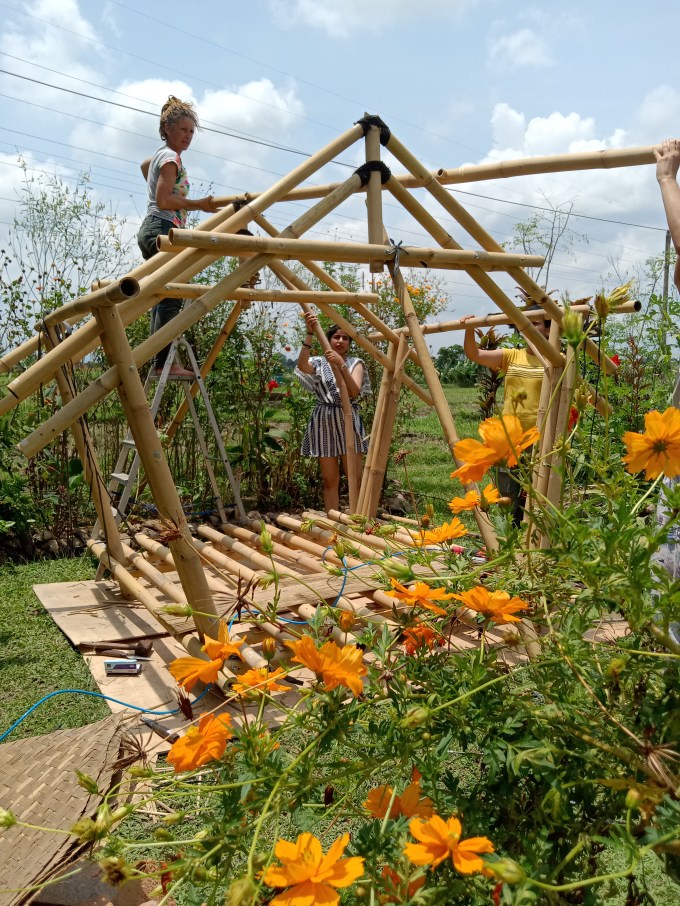
As I drive to work, just after 7am, not far down the street I pass a group of people gathering around a man and his push bike. I marvel at the light wooden contraption on the back of his bike holding an array of small bags of what look like food items and portioned vegetables. There is gabbering and laughing and I catch a few words in passing. It’s the same scene each morning…
He’s an older fella. And those surrounding him live in the adjacent houses. How great that they can just walk out their front door and be able to buy what they need to cook for their families for breakfast that morning… Talk about covenience! All those cute little portions. He must go to the central market super early at like 3am and buy his produce – and then head home; wash, cut and bag everything up ready for his neighbourhood round…
What a service he’s doing for all those people who buy their daily breakfast needs… none of them have to have a fridge in their house, or even spend fuel to get to the market each day. Not until the afternoon anyway. There aren’t any ‘supermarkets’ here… nowhere running fridges and freezers 24/7 – or air-con – quietly and continually belching out CO2 like in my country… Just open produce markets dotted around – called “pasar sengol” if you’re ever looking to find one in Maps.
I wonder how much petroleum it takes to make one of those small “single use” plastic bags, compared with the amount of fuel it takes to get to a supermarket, run a central A/C system; the fridges and freezers… in my own country. While we claim to be so “eco-logical” with our cloth shopping eco-tote bags, how much are WE actually contributing to CO2 emissions to maintain our version of “convenience”. Single use plastic may look bad in the environment – but I’m sure if you equated the function it performs with the actual amount of petroleum used to achieve the same result in the global north (getting/distribution of groceries) – it would be a small smudge – and it only becomes carbon-polluting if it’s burned no?.
The old man’s distribution business and the daily sociability and chitter chatter always makes me smile as I go by – beating by miles the lonely robot check-outs I find in my own country these days. He, and others like him, enable people to buy just what they need for that day – so they don’t need to run a fridge – and maybe also resulting in low domestic food waste. In comparison, “developed” country packaging of equivalent products is usually denser, creates more landfill – and requires many many many more transport miles and fossil-fuel burning to reach the “consumer”. We pride ourselves in being an “advanced” society, but our own more massive contributions to global ecological decline are perhaps “hidden” in plane sight.
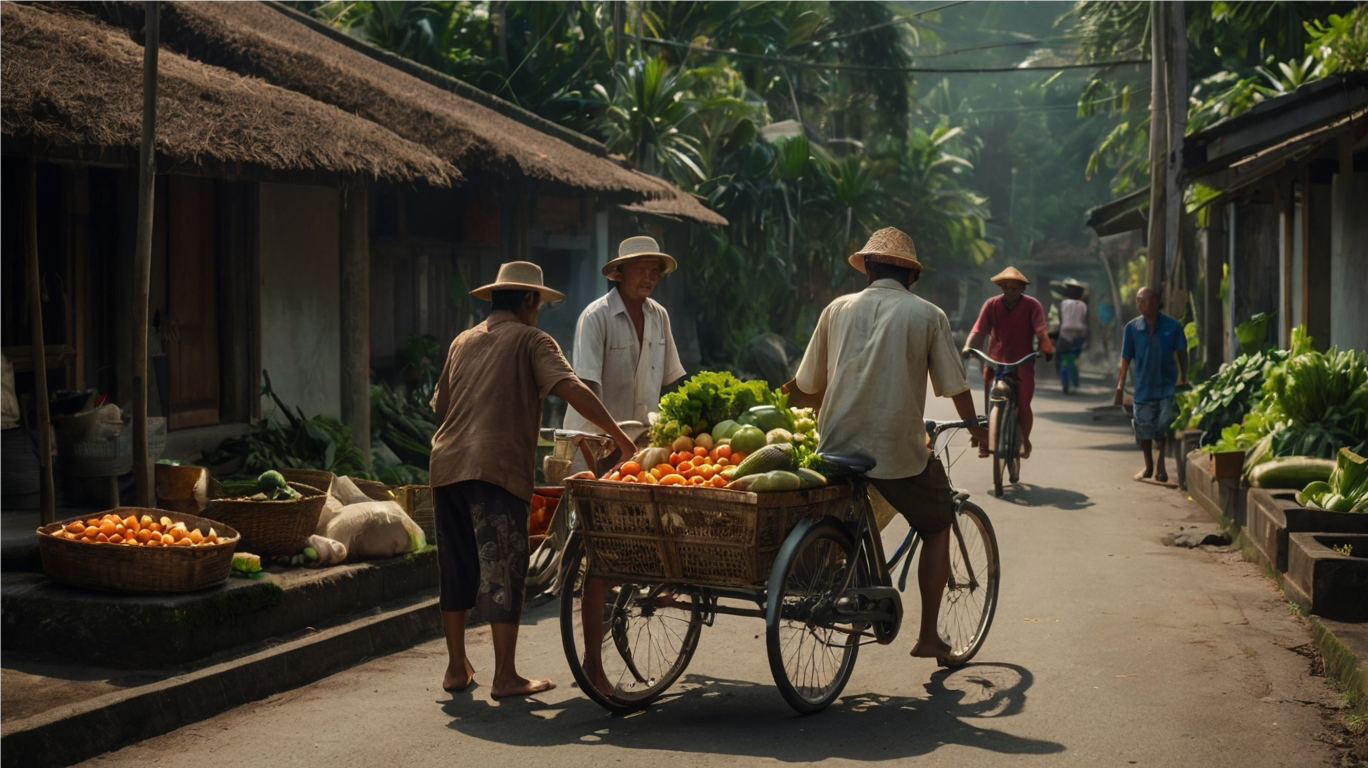
Packaging is a necessity – the further we move away from our “food source”. In “village-life”, packaging isn’t really needed, because most things are consumed fresh and can be bundled with a grass tie and/or transported in a bamboo/cane basket/tray. Plastic, a miracle substance, enables people here to buy wet foods like tempe and tofu – without having to use copius amounts of harder plastic packaging, least of all tetra-pack (that evil environmetal hazard containing not only plastic but aluminum also) so commonly used in the global north.
Perhaps if we revitalised villages and brought sustainable syntropic food farming into our modern lifestyles – and decentralised food production, created lower food miles and a closer relationship with our communities and our food source – Replanted instead of cut down trees to make way for “development” (the real killer)… Then maybe, we could find a way to develop around/with and not fill in/over farm lands – And, need a lot less plastic AND petroleum in the process.
Insert: (an interesting Youtube video on the concept of “future transport” and Vegetizing Car Parking.)
The reality is that we continue to deflect responsibility, fixating on single issues while ignoring our broader dependence on petroleum that powers our vehicles, refrigerators, and air conditioners – a constant, invisible stream of emissions accumulating in our atmosphere. And in turn, ignoring how the pattern/method of current development is itself fueling climate change. Meanwhile, old mate has probably just finished bagging up his produce for today’s rounds… as I write these early morning reflections from Bali, a place embodying the very contradiction between environmental awareness and practical necessity that defines our modern predicament. This juxtaposition of global environmental concerns against everyday human activity highlights the complexity of finding solutions that work across different economic and cultural contexts.
The environmental impact of single-use plastics extends far beyond what meets the eye. The core challenge isn’t just their production but their aftermath – how we dispose of or repurpose them. If public awareness increased regarding synthetic estrogens leaching from plastics into our ecosystems and their documented effects on reproductive health across species, we might collectively approach disposal with greater care and responsibility.
What To Do?
A possible practical solution lies in reimagining plastic’s value proposition. By creating economic incentives that transform discarded plastics from waste into resource, we could dramatically reduce the “throwaway” mentality that currently dominates our consumption patterns. This approach addresses both environmental protection and creates sustainable value chains that benefit communities and ecosystems alike.

Already viable technologies exist for producing fully plant-based plastics, which could substantially address these environmental concerns. However, these innovations require significant government investment to achieve the scale, integration, and affordability needed for mainstream adoption. Unfortunately, as long as petroleum corporations maintain their substantial financial influence over policymakers, the likelihood of securing adequate public funding to accelerate this transition remains slim. This political-economic dynamic effectively delays the widespread implementation of these more sustainable alternatives, despite their proven feasibility.
Since experiencing South-East Asia’s relationship with single-use plastics firsthand, I’ve gained a new perspective.
What many label as an environmental crisis actually serves as a remarkable efficiency driver in these societies. Perhaps our focus should shift from elimination to innovative reuse—preventing soil and water contamination while simultaneously redirecting these materials from environmental hazards into valuable resources.
This approach could fundamentally transform our relationship with plastic waste by integrating it into circular economic models. Imagine repurposing these materials to construct sustainable buildings, complemented by renewable resources like bamboo. As someone whose passion lies in construction, I naturally gravitate toward building-centered solutions—my professional bias gladly acknowledged.
(See more about our Ecobricking at https://bamboocreative.org/ecobricks)
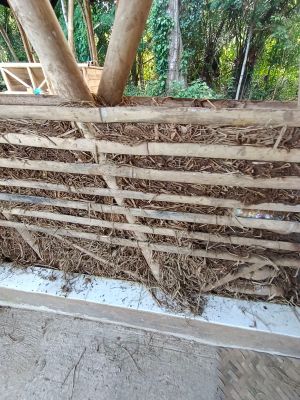
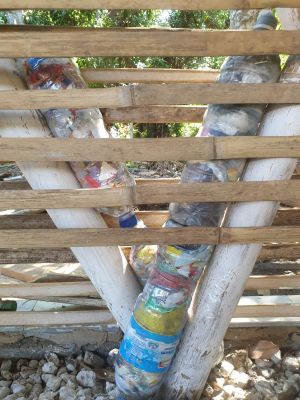
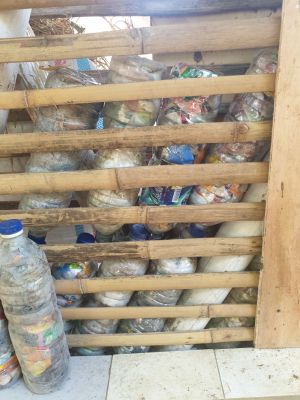
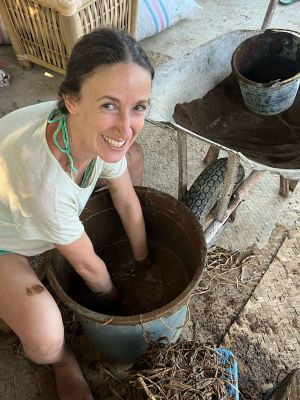
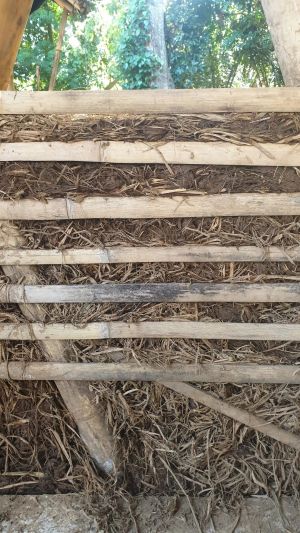
Give me plastic! I’ve discovered a way to build out bamboo structure walls using Ecobricks—plastic bottles packed tightly with soft plastic waste to create solid building materials. Last year, we constructed a bamboo-framed wall section featuring clay-straw infill reinforced with these Ecobricks.
https://youtube.com/shorts/0fn2agU8cds?si=LiidHMC-S-Sl-IrM (better for phone)
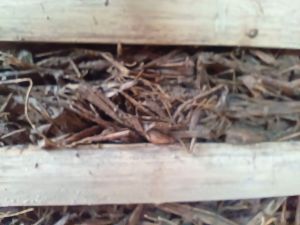
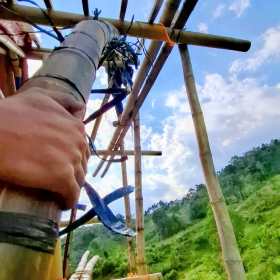
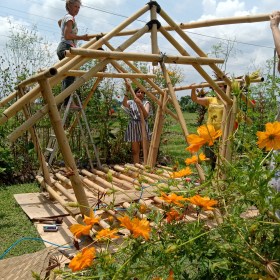
The experiment involved creating a hyperboloid structure simulation using 7-8cm bamboo poles with split bamboo horizontal reinforcement. Following techniques learned from Josh Geiger in 2022, using a movable plywood formwork that progressed section by section as we built. Ecobricks filled the cavity spaces, with light clay-straw mixture (essentially wet clay and straw combined) filling the gaps between them. We finished one side with a clay and ash plaster.
The result? A pretty sturdy wall that effectively repurposes plastic waste while creating a sustainable building solution! We are yet to do the final plaster finishing,..


Building for the Future: Bamboo, Ecobricks, and Beyond
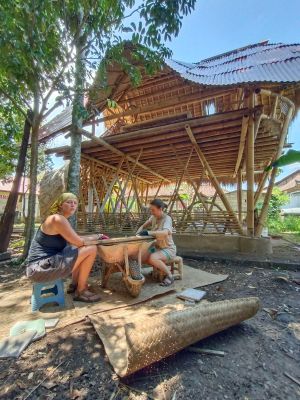
This year, we’re taking things further with a three-month program to build a bamboo and light-clay straw and Ecobrick “eco-tourism” structure. Our project aims to create a modest yet complete dwelling that combines an all-bamboo framework with complementary eco-materials. Bamboo is an incredible renewable material, but it comes with challenges—especially when it comes to insulation, soundproofing, and pest control. By integrating Ecobricks and clay-straw infill, we aim to create a more solid, comfortable, and animal-proof living space, all while maintaining natural ventilation and minimizing the need for energy-intensive solutions like air conditioning.
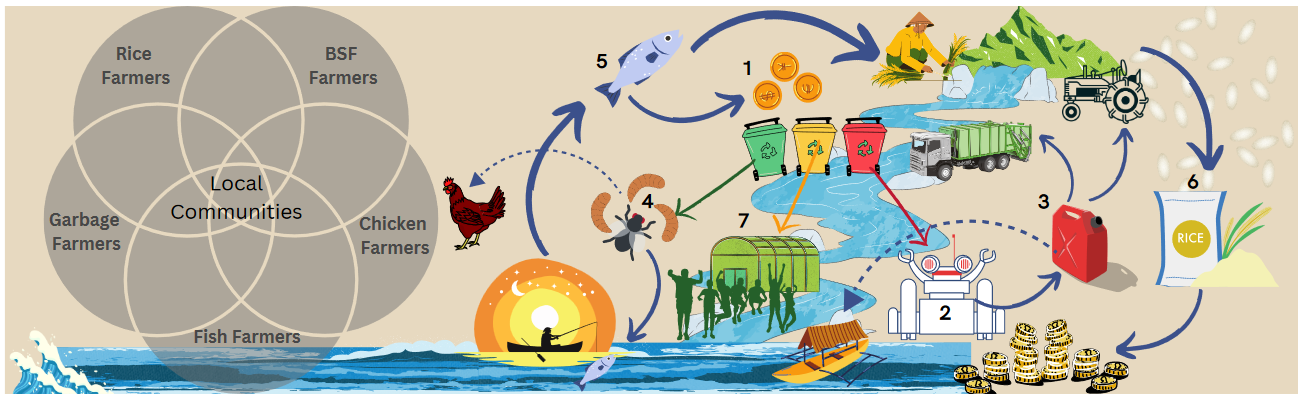
But our vision doesn’t stop at construction. We’re developing a circular economy model that includes waste separation, plastic recycling, and even organic waste management using Black Soldier Fly (BSF) systems. These systems can convert organic waste into feed for chickens and fish, reducing reliance on industrial feed and supporting local food systems. With your support, we aim to develop this and wider Outreach projects to offer hands-on programs where participants can learn bamboo building, plastic upcycling, and circular economy principles and practices.
Empowering Communities: Skills, Incentives, and Outreach
The greatest need for sustainable building skills is at the village level, where people still have traditional knowledge of farming and skills to work with bamboo, own their own land and are not feeding the industrial complex (definition: warning giant rabbit hole). By introducing Ecobricks, bamboo treatment and modern eco-building techniques, we can make building practices more sustainable, affordable, and attractive—making “village life” more comfortable and help communities resist the pressures of urban migration and land conversion/unsustainable development.
Through collaborative efforts, we could reduce rural-to-urban migration and farmland conversion by creating viable local economies. While carbon emissions receive much attention in climate discussions, the underlying issues of biodiversity loss and ecosystem destruction are what truly drive flooding, temperature increases, and environmental instability. After that, it is fossil fuel use in developed countries (Cars refrigerators, air-conditioners etc.) contributing the most to “climate change”, and Then, the fine layer of plastic sprinkled by the communities that have been impoverished by the modern economic system/Neo-capitalism – and by necessity , have been forced to innovate in order to survive (something we humans excel at… but most of us are comfortably housed and isolated – unaware of what’s really going on in the world at large… though maybe not for long. and that’s when we will be pushed to change and things will become really interesting and exciting!!! 🙂 ).
There is definitely a lack of education and awareness of the real dangers of plastic residues in our environment at the local level. Many communities remain oblivious to the long-lasting effects of plastic estrogens leaching into our groundwater, which can disrupt hormonal balances and threaten both human health and wildlife. Furthermore, the dangers of inhaling toxic fumes released from burning plastic are often underestimated, leading to alarming health issues that could be easily mitigated with better understanding and proactive measures. Perhaps if people were more informed, it wouldn’t seem so hard to sequester that plastic BEFORE it becomes Trash or Pollution. Instead, they could recognize the importance of developing robust systems at its POINT-OF-USE that enable efficient recycling and repurposing, effectively flicking it straight back into a circular economy BEFORE it turns into pollution. Empowering individuals and communities with knowledge could foster a culture of responsible consumption and waste management, making it possible to combat this pervasive issue before it spirals out of control.
We believe it’s POSSIBLE and NECESSARY to create awareness and incentivize the sequestration of soft-plastic and single-use packaging waste – until such time as all the packaging currently used to deliver these products to the general public can be replaced with totally organic (non-petroleum based) substitutes.
To incentivize participation and local collaboration, we are proposing a waste-separation currency system called Ebblets. For every 1.5L Ecobrick made, community members earn an Ebblet, which will be redeemable for goods at local stores. This system not only rewards plastic sequestration but also encourages the use of refillable containers and bulk goods, reducing single-use packaging even further as participating shops will be provided with bulk-dispensers and reusable containers for common products like dish soap, laundry detergent & shampoo.
Together, we can build a circular economy around plastic waste through recycling, upcycling, and organic waste management.
Be part of our educational enrichment initiatives that incorporate arts and language exchange to strengthen village cultural programs…
Join the Movement: Be the Change
Our monthly Karma Yoga Community Days are a chance to make Ecobricks, Ebblets, and craft with bamboo, while discussing circular economy and connecting with others. By “helping together”, we can create a circular economy around plastic, organics, and appropriate technology—empowering communities, protecting biodiversity, and building a more sustainable future for all.
If you’re passionate about making bamboo building attractive, affordable, and accessible, join us. Be the change—experience sustainable construction, circular economy thinking, and build collectively for the future with your own hands!
Take Action!
The Ecobrick Challenge: Creating Value from Waste
To incentivize plastic waste transformation into building materials, we’ve developed the Ebblet currency system. Here’s how it works:
- Community members collect and compact soft plastics (bags, wrappers, sachets, styrofoam, cigarette butts, toothpaste tubes, and other non-recyclable plastics) into empty 1.5L PET bottles (with a grading system so – no cheating!)
- Each properly compacted Ecobrick earns one “Ebblet” token
- Ebblets can be exchanged at participating local stores for goods valued at 5,000 Indonesian Rupiah per token
Participating stores will offer refillable containers and bulk quantities of common household products typically sold in single-use packaging. The pricing structure includes the value of sequestered plastic (1.5L bottles) plus a 10% sales tax and 15-5% operations budget.
This system creates immediate economic value from waste materials while building a sustainable supply chain for our construction initiatives and reducing environmental contamination.
Sponsor Ebblets!!
Buy 10 ebblets (Rp.50,000) – (+ admin/operations [15%] +govt tax [10%] 25%) = Rp.62,500
Buy 16 ebblets (Rp.80,000) + (admin/operations [15%] +govt tax [10%] 25%) = Rp.100,000
Buy 30 ebblets (Rp.150,000) + (admin/operations [15%] +govt tax [10%] 25%) = Rp.187.500
Buy 100 ebblets (Rp.500,000) + (admin/operations [10%] +govt tax [10%] 20%) = Rp.600,000
Buy 1500 ebblets (Rp.7,500,000) + (admin/operations [10%] +govt tax [10%] 25%) = Rp.9,000,000
Make a one-time donation
Make a monthly donation
Make a yearly donation (Bamboo Membership)
Tier 1: $50 – Members area & Video content
Tier 2: $562.50 – 1500 ebblets+ Free access to Members’ Area, Design Mind & Video Content
Tier 3: $1500 – Pre-purchase 10 day/11 night VIP program at Bamboo Creative Bali
Choose an amount
Or enter a custom amount
Your contribution is appreciated.
Your contribution is appreciated.
Your contribution is appreciated.
DonateDonate monthlyDonate yearly- Buy 80 ebblets (Rp.400,000) + (admin/operations [15%] +govt tax [10%] 25%) = Rp.500,000
- Buy 200 ebblets (Rp.1,000,000) + (admin/operations [10%] +govt tax [10%] 20%) = Rp.1,200,000
- Buy 500 ebblets (Rp.2,500,000) + (admin/operations [10%] +govt tax [10%] 20%) = Rp.3,000,000
- Buy 800 ebblets (Rp.4,000,000) + (admin/operations [10%] +govt tax [10%] 20%) = Rp.4,800,000
- Buy 1000 ebblets (Rp.5,000,000) + (admin/operations [10%] +govt tax [10%] 25%) = Rp.6,000,000
- Buy 1500 ebblets (Rp.7,500,000) + (admin/operations [10%] +govt tax [10%] 20%) = Rp.9,000,000
- Buy 2000 ebblets (Rp.10,000,000) + (admin/operations [5%] +govt tax [10%] 15%) = Rp. 11,500,000
- Buy 5000 ebblets (Rp.25,000,000) + (admin/operations [5%] +govt tax [10%] 15%) = Rp.28,750,000
- Buy 10,000 ebblets (Rp.50,000,000) + (admin/operations [5%] +govt tax [10%] 15%) = Rp.57,500,000
Karma Yoga….
Come join our Karma Yoga program and help raise awareness about Ecobricks while protecting our planet from plastic pollution! We host monthly community events focused on creating Ecobricks, Ebblets, and bamboo toys—a perfect blend of environmental action and creative engagement.
We’re seeking collaborators interested in bringing sustainable bamboo construction techniques to village communities where they’re most needed. Rural residents still possess valuable farming and bamboo-working skills, but we can help make these practices more sustainable, economical, and appealing.
This approach creates a self-sustaining network that simultaneously expands practical bamboo construction expertise while addressing single-use plastic waste through our community-based Ecobrick Challenge programs.
Our vision is to deliver integrated bamboo education directly to villages through our Outreach Programs. Graduates from our 3-week courses can join as volunteers or assistants on community builds, applying their newly acquired bamboo skills and knowledge. Those completing our comprehensive 3-month program can advance to paid teaching positions within our International Collaboration initiatives.
Your participation helps implement appropriate technologies and community capacity-building that transform how we handle waste. Join our mission to spread critical awareness about the reproductive health threats that environmental plastics pose to humans and animals alike. Make a tangible difference while connecting with like-minded community members committed to sustainable solutions!
With your support, we aim to develop Outreach projects to brainstorm and demonstrate the possibilities of combining bamboo with other natural and recycled materials to make attractive AND affordable buildings!
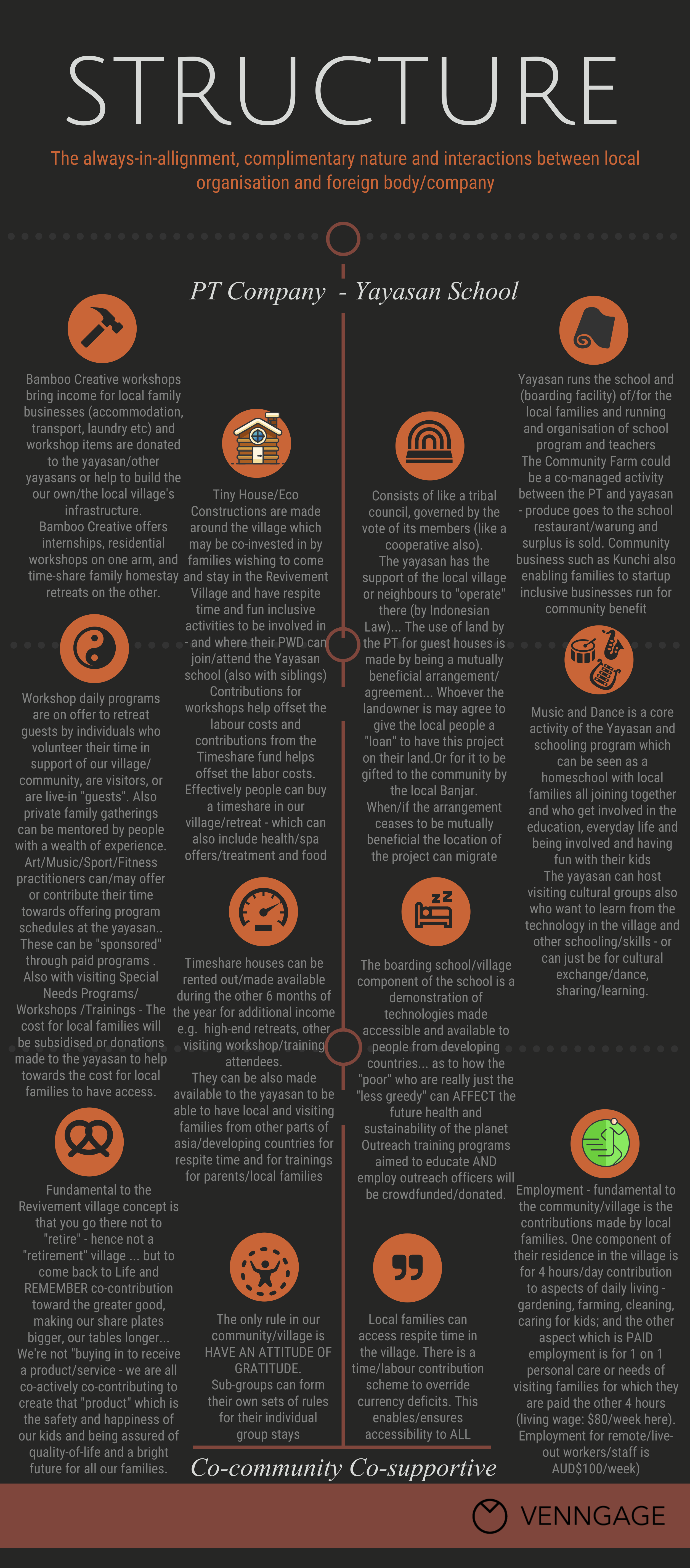
All our Bamboo Workshop Participants automatically become part of our Regenerative Outreach Network – earning stay time through their contributions to building the structures which are the prototypes and soon-to-be Real Designs populating our sister projects and being shared through the Bamboo4Africa Regenerative Village Network. These climate-adaptive family-friendly living environments are where families, volunteers, professionals/investors, educators, community, people with disabilities and builders can all combine forces and create the Regenerative Force for Change through cooperative collaboration opportunities that benefit Everyone.
Imagine if people truly valued nature and deeply understood why so many individuals from the “west” are willing to spend significant amounts of money just to immerse themselves in a “natural” setting. This desire often stems from a longing for connection, serenity, and rejuvenation that the hustle and bustle of modern life cannot provide. If we could create an economic system that benefits everyone fairly and equitably, rather than continuing with the current flawed system that inflicts harm on both communities and the environment, we would cultivate a society that thrives on mutual respect and shared values. In doing so, we would not only foster a more connected community but also inspire future generations to cherish and protect our natural world, ensuring that the beauty of our planet is preserved for all to enjoy and cherish for years to come.
Imagine if we had ‘Rat Park’-style towns (insert reference) for People!… Buzzing with fun activities, cool experiences, and real connections (instead of being stuck in lonely, consumer-focused places that just make us feel isolated and unhappy). These towns could be centers of Revivement where creativity explodes/thrives, encouraging/enabling time for folks to dive into their hobbies/passions/talents – with community gardens, shared art spaces, and collaborative workshops. These are places where we can grow together… and see ourselves as sacred/valuable parts of the universe, working together to create that good cosmic energy through every interaction and project. By building meaningful friendships and supportive networks, we’d not only find joy in working together, but also feel like we have a role and meaning in the “grand scheme of things/ “bigger picture” of our societies and perhaps strike a healthy balance between chasing personal happiness and bettering one’s community. There would be various levels of “contribution” (not only economic) towards common goals, fostering a real sense of belonging and purpose that uplifts both the individual and the group.
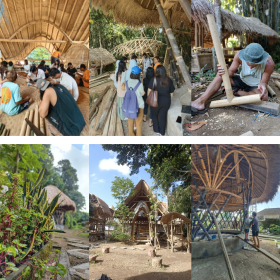
Join our International Collaborative Eco-Bamboo Festival Regenerative Network – an amazing opportunity to Live and Experience Bamboo Building for the Future! offer hands-on programs where participants can learn bamboo building, plastic upcycling, and circular economy principles and practices. Be part of our educational enrichment initiatives that incorporate arts and language exchange to strengthen village cultural programs.
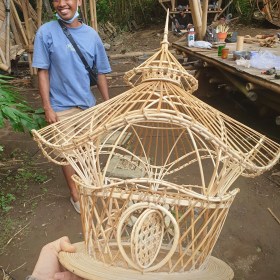
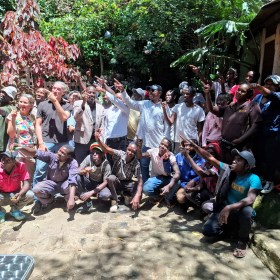
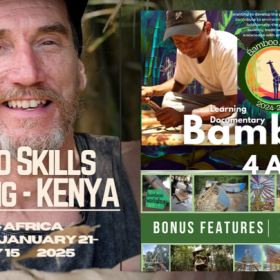
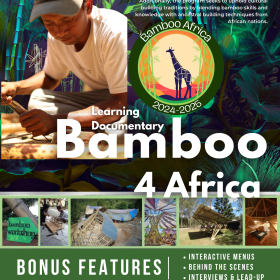
We will be taking this design on our Phase 3 Bamboo4Africa journey next year starting in January-February 2026 in Naivasha, Kenya – followed by Ghana later in the year. Give us your feedback on the design and what you think could be improved… If you’d like to join us on this mission to make bamboo attractive, affordable and accessible, Join Us, and Be The Change – experience bamboo building for the future! PLUS: Access our Video Documentary Content and Online Meetings and Training Forums…
Register for Bamboo Regenerative Network/Bamboo4Africa Training:
Book/Pre-purchase a specialised family, group and individual programs and workshop/stay at our Bamboo Eco-School in Belega NOW and receive 25% discount on all packages..
Early-Bird Specials to help seed this project:
1. Family Time Bamboo Awesomeness
(3 days/2 nights) – A hands-on experience developing confidence around the basic concepts and techniques of working practically with bamboo. Make bamboo toys & doll house/ furniture piece/ model for a building design or customisable bamboo creation [up to 5 people].
2. Sprout to Serenade
(4 days/3 nights) – Learn about Bamboo’s benefits – from the restorative effects on soil and combatting climate. Visit a bamboo factory, learn to treat bamboo and make a bamboo cubby house or playground structure [up to 5 people].
3. Build with Bamboo
(5 days/6 nights) – Immerse into Bamboo Culture and Technique – Learn to harvest, design and build with bamboo in this introductory seminar and practical workshop. Make your own bamboo design starting with learning basic carpentry techniques, making a design model, learning about bamboo treatment and what method would be most suitable for your situation
(All skill levels welcome) [1-3 people].
4. Bamboo Building Design
(1 day/1 night) – Insights into Bamboo Building: Make your own Bamboo Building Design Model – Mentoring and Model Design with our Bamboo Mastercraftsmen ! [1 Design: 1-2 persons]
5. Design and Build Bamboo
(10 days/11 nights) – Workshop Program in Bamboo Carpentry, Design and Building a half-scale design to learn bamboo building and design technique for a prototype model. Individual Workshop – 1 design: [1-2 persons] & access to our Membership Video Content and Design Mind Group
6. Bamboo Night
Pre-purchase single-night accommodation-only. Stay in our Bamboo Eco-Design [up to 5 people] or Tarzan Tower [1-2 persons].
Inclusions/Exclusions:
Packages include Accommodation and Workshop Tuition, Tools and Basic materials – Meals are not included. A variety of Menu options are available and you can BYO meals if desired.
Dates/Availability:
From September to April on a yearly basis.
Package purchases have a 5 year validity period and may be gifted.
Come and build bamboo with us! See our workshops page for info on current programs.
Time Lapse of Building our School Building in Belega
Discover more from Bamboo Creative Bali
Subscribe to get the latest posts sent to your email.

 Bamboo Creative Bali